Showing posts with label EZU. Show all posts

2022-09-04

Elevated Squeeze Risk vs Baizuo Freight Train Headed Off Cliff and h-Patterns Everywhere

Squeeze risk is currently elevated, but the caveat is crashes happen in oversold conditions. You don't want to be opening short positions here unless you have tight stops or are watching closely. That said, intraday reversals such as we saw on Thursday and Friday can reset this equation in a day or less. Short the right rip and one need not cover until the bottom.

On the other side of squeeze risk is the reality of Europe's energy situation. Using the Elliot Wave as a framework, here are the stages of accepting the European energy crisis.

1. Sanctions/Russia cuts supply. Uh oh!

2. Priced in, not that bad.

3. The market doesn't realize how bad winter will be. Euro must devalue XX percent based on printing needs. (We're here now.)

4. Priced in, won't be as bad as expected.

5. Final panic over energy or collapse in currency or panic in stocks, or all three.

The euro made a new 52-week low on Sunday night. The futures chart, along with many assets such as weaker stocks and crypto, has formed the dreaded h-pattern. It's the prelude to a bear squeeze or resumption of selling to a new low. Since I believe this is a bear market, the h-pattern will be more friend than foe to bears from now on.

My view is macro and psychology overwhelm technicals in Wave 3. Bears are already all-in by some measures, but my expectation is commodities will implode and cause panic in the inflation trades.

There's also something very wrong in how the market is pricing Europe's energy crisis in my opinion. Or I'm very wrong and it isn't nearly the crisis everyone is making it out to be. What's the truth? 

Most people still pay attention to major media and the media are 100 percent behind the Baizuo governments of the West. Markets are down, but investors remain sanguine in the face of what is coming because "all is well" propaganda is running 24/7. My hunch is something will break the facade such as a sudden, impossible to ignore drop in economic output or company earnings. European companies are shutting down left and right because power costs are finally filtering through the broader economy. It is akin to a permanent lockdown or a lockdown with no expectation of exit. 

If energy costs are permanently higher, then economic output is permanently lower, and equities must reprice far lower. Even without any of these problems, a major bear market is possible. Add higher energy into the mix and a 60 percent or higher decline (adjusted for inflation) is a conservative target.
Hussman has the projected 12-year return at something more than negative 3.5 percent annualized. That means a portfolio would be down about 35 percent 12 years from now. Stocks don't slide year after year though, they plummet and then climb back. How low would stocks have to go to achieve that return over 12 years? One way it to lose close to 80 percent up front and then recover with a couple of 30 percent and 20 percent annual returns mixed in. History says plunging prices are more likely than not.
RUSSIA INDEFINITELY SUSPENDS NORD STREAM GAS PIPELINE TO EUROPE: FT
Markets are wildly optimistic about how this will shake out. I'm not talking about what people are saying, but what asset prices are saying. This is barely priced into stocks. Or as I like to see it, we're att the starting line of the plunge.
I could see those indexes touching support on nothing else except a bear market similar to the 2000s dotcom bust. Things are far worse though, unprecedented since maybe the Arab Oil Embargo of the 1970s. EZU at $15, retracing all gains since 2008, is a real possibility. A nearly 60 percent drop from here. 

2022-06-12

Chart for the Decade: Greece vs Germany

As I first pointed out in April, the Greece ETF has been basing versus the German ETF.

Greece doesn't look as strong versus the Eurozone ETF, but EZU includes countries such as Italy that also look like Greece:
Note that these ETFs include fluctuation in the euro, but the relative charts cancel that out. 

Investors in European debtor states have not made any money for 20 years. The chart of the Greece ETF alone looks like a gold mining stock, some "expensive oil" services companies such as offshore drillers, but hasn't broken out yet. Italy doesn't look as good here, but it is also tracing out a large basing pattern. In short, outperformance is happening on the downside for now.
Here is the Germany ETF. A possible low could be in the $20 area. Below the green support line and the blue horizontal, there is nothing but air to the downside.
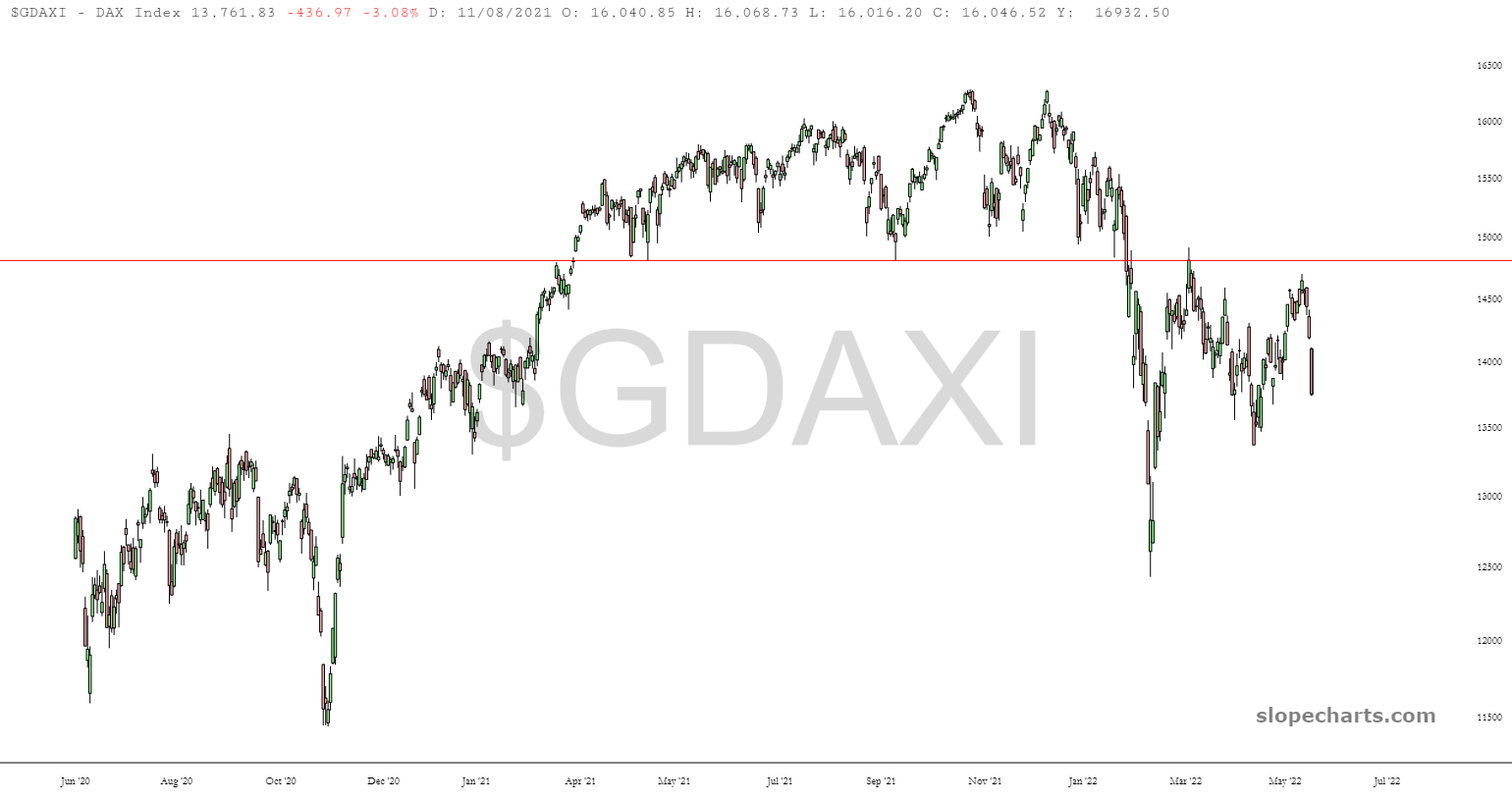
The DAX Index has a clean top and two failed reversal attempts. Major support lines are about 23 percent lower and 50 percent lower from Friday's close.

Going all the way back to the post-2008 fallout era, when Greek sovereign debt emerged almost immediately and first rattled markets in the spring of 2010, critics of the euro and European Union have explained how Greece was being harmed by the euro and austerity programs being forced on the nation without any fiscal transfers:

Greece made a big mistake taking on too much debt in the 2000s at artificially low interest rates afforded by a credit bubble and its use of the euro. Any sovereign state in a similar situation post-bubble would intentionally devalue its currency or see the market would depreciate it for them, outside of an incredible reform movement.

Would it be impossible for the Greek stock market to rally in a bear market? No. There is one outlier scenario where that happens: Greece does something extreme such as exiting the euro and redenominating its sovereign debt in drachmas. More so than most nations, Greece would benefit from currency devaluation because it's economy and assets are already devalued. 

Currency devaluation is an escape valve for incompetent sovereigns. Serial devaluation shows a nation doesn't make hard choices and opts for the easy way out, impoverishing its own people and foreign investors over time. All nations will eventually devalue their currencies though, if reforms were not undertaken and credit not controlled. The mistake was blowing the bubble in the first place, not the currency devaluation that balances assets to liabilities.

Trade Implications

If Greece assets could rally on a euro exit, then Greece should outperform amid high inflation and euro weakness. The macro forces that crushed Greece in the prior decade are now turning in Greece's favor and against Germany. If trends continue for years, it might be Germany that wants out soon.

The cleanest trade here is short Germany, in local currency or in dollars via an ETF such as EWG. (Not necessarily a trade to put on Monday, but one that could have been put on in January and still held today.) Greece is not a clean buy because it will probably fall in a global bear market, but if that basing pattern turns into a breakout at any point, then I would recommend accumulating Greek assets along with Italian and other debtor countries, depressed sectors and so on during the dip because they should outperform in the next bull market. If you find a depressed asset that is harmed by a strong euro and deflation/disinflation, and it still has good underlying fundamentals, it sounds like a potentially good buy on the surface.

A breakout in the "Greece vs Germany" chart would signal a significant turn in macroeconomic forces. Conversely, if the chart were to fail (a "bear market" rally that delays the eventual breakout is not a fail) and sink again, it would tell me the post-2008 central bank trap is alive and well with potentially more QE and even more negative interest rates on the way.

2022-04-24

Greece Beats Germany

Fresh off the heels of posting Tomorrow's News Today, I give you the Greece ETF divided by the Eurozone ETF and the Greece ETF divided by the Germany ETF. Not complete...but basing. Now work backwards: in what scenario will the pattern complete and break out?

2022-02-22

Buy the Reversals of Fortune

Germany was a leader. It should turn into a laggard. This doesn't mean long Greece, but probably at least one of the PIIGS will outperfrom for awhile.

2014-05-25

Has the Die Been Cast in Europe?

Even though Eurozone countries (EZU) are in an uptrend, Ireland (EIRL) and Greece (GREK) slid this year. The rest of the PIIGS: Spain (EWP) has held up as well as EZU, but Italy (EWI) and Portugal (PGAL) did break down in May.

The best explanation is that Greece and Ireland sold off along with momentum stocks because if you plot GREK and EIRL against the Nasdaq, Russell 2000 and biotechnology, a similar chart pattern is clear. Italy and Portugal are tougher to explain.

It looks like a surprise win by the euroskeptics is priced into stocks and the euro. Nevertheless, I've always maintained this is political crisis, not an economic one. The main issue was never the debt levels or the economic imbalances Michael Pettis' cites in his post liked below (though these are very real), but whether the nations of Europe will find a way to solve them together. Social mood is not working in favor of the EU: nations increasingly want to assert sovereignty, best exemplified by secession movements in Scotland, Catalonia, Belgium and Northern Italy, but now most clearly evidenced by political victories for parties such as UKIP.

Most alarmingly for the pro-EU politicians is that nationalistic parties have won in the absence of crisis, during a period of relative calm. In reality, the political crisis has grown during this period of calm as social mood remained negative. Since this is a political crisis driving the markets, another crisis is more likely following the victory of euroskeptic parties. Even if pro-EU politicians want to ignore them, the rise of parties such as UKIP is now an existential threat to the domestic political order because voters have a legitimate option to express their anger. What happens in Brussels no longer stays in Brussels: national elections may turn on votes that parties take in the European parliament.

The odds of another financial crisis are higher if these euroskeptic parties win in this weekend's election, and another crisis will serve to increase the popularity of euroskeptic parties because it will force the pro-euro and pro-EU parties into more unpopular votes. The euroskeptics aren't causing this though, behind them are the voters who in a period of negative social mood, want to express national sovereignty and want to protect their own nation. Ultimately, since social mood swings from positive to negative, is that the European Union and euro are positive social mood projects that do not account for periods of negative mood. The trend is for increased centralization of power, which increases the instability of the entire system heading into a period of negative mood.

This weekend's vote will cast the die for the dissolution of either the eurozone, the EU, or both, and stopping it will require an extraordinary effort by pro-EU politicians because they are now running uphill— even if they don't realize it yet.

Related: here is Michael Pettis thinking about possible implications from the EU elections: Some things to consider if Spain leaves the euro
The May 26 votes might end up reminding us that the euro crisis isn’t over. The longer unemployment and hopelessness drag on, the greater the erosion of support for the establishment and the stronger the support for the radicals who want to abandon the euro.

......How much longer is the rest of Europe willing to maintain high unemployment in order to support the German economy? On May 26 we will discover, I suspect, that at least some parts of the rest of Europe have little interest in continuing to maintain the euro if that simply means that they must suffer unemployment in order to protect Germany from its unwillingness to pay workers more.


2010-01-29

PIGS get slaughtered

Greece is doing a number on the euro and that, plus a general decline in markets, has the eurozone ETF sinking below its 200-day moving average.

Here's the Athens composite index. Notice the 50-day has crossed the 200-day.

Here's iShares Spain (EWP) crashing through its 200-day. Spain is a bigger threat to Europe and the euro because it is a much larger economy than Greece and still has a housing bubble.

I have no idea what will happen next week, but it seems Greece is coming to a head. Once bailout rumors begin, they can only be stopped by very forceful action. Words will no longer satisfy the markets.