Crude oil is about $10 away from a clear bullish breakout, but it is battling at a resistance area. It is $20+ away from a major bearish breakdown.


![[Most Recent Quotes from www.kitco.com]](http://www.kitconet.com/charts/metals/base/copper-d.gif)
|


Crude oil is about $10 away from a clear bullish breakout, but it is battling at a resistance area. It is $20+ away from a major bearish breakdown.
ZH: China Cuts Reserve Requirement Ratio By 25bps, Boosts Economy With $70BN In Fresh Liquidity
Below I've reproduced my post from December 6, 2021: China RRR Cut is Bearish
ZH: China Cuts RRR By 50bps; More Easing Expected
Specifically, the PBOC cut the RRR by 50bps effective 15th Dec. The move will release CNY 1.2 trillion in liquidity - some of this new money will be used by banks to repay maturing loans from the PBOC’s medium-term lending facility and some of it will be used to replenish financial institutions’ long-term capital, the central bank said. There are almost 1 trillion yuan worth of the 1-year loans maturing on Dec. 15, the day the cut takes effect.It releases zero trillion in new lending. It eases financial pressure on banks who are probably running into some trouble because of the strong dollar. Look at the chart posted with the article. The RRR cuts come during the taper. They occur before yuan depreciation in August 2015 and before a broad global sell-off in risk assets in autumn 2018.

The October PPI report was bullish for stocks. The market should love than news and run higher this week, but there are signs of weakness. I was caught wrongfooted opening short positions yesterday, but I might have been early instead of wrong about the rally completing.
The exhaustion I saw in the market yesterday was wiped out by the morning’s response to the PPI. Most people are not looking at China and other data sets showing the clear tilt into deflation underway and more oncoming in 2023 once housing data trickles through. At least through the PPI release, the market is still viewing falling inflation as bullish.
The core PPI services segment went negative in October.
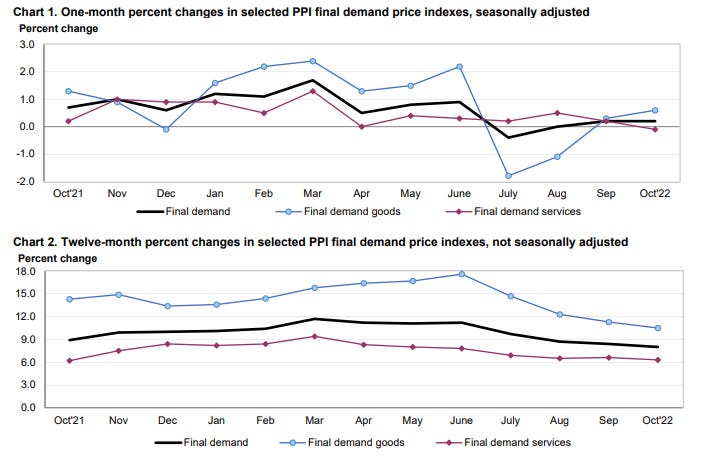
There’s one potential paradox: speculators have been bidding up commodity prices in response to lower inflation readings. Will that continue? Today’s initial response was a jump in commodity prices that quickly reversed. It will be telling how this plays out today. If copper and oil continue sliding, it may indicate the market has started realizing the downturn in prices and slowing pace of Federal Reserve rate hikes might not be bullish.
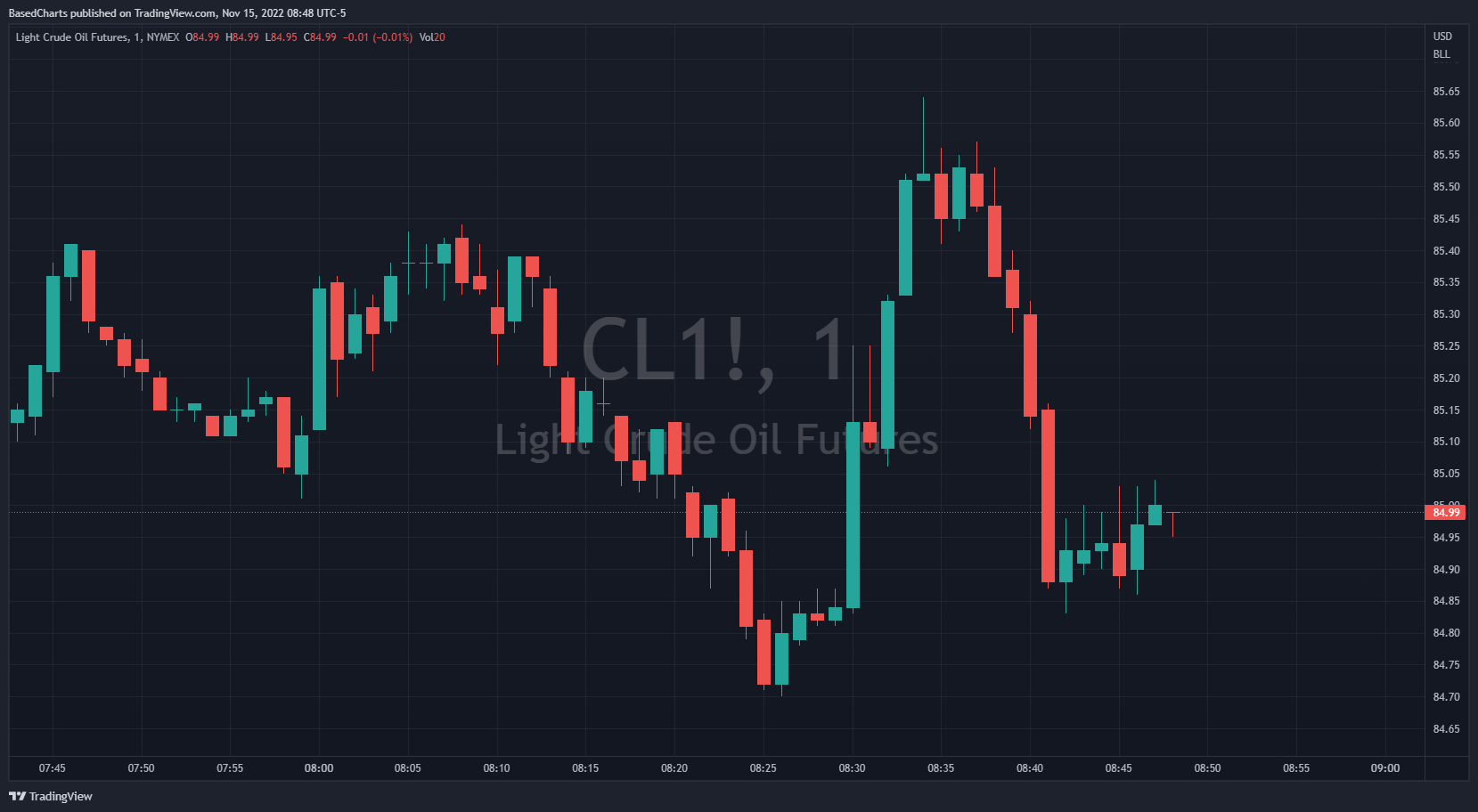
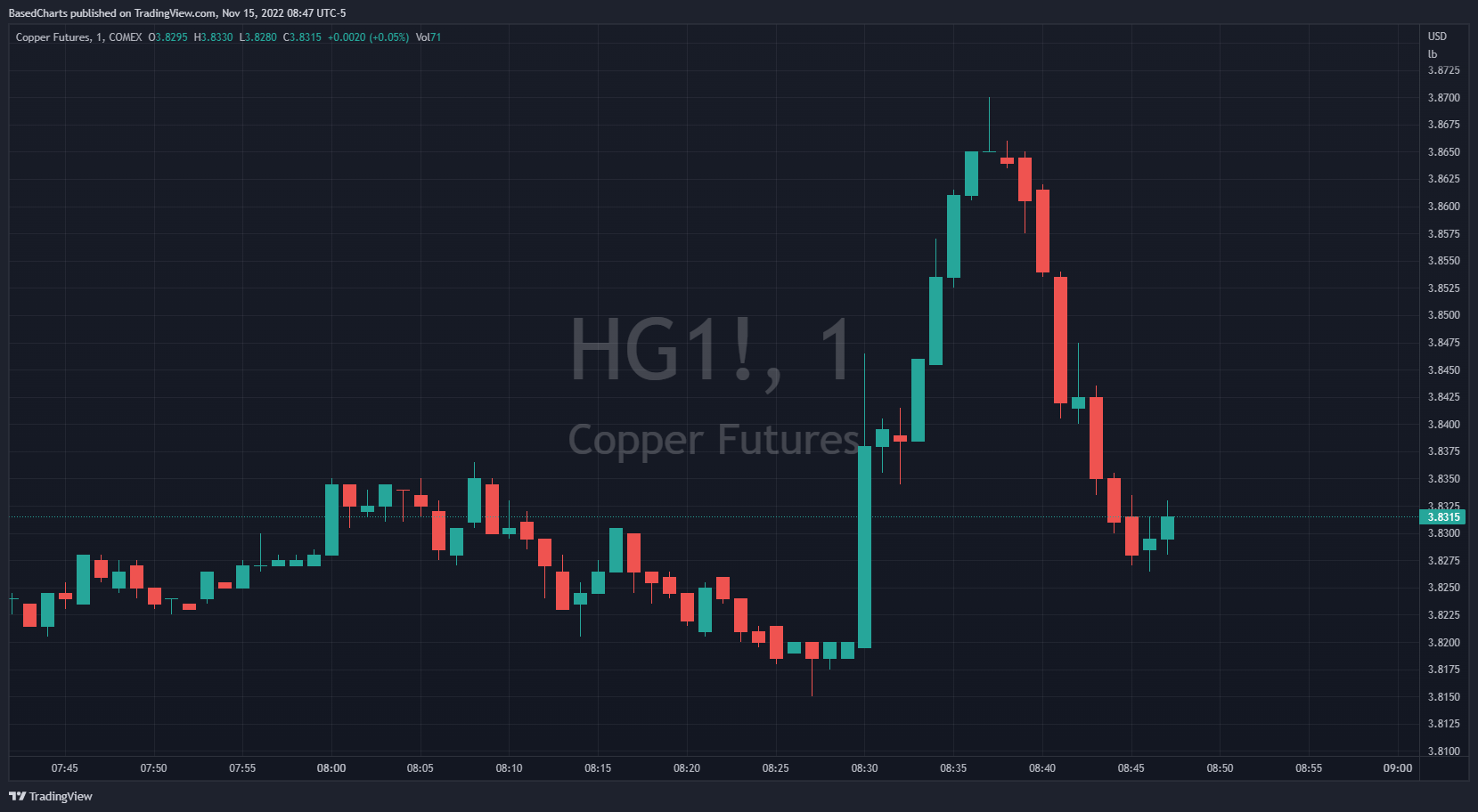
Stocks reacted far more positively because there’s no sign of recession yet. Falling commodities without a recession would be positive for GDP growth, consumer spending and limit Federal Reserve rate hikes. It would be a move back towards the “Goldilocks” economy that stocks love.

If instead stocks and commodities start sliding, it will be evidence the market has moved beyond inflation worries and started on deflation worries.
Yesterday I opened a bunch of short positions having seen exhaustion on the tape. I’m going to be underwater at the open, but notice the line on the NQ chart. I have two resistance lines on the NQ at 12100 and 12200. Right here, my thinking is to add more shorts at 12200 if it can get there, but cut loose all the short positions above.
The NFIB survey of ‘small’ and independent businesses is now showing that an equal number are reporting inventories too low compared to those reporting excess inventories.There's a chart at the link if you want a graphical representation.
He is the ratio of inventory to sales:

"Global volumes declined as macroeconomic trends significantly worsened later in the quarter, both internationally and in the U.S." FedEx CEO Raj Subramaniam warned in the release. "We are swiftly addressing these headwinds, but given the speed at which conditions shifted, first quarter results are below our expectations."Economic data is going to fall off a cliff.


Events always take longer to play out in time, but bear markets are when time accelerates. The extreme bear scenario includes several possible tripwires. One is the Federal Reserve loses control. Everyone expects inflation, which is why losing control means uncontrolled deflation. Everyone, even deflationists such as myself, assume the government would print money in that scenario.
What few have contemplated is what happens when its say August 2023 and inflation is back to 5 percent and the Biden admin is pushing a big spending plan because the recession is going on six consecutive quarters. There are easily imaginable scenarios where some combination of the Fed funds rate, inflation and U.S. budget deficit conspire such that the Fed's choice is massive dollar devaluation and exchange-rate driven "hyperinflation" on the one hand and deflationary collapse on the other. The GOP only needs one house of Congress to block any type of crazy spending plan from Biden.
Additionally, read Ages of Discord. The indicators point to civil war, political violence and depression. The setup for an economic depression that exceeds the 1930s is there if enough dominoes fall.


Throwing a wrench into any bond forecast is my bearish outlook for stocks over the next two months. I expect the next move in ZB will either be bad for stocks (down) or will be because stocks are performing so badly (up). Stocks down is my main forecast at the moment.
One way the market could crash is if the 30-year bond sells off another 20 percent from here (which hits the aforementioned targets). I have in the past often discussed a crash scenario where the market is dropping because of inflation and/or a weakening U.S. dollar and the Fed's only solution at the point would be interest rate hikes. While I expect deflation, I could also imagine a mirror of 2020. There was a brief deflation panic that gave way to roaring inflation only months later. Here in 2022, there could be on final plunge in bonds that helps fuel the final selling wave of 2022 and delivers a much stronger tradable low.
If Powell wants to go Volcker, that's the right move here. Front load all the pain into the next two months and inflation as recorded by the CPI will be negative.


Researchers found that students may be incentivized to borrow more money because the Biden administration is capping loan repayments at 5% of borrowers' income
The largest potential cost-driver Penn Wharton identified is the Biden administration's new income-driven repayment plan, which includes capping monthly student loan payments at 5% of a borrower's discretionary income and reforming the repayment guidelines to guarantee that no borrower who makes "about the annual equivalent of a $15 minimum wage" will have to make monthly loan payments.My hunch is debt levels will not increase because there will be losses borne by lenders. Even if the amount of outstanding debt increases, the value of that debt will decline because repayment is less certain. When a bond goes from AAA to B, it deflates. The money supply declines because lower quality bonds do not function as money. If the Biden admin makes enough rules that favor borrowers, at some point the value of student debt will decline faster than new lending increases.Debt cancellation alone will cost the United States up to $519 billion, Wharton found in an analysis published Friday. Loan forbearance, which allows borrowers to temporarily stop paying, will cost an estimated $16 billion. The income-driven repayment plan will initially cost $70 billion, however, specific details have yet to be released and the price may be significantly higher.
The income-based portion of Biden's plan needs further analysis, but it may cost $450 billion or more, bringing the total cost of student loan forgiveness to more than $1 trillion, economist Junlei Chen wrote in the Budget Model.
One possible problem researchers found with the income-driven repayment plan is that students may be incentivized to borrow more money because the Biden administration's plan caps loan repayments at 5% of the borrowers' income.


If the U.S. has it bad, Europe could become a wasteland. BOE Raises Rates by Most Since 1995, Warns of Long Recession (Archive link)
The Bank of England unleashed its biggest interest-rate hike in 27 years as it warned the UK is heading for more than a year of recession under the weight of soaring inflation. The pound fell.Europe is in far worse shape because of the Russia sanctions. The could alleviate price pressures by backing off the war, otherwise things will play out as they predict, but probably worse. Since the U.S. is already in recession, it isn't going to be helped by the UK and Europe weakening. Maybe the U.S. can recover sooner, or maybe China will as in 2008.The half-point increase to 1.75%, predicted by most economists, on Thursday was backed by eight of the central bank’s nine policy makers, who also kept up a pledge to act forcefully again in the future if needed.
“The committee will be particularly alert to indications of more persistent inflationary pressures, and will if necessary act forcefully in response,” Governor Andrew Bailey told reporters in London. “All options are on the table for our September meeting, and beyond that.”
The pound slid after the move, which was accompanied by warning that a UK recession will begin in the fourth quarter and last all the way through next year.
The BOE also boosted its forecast for the peak of inflation to 13.3% in October amid a surge in gas prices, and warned that price gains will remain elevated throughout 2023. That will sharpen a cost-of-living crisis that will see real disposable incomes fall more than at any time in around 60 years.
Here's the DSGE model. I disagree with their forecast because I doubt there will be two years like the past six months, a mild recession that goes on and on. Instead, it should have some point where things reach a peak. That said, the model also doesn't predict much growth after the economy bottoms out. The growth out of that recession is also expected to be mild, meaning it could take another year or two to get back to the prior peak of GDP. Looking at an economic downturn as the time to recapture prior peak, this could be the longest recession since the Great Depression.


For more of my thoughts on the economy, see It's Not a Recession. It's a Depression.

The rise of the U.S. dollar exchange rate this year has made monkeys of all the dollar bears. Cyclically, the U.S. dollar was primed for a decline, yet instead it has broken with four decades of cycle history and moved higher. The U.S. economy is shrinking as a share of the global economy, yet as a reserve currency and unit of account, creation of simulacra dollars (Eurodollars) exceeds that of the base money. Base money growth in the U.S. rises, but demand on that base money rises faster because of overseas credit creation. Hence demand for the base money rises when expansion of the credit money (Eurodollars) slows or contracts.
I predict that, if the U.S. dollar loses reserve currency status, avoids going the way of Zimbabwe and something like SDRs replace it, the U.S. dollar will eventually appreciate versus the SDR. For the same reason the German deutschmark would appreciate versus a rump euro. Whenever there is a shared resources such as a common currency, he who prints most will drive the value of the currency lower.
Mises.org: ECB’s Long Journey into Currency Collapse Just Got a Lot Shorter
The new instrument, born under the name “transmission protection instrument” (TPI), will be the catalyst to the accelerated full transformation of the ECB into a bloated European “bad bank” fund. This entity enjoys a giant privilege. Its liabilities are in large part the designated money (whether as banknotes or as reserves of banks) enjoying huge protections as such (most importantly legal tender) in all member countries of the European Monetary Union.The euro is weak because it allowed countries such as Greece to issue "deutschmark" bonds in the 2000s. The euro was strong because of Germany, rather than weak because of Greece. Economic policy in Germany looks even worse than that of Greece in 2022, hence the rapid decline in the euro. The breakup scenario for the euro, however, has always been a German exit because the common currency exchange rate trends towards the most profligate borrowers over time. As soon as the European Union passed on kicking Greece out, it guaranteed the most likely breakup scenario is a German exit.In effect, since the EMU crises of 2010-12, the ECB has been the agent which has “communalized” much of the bad state and bank debt of Italy (also Spain, Portugal and Greece). It has done this by issuing euro money liabilities against giant purchases of government paper and long-term lending (called LTROs) into the corresponding weak banking systems (again most of all Italy).
This communalization has created three big problems for the future of the euro:
Third: the tolerance of the German public for this transformation of the ECB and its money could snap in a way which means that the Federal Republic pulls out of the union. Germany has been critical in keeping the ECB humpty dumpty together. Partly this critical role depends on public perception (that Germany stands behind the ECB and all its potential losses), albeit there is much wishful thinking here rather than legal fact.The same logic can be applied to an SDR, special drawing rights from the IMF. Whether it is formal or not, a move to a world with no dominant reserve currency is not that different from one with the SDR as the main reserve asset because in both cases, countries will be using currency baskets. The U.S. losing its reserve currency status would look more like a German exit from the euro than not in terms of the domestic economy. A costly adjustment period followed by the U.S. "decoupling" from the global economy as it becomes free to pursue a mercenary America First national economic plan. Placing tariffs on Chinese goods and on Chinese purchases of U.S. assets is fraught with economic costs today because it threatens the reserve currency status of the U.S. dollar....If, for whatever reason, the Italian spread (Italian government bond yields vs. German) suddenly widens – perhaps because markets distrust the political direction or sense that Italian credit institutions are in a new bleak situation – then the ECB can turn on the taps. Yes, it will sterilize the new lending, that means presumably disposing of German and Dutch paper in the ECB balance sheet to make room for Italian for example, becoming even more of a bad bank.
There are decisive moments in monetary history. The aftermath of July 21 is likely to be one of them as regards the European monetary future. These problems have become a lot worse
In the near-term though, it is the breakup of the euro that is helping lift the U.S. dollar because the (formerly?) dominant Germany economy is being pulled down by green idiocy, Baizuo foreign policy and the deficit spenders in Southern Europe. Declining social mood makes a total breakup increasingly likely. Keeping the euro together will require printing money much faster than in the United States. Investors and businesses that leverage themselves on the assumption of a relatively weak dollar will experience deflationary collapses as happened in 2008, 2011, 2014, 2018, and again in 2022.
There are more than 160 million market entities in China, and the people are diligent and intelligent, which is the greatest resilience and confidence in economic development. In recent years, we have implemented macro policies in the face of the needs of market players, stabilized employment and increased residents' income by stabilizing market players. We will maintain the continuity and pertinence of macro policies, continue to focus on helping market players to relieve difficulties, and retain the "green hills" of economic development. Macroeconomic policies are both precise, powerful, and reasonable. We will not introduce super-large stimulus measures, over-issue money, or advance the future in order to achieve excessive growth goals. We must adhere to seeking truth from facts and do our best to strive for a better level of economic development throughout the year. There is still considerable room for a package of policies and measures to stabilize growth. The value-added tax refund has exceeded 1.8 trillion yuan in the first half of the year, and the continued implementation of the policy will further expand the actual scale of tax refunds; the actual use of local government special bonds, newly introduced The use of policy-based and developmental financial tools will effectively invest in more physical workloads and stimulate employment and consumption. We will continue to use reforms to boost momentum, deepen the reform of "delegating power, delegating power, improving regulation, and improving services", so as to stimulate market vitality and social creativity.The global economy is slowing and financial conditions are tightening. China will not issue suicidal stimulus that could crater the financial system and currency while these conditions are ongoing.
Extremely negative economic outcomes should be expected in this moment should the Fed follow through. Contrast that with stocks that are bouncing between green and red today tells me the rally thesis is intact. It could take two weeks until the Fed meeting depending on how assets behave. I do expect that in a bear scenario, oil could be below $80 per barrel by the Fed meeting or shortly after.


This is not normal. This is not fine. This is absolutely the end of "inflation."
— Jeffrey P. Snider (@JeffSnider_AIP) July 13, 2022
Markets after today's "red hot" CPI, most inverted yet (USTs, too).
The curve has never been this f-ed up. Not even '07. pic.twitter.com/GOpHZH5fM2


