Showing posts with label inflation. Show all posts

2023-04-12

Take the Quiz

After checking the result, I looked up dividend yields and calculated the compounded return. Then I looked up historic dividend yields versus bond yields.

China Prints at Devaluation Speed

China Printing At Devaluation Speed
The annualized three-month growth rate of M2 money supply growth hit 24.1 percent in March. The last time it hit 24.1 percent? July 2015. The “surprise” yuan depreciation was in August 2015 under similar economic circumstances.
Everything is not the same, but the key component in this mix is the U.S. dollar...

2023-03-28

Inflation-Adjusted Possibilities

If the Fed can't or won't stop inflation, the inflation-adjusted losses on the market indexes may erase the entire 40-year bull market. A drop to the 1966 inflation-adjusted DJIA seems like a lock to me in any major bearmarket. It is about a 69 percent loss down to the 1500 area onthe S&P 500, the 2000 and 2007 topping area (I used DJIA for any data before the 1980s because it was the most watched index then), that I think can be hit in nominal terms during a front-loaded bear market. The longer a bear takes to unfold, the more losses will be made up of lost purchasing power. That might sound nuts, but consider the CPI-adjusted low in 1982 matched where the DJIA was in 1947.
The CPI is about 300 right now. What if the CPI hits 500, about 60 percent inflation, over a decade. Multiply the CPI by 30 to get 15,000, matching the inflation-adjusted peak in 1966. Zero inflation-adjusted gains not including dividends. You may point out the dividend gains aren't too shabby and you're right, that's a lot of compounding. However, we are looking ahead. Do you want to suffer that loss while only collecting about 1.6 percent yield on the S&P 500 Index? Also, bonds can compound too. If inflation rises, 10-year treasuries will be paying substantial interest, possibly as much as the 8-percent investment return target many investors and institutions default to.

2022-12-15

If California Didn't Exist, Austrians Would Have to Invent It

Clownifornia delivers another lesson in central planning and interventionism gone wrong. Retail sales spiked in October when California issued a stimulus check. Retail sales fell in November.
If America chose a pet rock for president, it would be a successful term because the pet rock would not intervene. Unfortunately, there are bad policies that do constant intervention that must be unwound, but a pet rock would come up with no stupid ideas, which it seems is the only thing the Baizuo ruling class can come up with.

2022-11-15

Hello Deflation

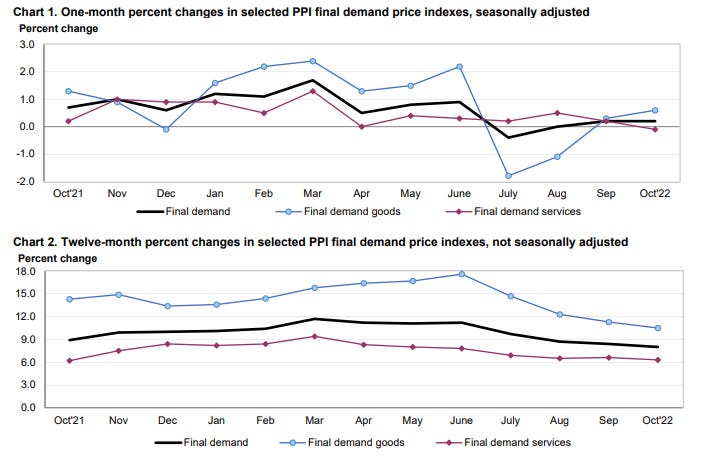
The October PPI report was bullish for stocks. The market should love than news and run higher this week, but there are signs of weakness. I was caught wrongfooted opening short positions yesterday, but I might have been early instead of wrong about the rally completing.

The exhaustion I saw in the market yesterday was wiped out by the morning’s response to the PPI. Most people are not looking at China and other data sets showing the clear tilt into deflation underway and more oncoming in 2023 once housing data trickles through. At least through the PPI release, the market is still viewing falling inflation as bullish.

The core PPI services segment went negative in October.

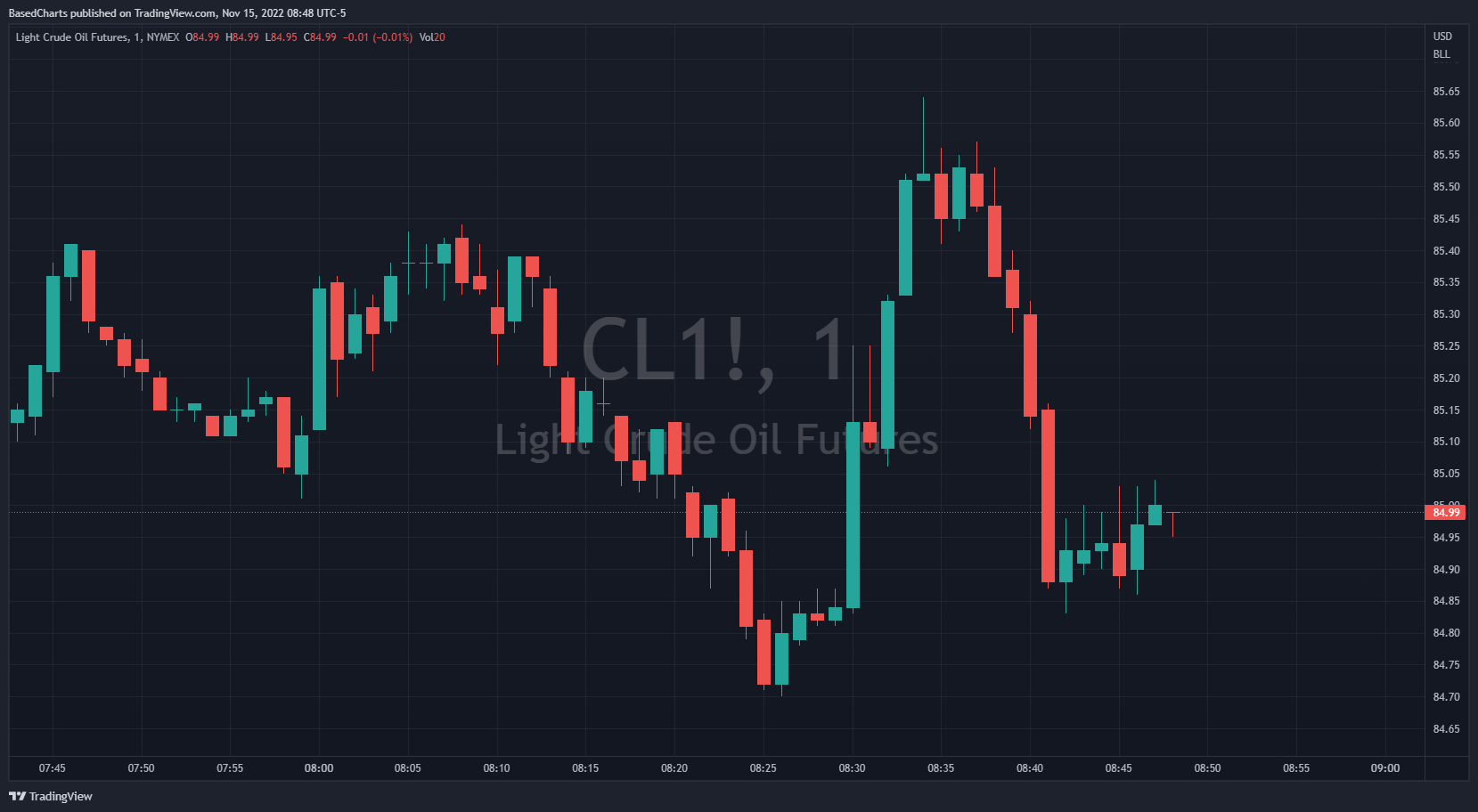
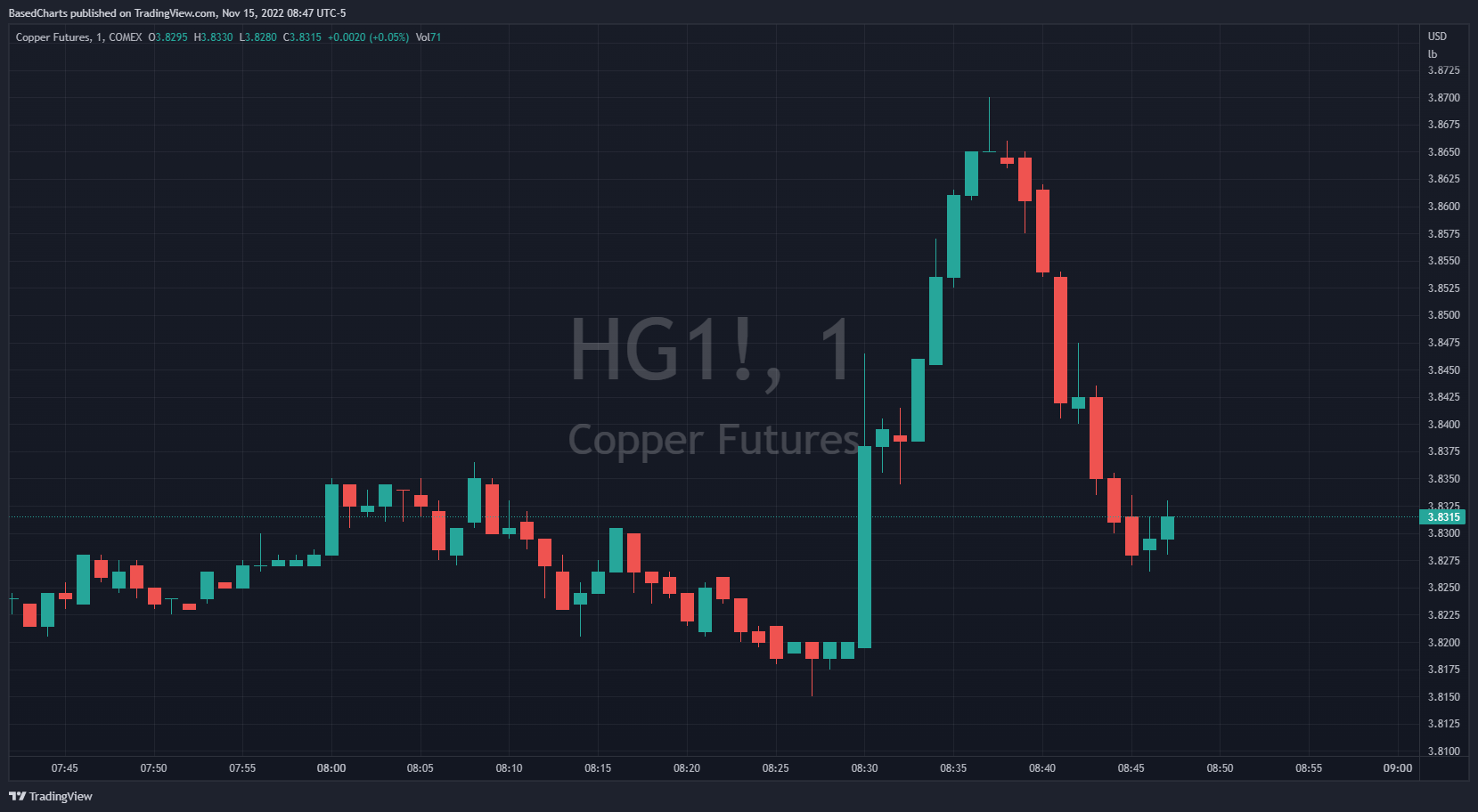
There’s one potential paradox: speculators have been bidding up commodity prices in response to lower inflation readings. Will that continue? Today’s initial response was a jump in commodity prices that quickly reversed. It will be telling how this plays out today. If copper and oil continue sliding, it may indicate the market has started realizing the downturn in prices and slowing pace of Federal Reserve rate hikes might not be bullish.

Stocks reacted far more positively because there’s no sign of recession yet. Falling commodities without a recession would be positive for GDP growth, consumer spending and limit Federal Reserve rate hikes. It would be a move back towards the “Goldilocks” economy that stocks love.

If instead stocks and commodities start sliding, it will be evidence the market has moved beyond inflation worries and started on deflation worries.

Yesterday I opened a bunch of short positions having seen exhaustion on the tape. I’m going to be underwater at the open, but notice the line on the NQ chart. I have two resistance lines on the NQ at 12100 and 12200. Right here, my thinking is to add more shorts at 12200 if it can get there, but cut loose all the short positions above.

2022-11-10

Inflation Cool, Stocks Hot

3875 is the key level today. Above and the bulls are in control. Probably going higher. Below and then 3850 and more important, 3830.
zooming out , 3930 is a resistance area should the bulls press it today or into tomorrow.
As for inflation, the number beat the most optimistic investment banks, while the Cleveland Fed missed by 100 percent.

2022-11-09

Inventory Crunch to Liquidation

The Sounding Line: Inventory Crunch Over
The NFIB survey of ‘small’ and independent businesses is now showing that an equal number are reporting inventories too low compared to those reporting excess inventories.
There's a chart at the link if you want a graphical representation.

He is the ratio of inventory to sales:

2022-11-05

Commodities Signal Something Wicked

Preface: I'm all set whichever way the market goes and I'll change positioning as necessary. Even if you're bearish, it makes sense to have real assets, some physical precious metals and you should have a small watchlist of lotto-ticket junior mining stocks in case things change in a hurry.

Commodities exploded higher on Friday. Market participants and more so financial media, always create an explanation for what happened. The story for Friday's move was China re-opening. 

Another explanation is that the money printers take power away from the Federal Reserve. There is a growing rumor that the Treasury Department led by former Fed chair Janet Yellen will seize monetary power. She has floated the idea of doing a "twist" where the treasury issues new debt and buys back older debts. This would squeeze shorts and shock the market in the short-term, though maybe not. First, if this is done, it is the financial equivalent of draining the SPR for votes. How many votes will the Biden administration get for the SPR policy? It looks like a negative number to me. I bet this move is a larger negative number. It wants to "drain" the treasury market of very favorable debt (from the view of the U.S. government) and replace it with more volatile short-term debt that will reset at higher interest rates. As with the SPR drain, they refuse the simple solution: issue less debt. Instead of sending $30 billion to Ukraine, issue $30 billion less in treasuries. What a concept! As with the SPR drain, if the policy fails and the future is worse, then they've screwed the country. Interest on the debt will bring forward the date when massive cuts in welfare and warfare spending will be made.

It's possible the gambit will fail immediately too. In addition to worsening the government's fiscal position, they are crossing a red line by interfering in monetary policy. As someone who opposes central banks for economic and political reasons, it nonetheless is a superior economic arrangement to a U.S. treasury run by literal money printing MMTers. It is possible the market reaction to this treasury move will be a collapse in treasuries, the U.S. dollar and an outbreak of inflation so bad that there are inflation riots in the streets. For this potential risk alone, it is insane for a Democrat administration to effectively take 100 percent responsibility for the nation's fiscal woes built up over generations, but that is what will be the "narrative" if they do it.

The above scenario is a valid explanation for a sustained explosion in commodities of which Friday was merely the start. Another is that for all the whining by degenerate speculators and gamblers, the Federal Reserve still has interest rates at negative 2 percent measured by core CPI. What if I and others who expect lower inflation are wrong? If neutral policy includes rates of positive 2 percent, that argues for an 8 percent Fed funds rate right now. That would mean mortgages above 10 percent. What if the move on Friday was the market calling bullshit on the Fed and inflation is about to rip higher? Say hello to 10 percent on the 10-year and 15 percent yield on mortgages. 

Intuitively it makes sense. There is no hope of a soft landing given the amount of debt-financed stimulus and lockdowns that preceded it. At the very least, the 30 to 50 percent rise in home prices, more than 100 percent in many places, should reverse nearly 100 percent if the inflation comes out. Factor in lockdowns and the economy should be at a lower level than it was in February 2020. There was a great deal of economic destruction carried out by politicians and then hidden by massive stimulus. The electoral guillotine that will drop on Tuesday November 8 is the public reaction to the tip of an iceberg of destruction that the ruling class sent our way in 2020.

Alright, there's your commodities bull case. How about the bear case? First, the Fed gets serious about inflation if the runaway inflation scenario is real. They do whatever it takes to get inflation down, including the hardest landing for stocks since 1929. You will hear screeching like never before if the Fed does an emergency rate hike, but it is the appropriate move if commodities are taking off. Copper is begging for a 100 basis point emerging hike if it has one more day like Friday.

More likely, the big move is the end of a speculative wave. Whenever I'm writing one of these posts, something big usually follows. Markets get to the starting line of a major phase change many times before they go through with the change. If this isn't the phase change yet, then history says Friday was a great shorting opportunity.

Prior spikes in copper, outside of the Ukraine war pop, came at the end of rallies:

Huge spikes in and of themselves can be bearish outside of V-bottom type moves preceding them. If China doesn't unleash massive stimulus and/or the U.S. treasury isn't dumb enough to trash the currency and treasury market, then that spike is unwarranted.
Friday's move still leaves assets such as gold and copper with their crash analogs intact. Gold did pop up, but that candle could still end up looking like April 2013 before the month is out.
Silver had a similar spike with similar volume in the futures market at the start of October.
That also came within the context of a stock rally. Using the the stock market for context and relative weakness in stocks last week, the pop in commodities looks like it could be an outlier move.

As for the broader market, it can be distilled down to one stock: Apple. The stock has a bearish topping pattern that has yet to break. The measured move off the topping pattern gives a target of below $80 per share. There is a gap at $95 per share. If it fell as much as the rest of BigTech, it would trade down around $110 at minimum. Long-term support is around $124 per share. Apple is the largest stock in the S&P 500 Index at more than 7 percent of the index. It is nearly 25 percent of the technology sector. It is 14 percent of the Nasdaq 100. Finally, it broke the AAPL/SPY uptrend ratio. While not a necessarily a trade signal, it does indicate Apple is officially losing its status as the largest company in the stock market. I doubt this will be a painless transition. It is possible Apple collapses alone, but unlikely. 


We'll find out soon enough what the market has in store. One thing I'm relatively certain of: if commodities go up, then stocks like Apple are going to crumble. If commodities reverse lower, it'll probably be for a bad reason that is also bad news for Apple. It's possible both stocks and commodities rally for a time, but I don't see them rising together for long. 

2022-11-04

China Going Supply Side

Yicai: China’s Local Governments Should Put State Assets to Better Use, Ministry Says
Chinese local governments should make better use of state-owned assets, such as houses, land and cars, in order to help plug the gap between fiscal revenue and expenditure, the Ministry of Finance said.

Local governments should conduct a thorough inventory of the assets that they occupy and use to make sure that they are being used efficiently, such as through the sharing, swapping, leasing or selling of these resources, and that none are lying idle, the ministry said in a document released yesterday.

Liu He had a widely-discussed editorial calling for supply side reforms: 刘鹤人民日报撰文:把实施扩大内需战略同深化供给侧结构性改革有机结合起来Hong Kong shares jumped 5 percent and A-shares more than 2 percent with more rumors of reopening. These two hotpot chains sport higher lows.
The emerging market ETF will open up near the gray line this morning.
Since everything is tied together, it still all boils down to the U.S. dollar. Copper is up 5 percent today, crude oil 4 percent for the same reason as the above. Will the Federal Reserve ease policy if the CPI reverses and goes vertical on a China reopening? Or are we headed for 10 percent interest on 30-year mortgages
FWIW, I'm looking for a reversal in the stock market today because none of these moves are good for U.S. equities. Short-term anything can happen though.

2022-10-29

Crash: Real Interest Rates and Gold

The real 10-year interest rate is inverted on this chart. This is a calcualted figure from a model, so I'm more interest in the trend than in specific levels.
Frequency: Monthly

The Federal Reserve Bank of Cleveland estimates the expected rate of inflation over the next 30 years along with the inflation risk premium, the real risk premium, and the real interest rate.

Their estimates are calculated with a model that uses Treasury yields, inflation data, inflation swaps, and survey-based measures of inflation expectations.

2022-10-28

Speaking of Inflation, Diesel is Up 40pc in a Month

Many people rightly point out that a supply shock is not inflation, but what they fail to consider is that if you have a supply shock, you by definition have printed too much money. If the central bank doesn't tighten up money supply, then people can easily bid the price of say, diesel, to the Moon. Hiking interest rates doesn't make more diesel available, but it can be the difference between $7/ga diesel and $20/ga diesel.

Bulls Want to Go Back, But We Only Go Forward

My expectation coming into today was that I either short again on a bounce or have to wait to short as the market drops. There's the PCE bounce on the release. I thought the numbers could come in lower, but they are in line with the market consensus. That is negative overall because according to the Cleveland Fed, inflation accelerated in October (confirmed by the rebound in commodities). Also, Cleveland Fed was looking for a lower number and was wrong. Their models have been biased on the underside lately, and they're already seeing faster price increases in October.
The peak conditions for peak stock prices are in the past. Not only is the bull market dead, but the future bull market will be a totally different animal. Bulls are still clinging to hopes of pivots, blaming the Fed for hiking rates and so on. They are going to keep being sucked into dip buying until they realize it's over. Then we can see a capitulation wave down, probably not the final one either. I suspect that wave is already underway with BigTech earnings coming in weak.

2022-10-26

Weak Knees

Watching the market overnight and it’s drifting back up. I don’t put much stock in the overnight moves because they frequently reverse, but I’m not bearish short-term if the market goes to a new rally high. The bull trap scenarios I laid out will be in play if the market cracks 3900 and goes for 4000 or 4100.

Apple and Amazon earnings will be huge tomorrow after the bell, followed by the PCE report for Q3 before the open on Friday. Harking back to those bull traps, the Cleveland Fed has the September PCE numbers coming in lower than expected. That will be crack for bulls if Amazon and Apple can merely avoid a “Meta” scenario with their earnings reports. Bulls will not care if October inflation numbers are worse and a weak dollar lifts the inflation rate. They'll enjoy a few days of rampage before the Federal Reserve drops the hammer on November 2.

Best case for bears who have shorted already is that Apple, Amazon or both disappoint and Cleveland Fed is wrong about the PCE. If not, one of the bullish trap scenarios is the best outcome.

Inflation Inflation Inflation

The most interesting chart today is ZB and the reversal in treasuries. It has made it back to my initial target level at 121. Above and there's a potential base in place. I've been holding some calls since Monday that were a short-term trade with possibility. The big question going back to the summer for me has been: when/will bonds signal a shift to deflation? Home prices are down on schedule, but as I've discussed before, the government inflation indices may not capture this until as late as early 2023 if Larry Summers has it right.
Copper and oil have stabilized with the markets. These factor into the "big question" beccause inflation is hard to kill. The 1970s saw the Federal Reserve take their foot off the rate hikes when recession hit and the CPI reversed, but it never made it back down. Result: endemic inflation.
As for the market, I don't think we're in an uptrending market with earnings season volatility. I'm not convinced in a rally yet. My current thinking is the transition scenario where the economy moves from inflation to deflation, bonds rally and stock market bulls and maybe commodity bulls (less successfully) interpret this as bullish. Then around January, the reality of deflation sets in. Contra that, the Cleveland Fed has been hiking thier inflation forecast for October. Maybe this rally gets garrotted like it has the past couple of months.

2022-10-16

Where Are We in the Credit Cycle?

When you zoom into a hyperinflation the chart is fractal. A constant collapse in value. The past 50 years is a slow-motion inflation of credit. History says there's no way to abort this trend without major damage. The peak in the total credt-to-GDP ratio 2009 was a result of the financial crisis. Is this a giant base with 2020 pointing the way north? Or was 2020 an overthrow creating a complex double top?

2022-10-12

Huge PPI Miss

Markets are calm after a huge PPI miss (in my opinion). I expected PPI would come in cool because of falling commodity prices, and thereby set-up a strong rally into tomorrow's CPI report that would either fail miserably or trigger a melt-up squeeze before giving way to new lows. There is still a risk of a cooler CPI for bears, but the odds of that are lower following the PPI.

ZH: Food Cost Jump Sparks Hotter Than Expected US Producer Price Inflation

Ex-Food, Energy, & Trade, PPI rose 0.4% MoM (double the expected +0.2%).

Both Goods and Services PPI are rising with Food increases dominating...

Finally, we note that the pipeline of PPI pain is easing further as intermediate goods inflation eased further...

Inflation is cooling for sure and monetary effects are lagging. Yet remember what Powell said this summer (paraphrasing), "We don't really know anything about inflation..." Yesterday, this article went viral on finanacial social media: Fed’s Inflation Fight Has Some Economists Fearing an Unnecessarily Deep Downturn
Traditionally, the Fed set policy based on forecasts of inflation, which lags behind changes in output. But officials now are reacting more to the latest inflation data “because they have absolutely zero confidence in their ability to forecast inflation,” said Nathan Sheets, chief global economist at Citigroup. He said he is concerned the Fed will overdo rate rises but concedes inflation in the service sector is “pretty concerning.”
I don't see how a central bank cannot overdo it when fighting inflation because it is the only way to be sure. They have to nuke inflation from orbit. The added factor is that they don't trust their inflation forecasts. Every month that doesn't show collapsing inflation is a month that doesn't cause any doubt about rate hikes at the Fed.

My scenario for this year is that inflation does cool, but then accelerates in 2023. Another scenario that will take longer to develop: the market sinks even as inflation drops because the Fed won't change course. Real interest rates will accelerate via falling inflation. Assume the Fed pauses at 4.75 percent. If CPI falls from 6 perecnt to 3 percent, real interest rates rise from -1.25 percent to +1.75 percent. In bear markets, all macro scenarios result in lower stock prices.

Not much has changed with charts the past few days. Some charts remain important such as USDCNY because I still expect a possible yuan depreciation, but that's not chart-centric. Instead, ZB looks the most compelling because it is sitting near the 52-week low. It is also coming within spitting distance of the measured move off the topping pattern (yellow horizontals indicate the top and the target). Note I am ignoring the March 2020 spike when measuring the top.

I've been wrong about ZB, TLT and government bonds finally catching a bid as the market drops. However, if there is a capitulation drop coming this month, then I envision ZB making a quick drop to around 121 before recovering, but equities continue falling. This "safe haven" behavior will indicate equity investors are finally capitulating and also turning to the "safety" of bonds. Safety in quotes because this year has shown they are not safe. The shift in psychology will be investors deciding bonds are safer than stocks. 

If I'm wrong, so be it. I have no position on TLT at the moment. I will also note TLT broke my lifetime support line. It's also possible a twin crash happens in stocks and bonds simultaneously.

2022-10-08

Random Thoughts

It is said that rate hikes do not help high oil prices. Do rate cuts?

You can't print oil. Aye, and what does currency printing do in this context?

Home prices climbed 42 percent since the pandemic according to Case-Schiller. Home affordability is at all-time lows. Assuming lockdowns damaged the econmoy, why should's prices fall 30 percent back to the pre-covid level?

For 12 years, the Federal Reserve suppressed interest rates and thereby indirectly funneled hundreds of trillions in capital into unsustainable projects and investments. Higher interest rates are the solution, no?

Why shouldn't the strongest companies and countries set their interest rates higher so as to attract scarce capital?

Short-term: if the U.S. dollar is peaking, where do commodity prices go? Inflation? Interest rates? Long-term: same questions, but also what if the dollar hasn't peaked for good yet?

2022-10-07

Inflation Going Back Up?

The overall CPI is coming down, but the Cleveland Fed sees Q4 above Q3. As with the economy and jobs, I may be very wrong about inflation, but it's "right for the wrong reason" with my bearish positioning.

2022-09-20

One Chart Every Investor Should Internalize

Prior to 2008, the low for the Fed funds rate was around 0 percent aka the CPI and the high in the prior 20 years was about 5 percent. If we put a 0 to 5 percent range on forward inflation rate of...let's be generous and say 2 percent...then the "normal" interest rate for next year is somewhere between 2 and 7 percent. The nominal interest rate of 0 percent is probably gone. The two pandemic years ruined it because the Fed will not risk a repeat. Interest rates can go down, but not much. It'll take actual deflation to get rates down to 0 percent and even then, the Fed might stop cutting around 2 percent and see what happens. There won't be any QE either.
Taleb said similar things in a recent interview.