


Man Group PLC : Form 8.3 - Gamma Communications Plc
-
*FORM 8.3*

![[Most Recent Quotes from www.kitco.com]](http://www.kitconet.com/charts/metals/base/copper-d.gif)
|


ZH: China Cuts Reserve Requirement Ratio By 25bps, Boosts Economy With $70BN In Fresh Liquidity
Below I've reproduced my post from December 6, 2021: China RRR Cut is Bearish
ZH: China Cuts RRR By 50bps; More Easing Expected
Specifically, the PBOC cut the RRR by 50bps effective 15th Dec. The move will release CNY 1.2 trillion in liquidity - some of this new money will be used by banks to repay maturing loans from the PBOC’s medium-term lending facility and some of it will be used to replenish financial institutions’ long-term capital, the central bank said. There are almost 1 trillion yuan worth of the 1-year loans maturing on Dec. 15, the day the cut takes effect.It releases zero trillion in new lending. It eases financial pressure on banks who are probably running into some trouble because of the strong dollar. Look at the chart posted with the article. The RRR cuts come during the taper. They occur before yuan depreciation in August 2015 and before a broad global sell-off in risk assets in autumn 2018.

Reuters: China's state banks seen acquiring dollars in swaps market to stabilise yuan
China's state banks stepped up their intervention to defend a weakening yuan on Monday, with banking sources telling Reuters these banks sold a high volume of U.S. dollars and used a combination of swaps and spot trades.I say it every time and I will say it again: if the dollar drops then no worries, the pressure will be alleviated. If the dollar continues rising...blatant intervention is the last step before letting the yuan reprice.
We have noticed some fluctuations in the financial market recently, which are mainly affected by investors' expectations and sentiments. At present, our country's economic fundamentals are sound, the potential for endogenous economic growth is huge, and substantial progress has been made in preventing and defusing financial risks. The financial system implements the decisions and arrangements of the CPC Central Committee and the State Council, coordinates epidemic prevention and control and economic and social development, supports logistics smoothness and promotes the stability of industrial and supply chains, and minimizes the impact of the epidemic on economic and social development. In accordance with the principles of marketization, rule of law, and internationalization, steadily advance and complete the rectification work of large platform companies as soon as possible, and promote the healthy development of the platform economy. The People's Bank of China will increase support for the real economy with a prudent monetary policy, especially to support industries severely affected by the epidemic, small, medium and micro enterprises, and individual industrial and commercial households, support agricultural production and energy supply and increase supply, and launch technological innovation and re-lending and inclusive benefits. Special re-loans for the elderly, an increase of 100 billion yuan in re-loans to support the development and use of coal and enhancement of energy storage, increased re-loans to support agriculture and small businesses and special re-loans for civil aviation, maintain a reasonable and sufficient liquidity, promote the healthy and stable development of the financial market, and create a good currency financial environment.Boilerplate. The point isn't what they said, it's that they said anything at all.
Elsewhere, the familiar "don't worry, please keep buying" message for the holders along with "where's the bottom?" for the nervous bulls.
iFeng: 李大霄:跌破3000点不是世界末日 恒指率先见底的希望最大
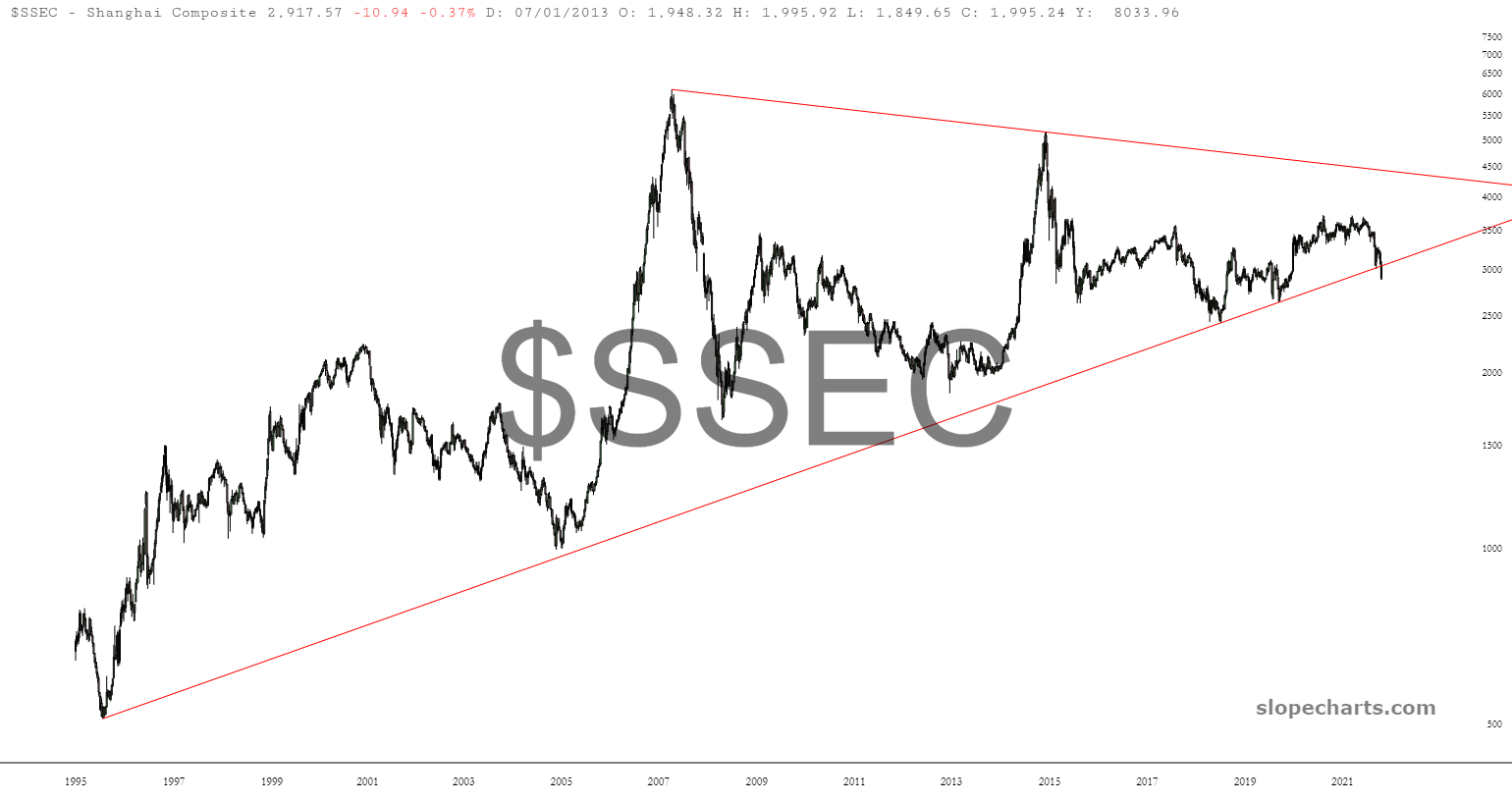
On April 25, the three major A-share stock indexes opened lower and moved lower. In the afternoon, the Shanghai Index fell below 3,000 points intraday. After 21 months, it returned to the "2" stock index and the ChiNext index fell by more than 3% intraday.Li Daxiao is like the Jim Cramer of China:In this regard, Li Daxiao said that falling below 3,000 points is not the end of the world. When the market is rising, there will also be periods of adjustment.
He believes that policies to stabilize growth are being introduced one after another, and the market reaction will be reflected later. Therefore, we should not be overly pessimistic about the market, do a good job of responding, change from offense to defense, choose equity products that match our risk tolerance, and calmly respond to market fluctuations. At the same time, don't lose faith in good stocks, avoid stocks with high valuations, and be careful with leverage.
Li Daxiao said that the Hang Seng Index is currently the most hopeful for the market to bottom out, and the second is the Shanghai Stock Exchange 50. When conditions are ripe in the future, A-shares may rebound with good stocks as the main force. With the stabilization of the economy and the intensification of steady growth, stocks related to steady growth will return to their proper value.
Li Daxiao’s share tips attract hundreds of thousands of views within hours of appearing on Chinese social media. The celebrity stock guru, who posts short, quirky online videos, is known to move markets when China’s army of retail investors follow his advice.iFeng: A股跌破3000点何时触底?孙建波:高估值压力已基本解除 长期建仓机会显现But Mr Li’s unshakeably optimistic outlook on Chinese equities has prompted scrutiny from authorities and a public backlash following the market rout caused by the coronavirus outbreak, with some investors blaming the star stock picker for their losses.
In one particularly ill-timed call, Mr Li in mid-February insisted the Chinese market was on the brink of a bull run, just days before stocks plummeted. Last year, his forecast that the Shanghai Composite index would hold above 3,000 points was repeatedly proved wrong as the US-China trade war whipsawed the market.
n April 25, the three major A-share stock indexes opened lower and moved lower, and the Shanghai index fell below 3,000 points, the lowest since July 2020. As of press time, the Shanghai Composite Index, Shenzhen Component Index, and ChiNext Index all fell by more than 3%, and more than 4,400 stocks fell.Coronavirus is a big distraction for the world. The virus is real, but the overreaction allowed for a 2-year life extension on a bull market headed for the end. It is also now covering up weakness in China. As I've put it before, losing all the gains since March 2020 only gets the bear market to the starting line. All the damage from inflation and supply chains will make the ensuing bear market and recession far worse than it would have been otherwise. China is in the same boat as everyone else, and in worse shape with a currency that needs propping with falling reserves.Regarding the sharp drop in A-shares today, Sun Jianbo, chief economist of China Reading Capital, told Phoenix.com Finance that on the one hand, since the fourth quarter of 2021, the valuation of track stocks and high-valued white horses has been challenged. This challenge requires individual stocks to return to normal valuations.
On the other hand, Sun Jianbo believes that when the market falls below 3,000 points, the pressure of high valuation has basically been relieved, but for the market outlook, Sun Jianbo believes that it may further decline, and the reason is the decline. Panic inertia superimposes the current confusing economic environment.
As for where the "bottom" is, Sun Jianbo predicts that it may continue to drop to around 2700, and then there is a high probability that it will stop falling and stabilize. At the same time, Sun Jianbo pointed out that panic declines are often opportunities for long-term positions. He suggested that you should look for industries and companies with better growth in the next 3-5 years, and "build positions at lower prices during a panic decline.


The prior post was China Reveal Comes in March. I'll go through how that's going to play out with real estate. The first print of the year comes in March because January-February is combined. Spring Festival is a two-week holiday that moves with the lunar calendar. The two-month total gives a clean number that requires no statistical adjustment. The increase of 38.3 was an easy comparison in Jan-Feb 2021 because it compared to the pandemic period. A comparison between December 2020 and Jan-Feb 2021 shows that increase was 17 percent month-on-month.
How much growth from December 2021 to January and February 2022 is needed to produce a positive print in the first reported real estate investment number in March? Answer: 35.94 percent. If real estate investment increases only 20 percent from December's total, the first number will be negative 11 percent. The government can avoid this by frontloading investment similar to 2021. The cumulative YTD growth total will decline as it did last year, but it will remain positive for many months, perhaps all of them if stimulus is launched during 2022.
I don't want to overstate the relevance of this data. What matters isn't this one data point, but the context. Back in 2014, when I paid close attention to provincial data, I noticed Liaoning's real estate investment plunged: Liaoning Sounds Warning on Chinese Economy. The province relied on higher stage production, industrial raw materials. After the 2011 peak in commodities, all of northeast China was slowing, but Liaoning was more acute. To make up for it, they shifted investment into real estate. Liaoning eventually had a brief headline recession as more dominoes fell. Banks were still failing in 2019. The government could deal with it all because growth elsewhere was strong.
What else was going on in 2014? The Federal Reserve's taper. The month that Chinese financial news clued me in to Liaoning's situation was the same month the taper concluded: October 2014. History is rhyming. Pay close attention. Even if China steers through it all again, the prior period included plunging commodity prices, a soaring U.S. dollar, "surprise" yuan depreciation and major headwinds for U.S. equities. It didn't end until 15 months later, when in early 2016 global central banks informally agreed to the Shanghai Accord.
January 2021: PBOC Vows to Step Up ‘Prudential Oversight’ of Online Platforms
December 2021: 重磅!央行开始动手了,哪些主播被禁止卖金融产品?
Improve the Internet financial supervision systemThe central bank and other relevant departments pointed out the three major necessity for the formulation of the "Measures" in the drafting notes.
The first is to implement the Party Central Committee's decision and deployment on anti-monopoly and preventing the disorderly expansion of capital.
With the vigorous development of the digital economy, social production and lifestyles are changing from production-oriented to demand-oriented, and customers and data resources have become important means for implementing monopoly in the era of digital economy.
Some Internet platform companies take advantage of online scenarios and reach customers to conduct financial business by participating in financial institutions or cooperating with financial institutions. There are some violations in the marketing of financial products, infringing on the rights and interests of financial consumers, and repelling and restricting fair competition. There is an urgent need to formulate policies and systems to regulate the online marketing of financial products.
The second is to protect the safety of people’s property.
Judging from the practice of Internet financial supervision in recent years, problems such as selling illegal financial products to financial consumers or inducing financial consumers to buy financial products that do not match their financial status and risk-bearing capacity are more prominent, which infringes on the people’s property safety .
Preventing and disposing of related risks are related to the vital interests of financial consumers. We must strengthen the supervision of financial institutions and Internet platform companies from the source link of financial product marketing.
The third is to improve the Internet financial supervision system.
In recent years, financial management departments have continuously explored and strengthened the supervision of online marketing of financial products. Relevant behavioral norms and management measures are scattered in the regulatory systems of Internet loans, Internet insurance, Internet fund sales and other fields. At present, there is still a lack of relatively systematic and unified supervision. Management System.
In addition, the Internet platform cooperates with financial institutions to carry out financial services, mainly to provide financial product marketing and customers' personal credit information services. The newly issued "Credit Investigation Business Management Measures" has included personal credit information services in the scope of supervision, and further measures are needed. Strengthen the supervision of online marketing and complete the system puzzle.
The reporter noted that the chaos of Internet marketing has already aroused the attention of regulatory authorities. In the past two years, the Beijing Banking and Insurance Regulatory Bureau, Chongqing Banking and Insurance Regulatory Bureau, Qinghai Banking and Insurance Regulatory Bureau and other local regulatory bureaus have issued consumer risk warnings on related chaos in the fields of Internet insurance insurance, insurance live marketing, and financial consumption on Internet sales platforms.
China cut its benchmark lending rate for the first time in almost two years on Monday providing support to an economy showing strain from a property slump and sporadic coronavirus virus outbreaks, the SCMP reported. The one-year loan prime rate (LPR) – on which most new and outstanding loans are based – was cut from 3.85% to 3.8% at the December fixing, while the five-year LPR – which is a reference for mortgages – remained at 4.65%, according to the People’s Bank of China (PBOC).Let me ask you a simple question. If the Federal Reserve starts cutting interest rates would you agree with all these bullish statements, or would you think the exact opposite, that more rate cuts are coming because the economy is weakening? Analysts are bizarrely bullish on China all the time. Many Wall Street analysts are paid shills at times, but I think the China analysts are paid shills all the time because saying negative things about China results in cancellation of Chinese business. Almost no one with serious business exposure in China is going to tell the truth...."The cut reinforces our view that authorities are increasingly open to cutting interest rates amid looming economic headwinds," said Xing Zhaopeng, senior China strategist at ANZ. However, he noted the decision to keep the five-year rate unchanged showed Beijing preferred "not to use the property sector to stimulate economic growth."
“[The] cut will immediately feed through to outstanding floating rate business loans and should also lead to cheaper loans for new fixed rate borrowers,” said Mark Williams, chief Asia economist at Capital Economics, who described the one-year LPR as “another modest easing step”.
“We expect a cut to the five-year LPR before long which will make mortgages slightly cheaper and help official efforts support housing demand" adding that he expects "a further 45 bp of cuts to the one-year LPR during 2022." The PBOC has already pushed banks to increase the volume of mortgage lending.
Additionally, emerging market earnings track Chinese interest rates. If rates are going down, emerging market earnings are going down as are emerging market stocks. It may be that China and emerging markets bottom first in this downturn as they have in the past. I will be keeping an eye out for that. But I'm not buying here because I think lower prices are coming.


Reuters: China’s PBOC showdown will force Xi to pick sides
Officials, per anonymous sources quoted in the Wall Street Journal, are bothered by alleged moves toward “independence” by the central bank. The PBOC has grown more powerful, but it has never been free to set rates the way the U.S. Federal Reserve Board or the Bank of England are. Even so, the presence of disciplinary watchdogs in a bastion of pro-market reformists looks alarming for their supporters.Most of the "China is better than the USA" and "yuan will replace dollar" arguments rest on the PBoC. That is, foreigners don't know the institutional breakdown inside of China, they don't know where the political power resides. The PBoC and SAFE and Ministry of Finance have fought turf battles for years. See for instance this post in 2018, made up of clips from news articles: Local Debt Risk Driving Turf War as PBoC and MoF Toss Hot Potato. An earlier post was SAFE and PBOC Battle For Control.Technocrats Guo Shuqing and Yi Gang, party secretary and governor of the PBOC respectively, were given wide latitude to reduce systemic financial risks as duff loans reached an estimated $1.5 trillion and household debt soared. They have played hard ball, holding interest rates relatively high throughout the pandemic, locking highly indebted companies out of domestic credit markets and suppressing shadow banking.
This made many investors and bureaucrats understandably cranky. Chinese equity indexes are some of the world’s worst performers this year. Local governments hate what austerity does to their balance sheets. The Ministry of Finance is unhappy because it foists the burden of preserving employment onto the fiscal side. But Xi’s support of deleveraging, in particular for real estate, appeared ironclad.
However, the latest suppression of the property sector, which drives up to a third of China’s economic activity, has destabilised markets and swollen the ranks of PBOC’s enemies. At the same time Beijing’s confidence that it has weathered the worst of the pandemic is wearing thin; top officials may have pressured the central bank to cut banks’ reserve requirement ratios on Monday. They might order the PBOC to drop benchmark rates next, which would take the heat off a long-running yuan rally, or ease other credit curbs.
If the PBoC loses stature in this latest turf war, I would interpret that as bearish for the yuan long-term. To use an analogy closer to home, as much as people (myself included) hate the Federal Reserve with good reason, the truth is someone like Powell would slam the brakes if Congress went hog wild with spending. Which would probably lead to Powell being replaced by someone more pliable, right? That's what may be unfolding in China. I'm not so interested in the real impacts of this near-term, but more with the narrative impact. Maybe some of the people who think China's planners have some genius strategy will realize they're running a giant credit bubble like everyone else. Once the bloom comes off that rose, some fractionof those people will realize loading up on Chinese debt because some jackasses at MSCI put it into an index is not a winning move. Imagine owning Chinese bonds and you can't take the currency out, how do you hedge against Chinese currency devaluation? It's going to be the world's biggest roach motel for global capital one day. For now, that hotel is the Nasdaq.
China’s currency has broken its traditional relationship with the U.S. dollar over the past few months, as a combination of surging exports and capital inflows have increased demand for the yuan, pushing its value higher even as the greenback itself strengthened.First, central planners never have to intervene in good times. They might, but they can sit back and let the good times roll. A rising currency is not a problem to any central bank that possesses a printing press. When the currency is falling, the opposite is true. The printing press is useless. As for their hands off approach, why does China still have ultra-strict capital controls in place? My forecast is the yuan is headed much lower in 2022 and if events get out of control, another round of "yuan devaluation?" will commence. More than eight years ago, I wrote Chinese Yuan Could Devalue 50% Or More. Then fundamentals are worse today than they were then. Back then, I picked 50 percent as a thought exercise. Today, I'd say 50 percent is a real possibility in a major crisis that spirals out of control, based on the amount of credit in their system as compared to reserves.This unusual currency decoupling, which has been evident since September, has added another element of uncertainty into the debate about where the yuan is headed in 2022, because the appreciation partly reflects the more hands-off approach the People’s Bank of China (PBOC) has been taking toward managing the exchange rate.
Less than a week after the US Treasury issued a report criticizing China's lack of transparency on the yuan (and its interventions), Beijing has 'intervened' more directly in a move forcing banks to hold more foreign currencies in reserve.Remember the RRR cut? I told you China RRR Cut is Bearish. The country is short on hard currency. The banks need more reserves for their currency positions. The RRR cut is about stability. I doubt much easing is coming, but if they do it, I'll feel even better about my long USDCNY position. I may have nailed the bottom.Financial institutions will need to hold 9% of their foreign exchange in reserve from Dec. 15, the central bank said in a statement Thursday evening Beijing time, a 2 percentage point increase.
Bloomberg reports that earlier in the day, the People’s Bank of China had signaled a limit to its tolerance for the recent advances by setting its reference rate at a weaker-than-expected level.
The move, which the PBOC said will help liquidity management, effectively reduces the supply of dollars and other currencies onshore. This implicitly puts pressure on the yuan to weaken and that is what it has done overnight...


Specifically, the PBOC cut the RRR by 50bps effective 15th Dec. The move will release CNY 1.2 trillion in liquidity - some of this new money will be used by banks to repay maturing loans from the PBOC’s medium-term lending facility and some of it will be used to replenish financial institutions’ long-term capital, the central bank said. There are almost 1 trillion yuan worth of the 1-year loans maturing on Dec. 15, the day the cut takes effect.It releases zero trillion in new lending. It eases financial pressure on banks who are probably running into some trouble because of the strong dollar. Look at the chart posted with the article. The RRR cuts come during the taper. They occur before yuan depreciation in August 2015 and before a broad global sell-off in risk assets in autumn 2018.
ZH: As Markets Brace For Beijing Easing, Chinese State Media Unveils 25bps RRR Cut Before Year-End
The cut in December 2019 didn't help.
How about in April 2018, did that work? Not so much. Whistling Past the Crisis: Dollar Pressure Breaks PBoC In 3 Months. What I wrote then:
That date is important. China cuts the RRR because liquidity in the financial system is tightening amid deleveraging efforts and global disinflationary forces. The pressure became extreme back in 2015-2016 when U.S. dollars were flowing out of China. February 2016 was the bottom of the 2014-2016 deflationary wave. The best explanation for the end of that wave is China's decision to flood its financial system with new credit, increasing risk with every increase in leverage. Now that credit wave is over.I also wrote:China may have hoped their targeted RRR cut would be the boost needed amid the "deleveraging" effort, thanks to "synchronized global growth." Global growth isn't so hot though, and neither is the Chinese economy. And so three months later, China makes a big 100 basis point cut in the RRR.
This is the most important chart in the world. It doesn't matter today and it may never matter, but if it ever matters, watch out. China's forex reserves only cover 11.4 percent of M2 money supply. Put another way, at current exchange rates there are 55 RMB circulating in M2 for every USD of reserves. The claims on reserves are rising faster than China can add reserves in a slow-growth world. There are periods of relief such as the reflationary wave kicked off in February 2016, but that month reserves backed 14.7 percent of M2 and there were 44 RMB for every dollar of reserves. Today, even if USDCNY moved back to 6.9, reserves would only cover 12.5 percent of M2. China can't risk rapid credit growth because capital controls can only do so much. Increased credit growth increases the claims on reserves and intensifies any outflow pressure.Below 9 percent coverage of M2 now.
If global growth remains slow, that could be enough to swing reserve accumulation back to depletion, ceteris paribus. It would also mean slowed GDP growth in China that would have to be offset with bigger reforms or faster credit growth. The latter would weaken CNY and increase outflow/depreciation pressure. The policy options are fading fast and only hope remains. Hope for a global economic recovery and a restart of the U.S. dollar (eurodollar) system. Right now, I don't see a restart. I see another bear market peak as in 2011 and 2014. The yuan depreciation in both of those previous deflationary waves. The next one will be larger and China will be starting from a weaker position.Does it feel like the end of a down cycle or the start of one?
China did another cut in June 2018: RRR Cut Talk Boosts Optimism, But For How Long?
Will an RRR cut help the market? The recent history is not encouraging. The September announcement had little effect on the market. The RRR cut took effect on January 25. The U.S. stock market peaked on January 26, China saw its intraday high on January 29. The closing high was on January 24. Maybe a coincidence. China announced a more significant RRR cut on April 17. The impact on the stock market wasn't significant, but the U.S. Dollar Index would rally more than 6 percent in the next six weeks. Emerging market currencies and local currency EM bond funds still haven't reversed.Occam's razor says the U.S. dollar bull market has impaired China's "dedollarized" balance sheet. It is a reactionary move.


That doedsn't explain why they'd shut power on ordinary Chinese citizens though. We know the CCP doesn't care about climate change (nor should they, the best science argues against draconinan policies). The most likely explanation is central planning, which always fails in some new and spectacular way. The local officials have no idea how to apportion energy demand. They are now given electricity quotas, like the lending quotas in the prior decade, and once they hit the quota they shut the lights off. The power goes off at Mr. Zhang's apartment and Mr. Liu's factory.
What if that doesn't explain it though. What is the next most likely explanation? Given the existence of strict capital controls and recent total ban on cryptocurrency, plus everything we know about their reserve position and shortage of U.S. dollars, the current situation with Evergrade, the next most likely explanation is they can't afford it.
Reuters spoke with Han Jun, governor of the northeastern province of Jilin, who said new coal suppliers are needed from Russia, Mongolia, and Indonesia. He added the province would also need to acquire coal mining contracts in the neighboring region of Inner Mongolia to ensure adequate supply.I have been discussing the potential for a major devaluation in the yuan for years. What I have repeated often is the following: the direction of the dollar is the key. Global macro forces are the key. If capital is flowing into China, if dollars are flowing into China, there is a near zero risk of currency devaluation in the short-term. The yuan will rally against the dollar. The same way that a highly indebted person or business has zero bankruptcy risk as long as their income exceeds their costs and interest payments, as long as their stock portfolio or whatever asset they have pledged against the debt is rising. The most bearish theory you can possibly imagine for the most incompetently run corporation will come to nothing so long as there is a positive trend. Enron, Lehman Brothers, Indy Mac were done in by the turn in the economy and markets. If the economy kept roaring along these past 20 years, Enron might be a $1 trillion company. Evergrande is going bankrupt now for a reason, one that we may learn more about in the coming months.Jilin is one of the ten provinces that have been hit hard by the power crunch. The government has rationed power to energy-intensive heavy industries like steel, cement, and aluminum plants to solve the problem, but that has yet to work. Power plants are also facing a surge in thermal coal prices and are unwilling to pass on to consumers.
I spent countless hours studying charting as a way to filter down macro ideas. The chart of USDCNY looks like it has bottomed and will turn higher. That means pressure on China's reserves is rising. That means they are holding dollars more tightly. Evergrande is not repaying foreign borrowers. Power is being turned off as coal prices soar and the governors are asking for more coal imports...imports that cost foreign currency.
If I'm right, we're in for a steady stream of negative economic and financial shocks. If I'm wrong, we'll find out really soon because charts like USDCNY that are close to long-term support (or resistance in other cases) will move opposite to my expectation. I will adjust accordingly. I certainly could be wrong. Market turns are often clouded in uncertainty, a crisis is defined as "a crucial or decisive point or situation, especially a difficult or unstable situation involving an impending change. We often think of a crisis as negative, but really it is peak uncertainty. It can go either way. What drives the fear is that it could go the wrong way.


With that in mind, this report on ZeroHedge is flashing a warning signal: Goldman Issues A Dire Warning On China's Property Sector
So before we go further, a quick reminder of the sharp deterioration observed in the past few months which has been a direct (if reflexive) contributor to Evergrande's downfall and which we touched on last week in "Chinese Data Dump Confirms Hard Landing Imminent" in which we noted something stunning: according to WIND, growth in land sales in value terms in the 100-city sample, a proxy for land purchases by property developers, slumped to -90.4% Y/Y during 1-12 September form -65.0% in August. In volume (floor space) terms, it also dropped sharply to -38.3% y-o-y from -21.9%.Local governments fuel investment with land sales. If land sales stall, they cannot repay existing debt. They either cut investment or they inflate with unbacked credit. Local government debt was described, along with the housing market, as a time bomb. It goes without saying that the CCP will not allow a deflationary collapse and will instead opt for an rescue, but they've been intentionally squeezing the property sector because more printing always flows straight into housing, not unlike how the Fed's efforts get funneled right into stocks. China also doesn't have a clean balance sheet to park bad assets on. It could easily refinance the banking system in 2000, but if it did the same now, it could end up with a higher debt-to-GDP than the United States.
Even if the numbers all square, the illusion of Chinese economic invincibility will burst. In the immediate present, China is in worse shape that the United States. It doesn't have the political or legal flexibility to handle a crisis. Everyone thinks authoritarianism benefits the system, but really it benefits the CCP. They can control how events play out to a degree, but they cannot control how foriegn and domestic investors perceive a crisis.
Finally, the cycles! China's housing market is rapidly slowing as it did in wjen QE 2 ended in 2011, and when QE3 was tapered in 2014.
Petition is up and you can comment here: https...


