


The Fall of Fiserv
-
FEEDNot long ago, one of the most persistently solid bullish stocks on the
planet was Fiserv (FISV) which, from 1990 to 2025, went up over 400-fold.
Sort o...

![[Most Recent Quotes from www.kitco.com]](http://www.kitconet.com/charts/metals/base/copper-d.gif)
|


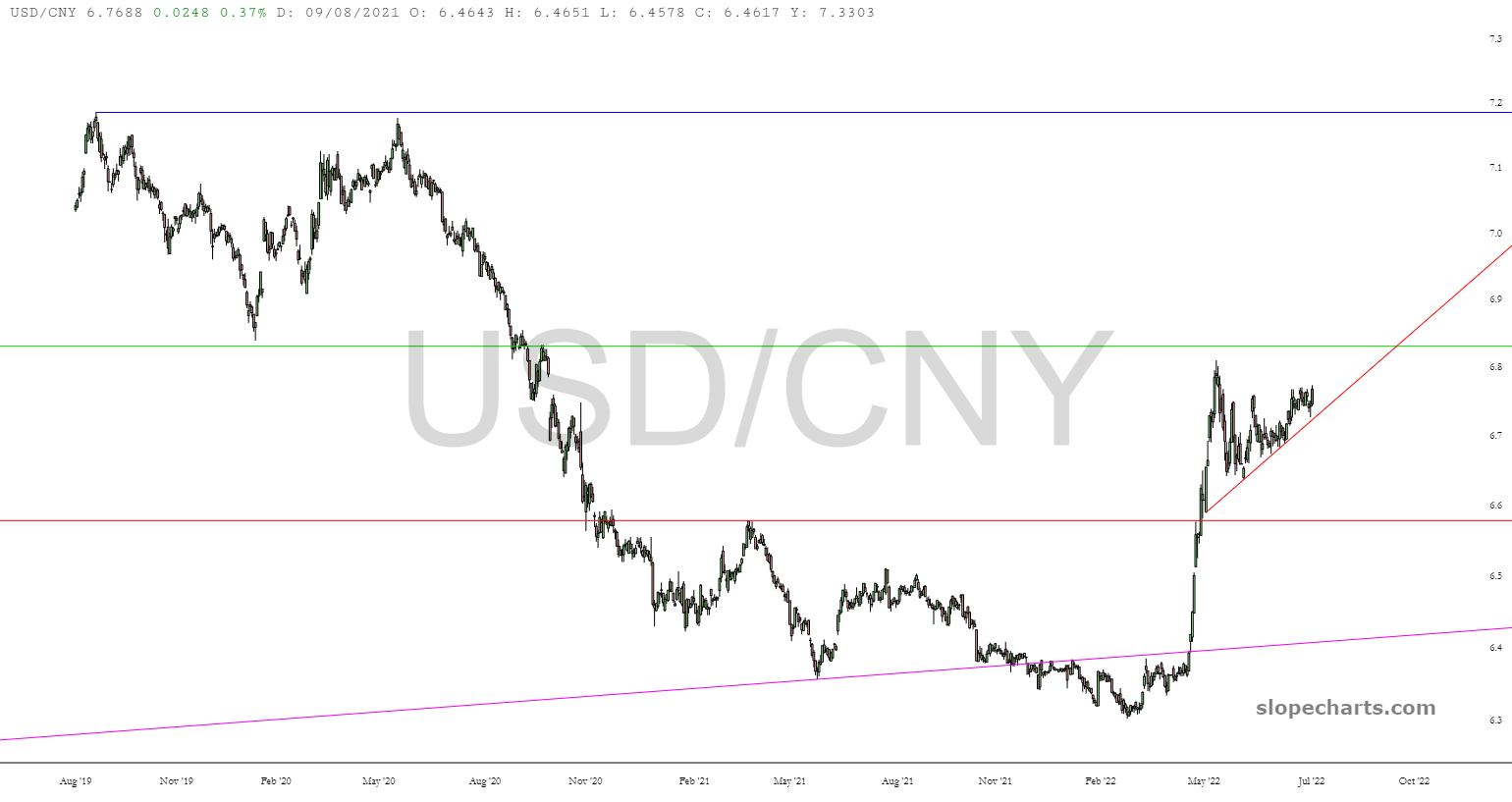
China cut its benchmark lending rate for the first time in almost two years on Monday providing support to an economy showing strain from a property slump and sporadic coronavirus virus outbreaks, the SCMP reported. The one-year loan prime rate (LPR) – on which most new and outstanding loans are based – was cut from 3.85% to 3.8% at the December fixing, while the five-year LPR – which is a reference for mortgages – remained at 4.65%, according to the People’s Bank of China (PBOC).Let me ask you a simple question. If the Federal Reserve starts cutting interest rates would you agree with all these bullish statements, or would you think the exact opposite, that more rate cuts are coming because the economy is weakening? Analysts are bizarrely bullish on China all the time. Many Wall Street analysts are paid shills at times, but I think the China analysts are paid shills all the time because saying negative things about China results in cancellation of Chinese business. Almost no one with serious business exposure in China is going to tell the truth...."The cut reinforces our view that authorities are increasingly open to cutting interest rates amid looming economic headwinds," said Xing Zhaopeng, senior China strategist at ANZ. However, he noted the decision to keep the five-year rate unchanged showed Beijing preferred "not to use the property sector to stimulate economic growth."
“[The] cut will immediately feed through to outstanding floating rate business loans and should also lead to cheaper loans for new fixed rate borrowers,” said Mark Williams, chief Asia economist at Capital Economics, who described the one-year LPR as “another modest easing step”.
“We expect a cut to the five-year LPR before long which will make mortgages slightly cheaper and help official efforts support housing demand" adding that he expects "a further 45 bp of cuts to the one-year LPR during 2022." The PBOC has already pushed banks to increase the volume of mortgage lending.
Additionally, emerging market earnings track Chinese interest rates. If rates are going down, emerging market earnings are going down as are emerging market stocks. It may be that China and emerging markets bottom first in this downturn as they have in the past. I will be keeping an eye out for that. But I'm not buying here because I think lower prices are coming.

Shanghai Securities News: President Yi, the Shanghai Composite Index fell 3.78% today. What do you think? ??Absolutely true. The percentage is a bit large compared to U.S. markets, but China should be a more volatile market.
Yi Gang: First, financial market fluctuations are affected by many factors. Today's stock market fluctuates and is mainly affected by emotions. The surrounding stock markets have also experienced a certain degree of decline. Since it is a market, there will be ups and downs. Investors should stay calm and rational.
Second, China's current economic fundamentals are good, the resilience of economic growth has increased, the total supply and demand have become more balanced, and the growth momentum has been accelerated. This year, the renminbi is one of the few currencies that have appreciated against the US dollar. Based on such economic fundamentals, China’s capital market is in a conditional and healthy development. I am full of confidence.The renminbi strengthened because of capital controls and possibly because China fears if they let the yuan depreciate as it should, the trade war will intensify. The rest is either true or narrative, depending on how you view it. China's macro economy didn't suddenly deteriorate on Tuesday.
Third, in recent years, domestic demand has driven the Chinese economy to increase. The degree of dependence on trade has dropped from 64% in 2006 to 33% last year. It is lower than the world average of 42%. The current account surplus also accounts for the proportion of GDP. In 2007, about 10% fell to 1.3% last year, and our economy’s ability to cope with external shocks has continued to increase. China is a big market with a population of more than 1.3 billion. The economic endogenous potential is huge and there are sufficient conditions and space to deal with various trade frictions.I don't like the sound of this at all. Maybe he's bad at public relations, but it is bad news when the central bank starts talking about its current account. That suggests serious concern on the part of the central bank, markets, or both.
Fourth, the People's Bank of China has always attached great importance to the impact of external shocks. We will proactively make relevant policy reserves, comprehensively use various monetary policy tools, maintain reasonable and stable liquidity, and grasp the strength and rhythm of structural deleveraging to promote The economy develops steadily and healthily, and the bottom line of systemic financial risks does not occur.Was the stock market falling because of trade fears or because of pledged stock landmines and deleveraging efforts? My tracking portfolio of Chinese stocks with heavily pledged shares fell 6.92 percent on Tuesday. How big a role trade played in the market drop on Tuesday, officials are clearly concerned about trade. And they're pushing the narrative of the strong renminbi. China has to keep the renminbi from depreciating. A rising dollar will trigger reflexivity that drives the dollar ever higher and the yuan lower, but it will also create narrative reflexivity as a falling yuan reveals weakness in China and investors turn more negative.
The 19th National Congress of the Party has made full arrangements for the next step of reform and opening up. China will continue to unswervingly deepen reforms and expand openness. Reform and opening up will benefit China and the world.


Three years after a national uproar when Chinese stocks plunged by nearly half in just over two months, traders and brokers say regulators are increasingly stepping in to influence trades and make China’s markets appear less volatile, especially during political events when Beijing wants to project stability.
The steps, aided by advanced surveillance techniques to monitor traders, include warning brokerage firms to police trades that are out of step with government wishes and phoning investors directly when they act out of line.
The intervention is becoming more common just when Chinese equities are about to be included for the first time in a global stock index. MSCI Inc., whose benchmarks many investment funds follow, is set to add more than 200 Chinese stocks to its emerging-markets index on June 1. The introduction means more foreign investors will be exposed to a Chinese market that doesn’t move purely to the dictates of supply and demand.
“Never in over 25 years of watching the Chinese markets has the state been so involved and interfering in micro issues,” said Fraser Howie, an independent analyst and author of “Privatizing China: Inside China’s Stock Markets.”


The central bank in charge of the newspaper hinted at Morgan Stanley and other international investment banks maliciously short A-share


Some investors apparently had inside information about China’s brokerage firms preparing to clamp down on margin accounts. That crackdown was credited with helping torpedo Chinese stocks Thursday.This isn't insider trading, for the same reason there isn't insider trading in currency markets: there are too many factors in play.
These investors pre-positioned for Shanghai’s stock market to decline by buying bearish put options on a major U.S. exchange-traded fund that tracks China’s stock market.
They are now counting their profits with glee. Some of the put options bought Wednesday have today nearly doubled. The investors profited by knowing that efforts to limit margin lending — investors borrow money from brokerage firms to buy stocks — would dramatically disrupt China’s stock market.
On Thursday morning at least three Chinese brokerages, including Guosen Securities Co (002736.SZ), Southwest Securities Co (600369.SS) and Changjiang Securities Co (000783.SZ) said they would tighten margin requirements.
"The brokerages are front running what the regulator wants to do," said Bernard Aw, an analyst at ING Markets in Singapore.
Haitong Securities (600837.SS) and GF Securities (000776.SZ) had made similar moves earlier in the week.
"This is no longer an individual case, but an industry-wide campaign," said Zhang Chen, analyst at Shanghai-based hedge fund Hongyi Investment. "Clearly, they got guidance from regulators, and this shows a change of government's attitude toward the margin trading business."


