2016-06-30

More Rumors of Buying Restrictions in Beijing

iFeng: 北京商住限购风声再起 一年社保或是最终版
the last two days some developers received information from Beijing government, commercial housing restriction policy final version coming soon: Requires buyers must pay social security Beijing for one year, and own no home.

This is not the first time rumors spread. Earlier, June 6, due to the illegal access both commercial and residential projects and public water, public electricity hype, Mentougou Construction Committee will temporarily stop the network to sign commercial housing, ready for commercial housing area rectify this information is the media interpreted as "commercial housing restriction coming from Mentougou start."

Since then, the rumor extended to Daxing, Shunyi and other areas. June 14, an event already developed to a climax, that time, sales of many projects have told the media: "Beijing will be at 0:00 on June 15 onwards, a full cessation of commercial and residential projects in all regions of net signed." In the absence of a state government statement, is to avoid the purchase of psychology, many developers have all night to buy a house, even the sale of real estate developers will not all go to the personal name, which is also reflected in the statistics on the month.
According to an official at the meeting, the government will not announce buying restrictions on July 1 or the rest of 2016.

China SPR Near Capacity, Oil Demand Set to Drop

ZH: Oil Bulls Beware: Crude Demand Is About To Slide As China's SPR Is "Close To Capacity"
As Bloomberg says, citing a JPM report, "one of the pillars of oil’s recovery from the lowest price in 12 years may be on the verge of crumbling."

The reason: as many speculated, a big source of China's demand in the past 5 months was Beijing's decision to stockpile oil for its SPR. However, that is now over as China is likely close to filling its strategic petroleum reserves after doubling purchases for it this year as prices plunged. JPM estimates that China's SPR demand was equivalent to approximately 1mm bpd. More importantly, stopping shipments for the reserve would wipe out about 15 percent of the country’s imports, according to the bank.
At current import rates, China's SPR would be filled by September.
Based on our base case of assuming another high SPR builds through August and the following three assumptions listed below, our model suggests a 15% mom decline in China’s crude oil net imports in September, or a loss of 1.2mmbbl versus August and 0.8mmbbl less from the 12-month average. Although it’s difficult to have an accurate forecast of the specific timing of the drop, we think it’s worth noting this risk and previous accumulation looks high based on our assessment. We do not believe the 16% growth in oil imports ytd is sustainable despite a domestic oil production decline, as demand is weak (2% expansion in oil processing with gasoline an increased risk), if inventory capacity reaches the limit.
Barring some change in the Chinese or global economy, that is more supply for the market. A further drop in oil might also cause countries such as Venezuela to send more oil to China, since they'll be out of dollars.

Does 中国 Even Exist?

Interesting look at how China is viewed from the outside, and how it relates to the battle over the South China Sea.
What if it Wasn’t “One China” vs. “Two Chinas”? What If There Was “No China”?
In my opinion the CCP views NQH in the context of a trend, supported by Japanese revisionists, Western strategists, and Indian hawks to question the existence of “ 中国” and legitimize support for separatist movements (of which the "Republic of Goetsu" is probably the least of the PRC's worries).

Of course, the outsider insistence on defining “China”--in a way that would probably have Edward Said nodding his head in rueful recognition--probably colors PRC resistance to Western efforts to question and supersede its sovereignty over another non-Han holdings: the South China Sea. The claim to the SCS, in the CCP's eyes, is not much weaker--or stronger--than the PRC's claims to any of its territories. If one is repudiated, what's the case for asserting legitimate sovereignty over the rest?

It's not just an academic issue with unpleasant implications for current affairs.

Denying the legitimacy of “ 中国” is a convenient bookend to current efforts to characterize the PRC as an enemy of the liberal order i.e. a rogue state. Not only is the government a pariah, the nation it claims to govern doesn't even exist!

It looks like a way to deny PRC sovereignty over its territorial holdings, and open the door for opposition to the PRC as an illegitimate occupier on the grounds of--take your pick-- R2P (neo-liberal flavor), struggles of national determination (liberal flavor), failed commie state that needs a healthy push into its pre-dug grave (knuckledragger).

Revisionism is alive and well as the dominant Japanese political discourse, as is questioning the PRC's legitimacy as a geopolitical stratagem (remember the "struggle of the international liberal order against authoritarian revisionism", anybody?), and encouragement of separatism as a strategic lever for the PRC's many adversaries.

"One China" may not be on its deathbed, but it's not looking that great.

One China? How about "No China"?

China Set to Change Land Sale Regulations

China passed a National Land Use Plan 2006-2020 in the prior decade, with a target for land use. Now it is planning to adjust the law in the face of another real estate bubble, but perhaps only to adjust the targets upwards such that provincial and local governments don't find themselves violating the national policy targets and running out of land to sell.
2006 land targets envisaged standing next fifteen years to use, and how "science", I guess not much science. In this era of big changes, even a people may not remember in 2006 how he envisioned in 2016 life.

Not to say that those plans would be meaningless, but that in a timely manner to the cognitive errors and deviations, and then corrected in time, it is very necessary. Than hugs then set the death figures to interfere with development of the market is better. As previously artillery shelling measure will first launch bombs, according to then-site wind speed, placement into the hair out of trajectory correction, no one will believe the initial cannonball can hit.

The country's construction land adjust how much?

After the regulations, the 2006--2020 land use for construction was set at a target of 5,317,600 hectares, this has grown to 8,796,900 hectares in 2016, an increase of 65%! (10,000 ha = 100 km2)
The chart below shows land use targets in red, and the difference from the target in gold.
With this perspective, in fact, we have the opportunity to make a more detailed analysis: for example, why Hebei increase of as much as 188%? Why Gansu is negative adjustment? Why do so many less developed areas of Jiangsu and Guangdong Guangdong belong adjusted index? For example, housing prices stagnation region is not more difficult to get a new index? ......

However, current published data is the total construction land, includes both urban and rural contains both contain urbanization also contains mining, ports, roads and railway. For example, a large number of new construction land in Xinjiang, it is unlikely the local urban and rural construction of settlements, industrial facilities, and more importantly, is "New Silk Road" related to the transportation construction. Also difficult to make more in-depth interpretation.
iFeng: 最新土地规划调整解读:政策意图何在、对房价何影响

Real Estate Expected to Cool in 2H

Fast FT: Moody’s calls peak for China home sales growth
A new report from the company on Chinese real estate suggests nationwide home sales growth has peaked, predicting the rate of growth will moderate to a single-digit speed for the 12 months ending May 2017. That would be down from 32.2 per cent year-on-year for the 12 months ended May 2016 as a favourable basis for comparison drops out and stimulus measures prove less effective.

The report also forecast the recent rise in land prices would increase margin pressures and risk for mainland property developers.
More on the Moody's report from SCMP: Soaring land prices continue to shrink developers’ margins
“The unit land costs for a number of these purchases were also close to secondary market housing prices in surrounding areas, implying an increased risk of squeezed profit margins over the next two to three years if the growth in property prices falls below developers’ expectations, ” he wrote in a new research note.
Bloomberg: Sunac Suspends Land Buying in China Auctions as Prices Surge
“We’ve suspended all bidding recently and didn’t even sign up” for auctions by local governments, Sun said at a briefing in Hefei of eastern Anhui province on Tuesday. “I feel the risk is too high,” he said without giving a time frame for the suspension, according to a transcript provided by the company.
Related: Regulators to Developers: Take the High Ground, Stop Chasing Land Prices

Bloomberg: Headwinds Loom for Hong Kong Land Amid Rising Supply, Few Takers
Builders including Sun Hung Kai Properties Ltd., the city’s largest by market capitalization, Cheung Kong Property Holdings Ltd. and Henderson Land Development Co. have been absent from the list of winning bidders for the eight parcels of land tendered by the government in the first half, as average land prices fell. They’ve been reluctant to stock up as home prices have slumped and sales of existing projects have been sluggish.
SCMP: Hong Kong sticks to land sale targets, with supply for about 9,500 units on track in six-months to September

Chinese Govt Willing To Take Yuan to Red Line in 2016


Reuters: Exclusive: China to tolerate weaker yuan, wary of trade partners' reaction - sources
China's central bank is willing to let the yuan fall to 6.8 per dollar in 2016 to support the economy, which would mean the currency matching last year's record decline of 4.5 percent, policy sources said.

The yuan is already trading at its lowest level in more than five years, so the central bank will aim to ensure a gradual decline for fear of triggering capital outflows and criticism from trading partners such as the United States, said government economists and advisers involved in regular policy discussions.

Presumptive U.S. Republican Presidential nominee Donald Trump already has China in his sights, saying on Wednesday he would label China a currency manipulator if elected in November.
China missed it's chance to devalue. The world would be better off today had the yuan declined in 2008 and underpinned a stronger recovery without the need for so much debt. China should have let the yuan devalue as soon as pressure showed up in 2011. Instead, it waited until the political mood overseas had shifted. The political window for depreciation closed; now China may face political repercussions for its currency policy. It is ironic that they escaped punishment when they were running a hard peg, and may be punished for the decisions of the free market (or maybe not if you believe in karma). Either way, the cost are rising, and when USDCNY goes through 6.80, the odds of markets taking over rises substantially.

As I wrote in early 2014 in The Logic of Strategy: Yuan Devaluation and the Road to Trade War
The protectionists are ever so slowly gaining the upper hand thanks in part to negative social mood. 2008-2009 will probably mark the peak moment for Wall Street and the Treasury Department, even though there is as yet no sign of it in Washington. Changes can be seen in the form of issues such as immigration, which has turned the grassroots of the conservative movement against the Chamber of Commerce and large corporations (due to an attack initiated by the latter against the former). This has pushed the Overton window of acceptable debate among conservatives who can now take shots at big business. There is also the growing libertarian faction pulled together by Ron Paul that supports his son, Rand Paul, that consistently attacks the Federal Reserve and Wall Street. Put it together and it is not hard to envision an anti-Wall Street, pro-manufacturing political consensus emerging. This will cut across party lines, with manufacturing unions pulling in Democratic support if there are specific bills to vote on.

...With a growing economic case against free trade, a shift in social mood making anti-free trade opinion more popular, plus the loss of political support for the financial sector, free trade will become a centerpiece issue in American politics. The trigger will be one of two factors. One is economic. China's credit bubble isn't going to slowly ride off into the sunset. There will be pain, it is only a matter of where it lands. The path of least resistance is devaluation of the yuan, something I have been looking for here for several years now due to the growth in credit. A target of ¥8 to $1 is a reasonable ballpark figure, with ¥10 to 1 not unbelievable given the rise of the shadow banking sector. The actual number isn't as important as the size of the devaluation: it will likely be large and set off the anti-China arguments that have been growing in the United States. The left and right have their beef with China's economic policies and the right has provided the main rhetorical cover for business. When that goes, there will be a bipartisan push for policies that counteract China's "predatory" currency policies. A Chinese devaluation could be the trigger.

The second factor is geopolitical. Do take the time to read the lengthy review linked above, and/or watch the video. Luttwak's main point is that China cannot simultaneously build up its economy and influence at the same time it builds up its military, and not run into resistance from surrounding states. He cites the Chinese policy on the island disputes as the case in point: instead of increasing China's power in the region, it has pushed Vietnam, the Philippines, Japan and Indonesia into the arms of the United States. An anti-China coalition is building up due to each nation following the logic of China's inevitable rise in power along with the perception of an increasingly aggressive China. China has "tipped its hand" so to speak and these nations are moving preemptively. Due to the nuclear arsenal of the United States and China (to say nothing of Russia's interest in the region), there isn't going to be a major war for survival. This reduces the options for confrontation, with one of the most powerful being economic. If there is a minor military confrontation that is too large to be ignored, the most politically acceptable response will be economic.

Either the economic or the geopolitical event can happen first then, but in time, the two will be seen as inseparable. Once events move in this direction, the logic to continue down the path is compelling.
It doesn't matter who wins the presidential election. Logic and the inevitability of market forces are carrying events forward now.

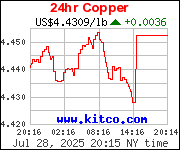
Double Top or Cup in Search of Handle

6 of Top 8 Steel Provinces Increase Production in 2016

Bureau of Statistics data show that from January to May of steel production in the country over a thousand tons provinces, crude steel production in Hebei, Jiangsu, Shandong, Henan, Hubei and Anhui were 83,522,700 tons, 45,909,800 tons, 29,196,300 tons, 1218.21 tons, 12.28 million tons and 10.2367 million tons, compared with last year's average rose a certain extent.

..."Since last year, annual production capacity of nearly 100 million tons has been recovered, and most of the enterprises that shut down have resumed production."

He believes that the core is to rely on the market to regulate business losses and give no support, the enterprise will automatically cut production. "At present, the overall demand for steel has reached a saturation point. After steel production accelerated, market prices will fall. At that time, a lot of loss making business needs to be closed, especially zombie companies."
iFeng: 钢铁去产能有多难:八个产钢大省五个不降反升(名单)