


![[Most Recent Quotes from www.kitco.com]](https://lh3.googleusercontent.com/blogger_img_proxy/AEn0k_uR4fzdje74Wf9NFSGpIwMsercdloA5yqtdN0KU2uumpL5zMf-8MLNq27WAMP83r5EH04RD9UsjuBYQSj-n83KC374IHZvbvCGHu2rohRXHqqouYntk-JEPr3Q=s0-d)
|


Bloomberg: China’s Pledge to Lift Consumption Sparks Debate on Cash Handouts
iFeng: 利好来了!公积金贷款利率下调


We have noticed some fluctuations in the financial market recently, which are mainly affected by investors' expectations and sentiments. At present, our country's economic fundamentals are sound, the potential for endogenous economic growth is huge, and substantial progress has been made in preventing and defusing financial risks. The financial system implements the decisions and arrangements of the CPC Central Committee and the State Council, coordinates epidemic prevention and control and economic and social development, supports logistics smoothness and promotes the stability of industrial and supply chains, and minimizes the impact of the epidemic on economic and social development. In accordance with the principles of marketization, rule of law, and internationalization, steadily advance and complete the rectification work of large platform companies as soon as possible, and promote the healthy development of the platform economy. The People's Bank of China will increase support for the real economy with a prudent monetary policy, especially to support industries severely affected by the epidemic, small, medium and micro enterprises, and individual industrial and commercial households, support agricultural production and energy supply and increase supply, and launch technological innovation and re-lending and inclusive benefits. Special re-loans for the elderly, an increase of 100 billion yuan in re-loans to support the development and use of coal and enhancement of energy storage, increased re-loans to support agriculture and small businesses and special re-loans for civil aviation, maintain a reasonable and sufficient liquidity, promote the healthy and stable development of the financial market, and create a good currency financial environment.Boilerplate. The point isn't what they said, it's that they said anything at all.
Elsewhere, the familiar "don't worry, please keep buying" message for the holders along with "where's the bottom?" for the nervous bulls.
iFeng: 李大霄:跌破3000点不是世界末日 恒指率先见底的希望最大
On April 25, the three major A-share stock indexes opened lower and moved lower. In the afternoon, the Shanghai Index fell below 3,000 points intraday. After 21 months, it returned to the "2" stock index and the ChiNext index fell by more than 3% intraday.Li Daxiao is like the Jim Cramer of China:In this regard, Li Daxiao said that falling below 3,000 points is not the end of the world. When the market is rising, there will also be periods of adjustment.
He believes that policies to stabilize growth are being introduced one after another, and the market reaction will be reflected later. Therefore, we should not be overly pessimistic about the market, do a good job of responding, change from offense to defense, choose equity products that match our risk tolerance, and calmly respond to market fluctuations. At the same time, don't lose faith in good stocks, avoid stocks with high valuations, and be careful with leverage.
Li Daxiao said that the Hang Seng Index is currently the most hopeful for the market to bottom out, and the second is the Shanghai Stock Exchange 50. When conditions are ripe in the future, A-shares may rebound with good stocks as the main force. With the stabilization of the economy and the intensification of steady growth, stocks related to steady growth will return to their proper value.
Li Daxiao’s share tips attract hundreds of thousands of views within hours of appearing on Chinese social media. The celebrity stock guru, who posts short, quirky online videos, is known to move markets when China’s army of retail investors follow his advice.iFeng: A股跌破3000点何时触底?孙建波:高估值压力已基本解除 长期建仓机会显现But Mr Li’s unshakeably optimistic outlook on Chinese equities has prompted scrutiny from authorities and a public backlash following the market rout caused by the coronavirus outbreak, with some investors blaming the star stock picker for their losses.
In one particularly ill-timed call, Mr Li in mid-February insisted the Chinese market was on the brink of a bull run, just days before stocks plummeted. Last year, his forecast that the Shanghai Composite index would hold above 3,000 points was repeatedly proved wrong as the US-China trade war whipsawed the market.
n April 25, the three major A-share stock indexes opened lower and moved lower, and the Shanghai index fell below 3,000 points, the lowest since July 2020. As of press time, the Shanghai Composite Index, Shenzhen Component Index, and ChiNext Index all fell by more than 3%, and more than 4,400 stocks fell.Coronavirus is a big distraction for the world. The virus is real, but the overreaction allowed for a 2-year life extension on a bull market headed for the end. It is also now covering up weakness in China. As I've put it before, losing all the gains since March 2020 only gets the bear market to the starting line. All the damage from inflation and supply chains will make the ensuing bear market and recession far worse than it would have been otherwise. China is in the same boat as everyone else, and in worse shape with a currency that needs propping with falling reserves.Regarding the sharp drop in A-shares today, Sun Jianbo, chief economist of China Reading Capital, told Phoenix.com Finance that on the one hand, since the fourth quarter of 2021, the valuation of track stocks and high-valued white horses has been challenged. This challenge requires individual stocks to return to normal valuations.
On the other hand, Sun Jianbo believes that when the market falls below 3,000 points, the pressure of high valuation has basically been relieved, but for the market outlook, Sun Jianbo believes that it may further decline, and the reason is the decline. Panic inertia superimposes the current confusing economic environment.
As for where the "bottom" is, Sun Jianbo predicts that it may continue to drop to around 2700, and then there is a high probability that it will stop falling and stabilize. At the same time, Sun Jianbo pointed out that panic declines are often opportunities for long-term positions. He suggested that you should look for industries and companies with better growth in the next 3-5 years, and "build positions at lower prices during a panic decline.

China's securities watchdog has tightened scrutiny on a popular derivative product dubbed Snowball, three sources told Reuters, as regulators seek to rein in risks in an opaque, $60 billion market.Pennies in front of the steamroller: selling volatility.Snowball, which offers a risky bet on stock market volatility and delivers double-digit, annualised returns barring a market tumble, has gained popularity among yield-hungry investors.
"Snowball products are often marketed as a type of fixed-income products, and investors are not fully aware of the risks. This worries regulators," a source said.Here we go.
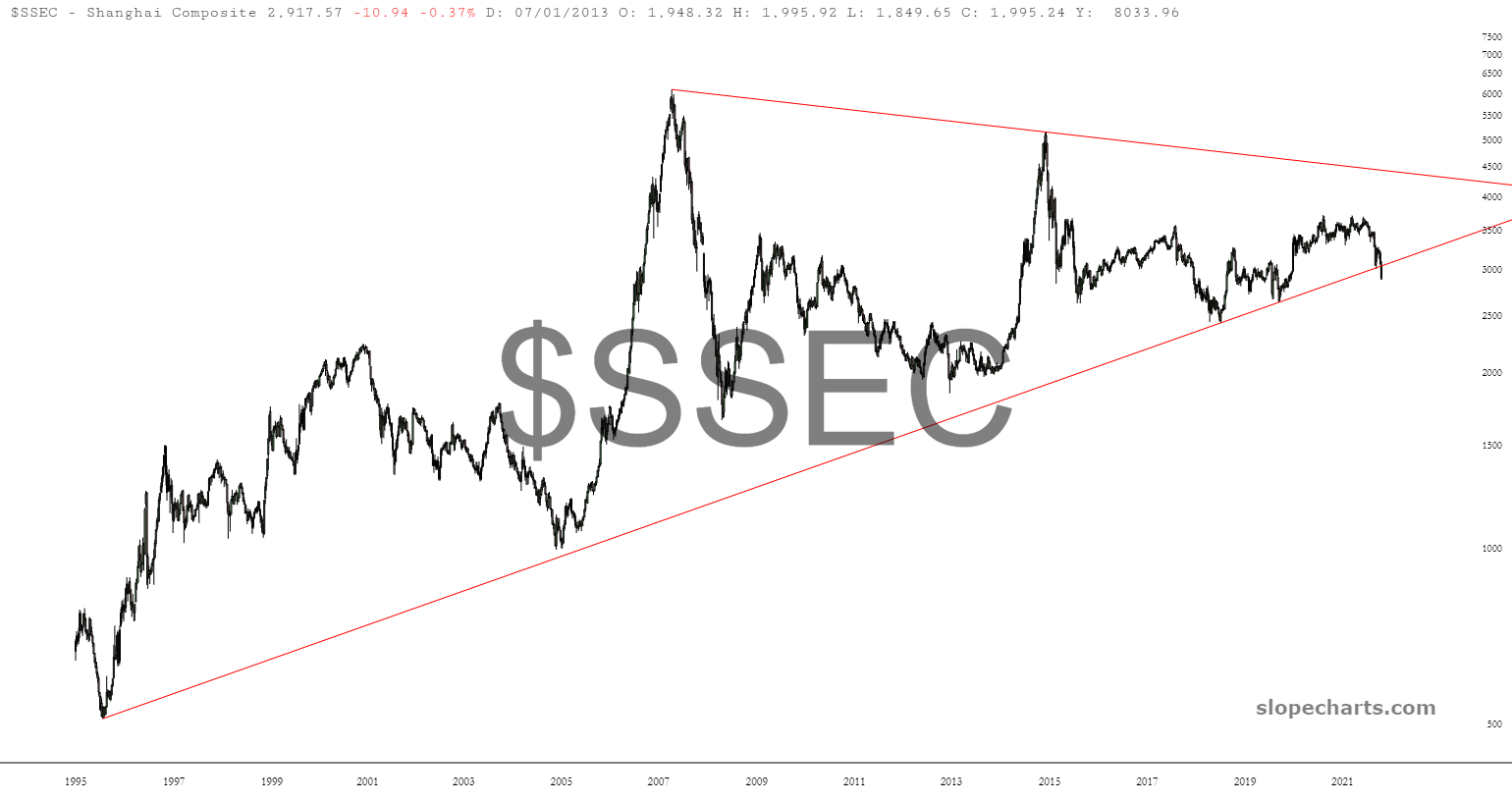
Some rival products offer annualised returns of as high as 20%. The benchmark Shanghai Composite Index SSEC. has gained 1.49% so far this year.About that: not quite a bear yet, down 15-percent from the recent high to the recent low. Do you want to bet on that trendline holding though?"You make money in a volatile market. You make money in a bullish market. But if you buy the product at the start of a bear market, you lose," Wang Yichao, managing director of Guotai Yuanxin Asset Management Co, told a roadshow on Snowball on Thursday.

"Recently, the sales of Snowball products are normal. The index snowball at the retail end has not been knocked-in in a concentrated manner. There is still a lot of room for the knock-in line. The possibility of the index falling sharply at this position is relatively low, so we I think the overall risk is still controllable." A person from the innovative finance department of a large securities firm in Shanghai told a Chinese reporter from a brokerage firm.Another article: 雪球产品被传“爆炸”,是否该为市场急跌“背锅”?Another brokerage sales person said that there is no special response from customers to Snowball products at present, and the company is also continuing to issue Snowball products.
"I have heard some unfriendly remarks, but those are all speculations of people in the non-derivatives industry. In fact, derivatives play a role in calming fluctuations in the market." said a derivatives person at a brokerage.
"Because the snowballs that open at the high point are basically 12 to 24 months in duration, the probability that the index will not rebound for such a long time in the future is very small, so as long as customers have a certain amount of patience, they can also get the set price at the beginning of the period. Profitable. Of course, I personally think that this kind of knock-in situation is basically difficult to occur, and it is an extremely unlikely event." The above-mentioned person explained.
A market source said that it is not appropriate to over-beautify snowball products, but it is also not appropriate to demonize them. Snowball structure products have certain risks, which mainly depend on the accuracy of investors' prediction of the market. According to him, there are two main types of risks in snowball structure products: one is the risk of knock-in caused by falling market prices, that is, the risk of principal loss; After the Snowball product was knocked out in advance, it was difficult to find the risk of assets with higher yields.
2. Has the index plummeted snowballed "because of the blame"?Maybe the "snowball derivatives" won't all melt to zero in a bear market. Or maybe they will, but won't cause major knock on damage. At the very least however, they show the type of reckless risk-taking that is found at speculative tops. My bet is that trendline on the Shanghai Composite won't hold.An asset manager of a brokerage firm in East China said that the reason cannot be attributed to a certain type of product, the scale of derivatives will not be very large, and the impact of snowball on the market will not be so great.
Yu Mingming, chief of the gold working group of Cinda Securities and deputy general manager of the research institute, pointed out in previous research that Snowball is not a beast. Acting on the convergence of the stock index futures discount rate will not have a significant impact on the direction of the index.
Mr. Jia, who is engaged in market work in the financial leasing industry, often comes into contact with options in his work, and has also been concerned about Xueqiu products for a long time. He analyzed that: "Look at Xueqiu's contract and know that if you type in, the product will be a fixed income product. It has become a futures index product that rises and falls with the index.”
In his understanding, the knock-in means that the over-the-counter put option has been exercised, and the product itself has no leverage.
Specifically, it is inevitable that the most important Greek letter of Snowball products - Delta.
According to Yu Mingming's analysis, Delta is the change between the product price and the underlying price. For ordinary vanilla options, the delta range is between [-1, 1], but exotic options no longer follow this principle. The figure below shows the Delta of the snowball structure. Distribution chart, in which the horizontal axis is the percentage of the underlying price, and the vertical axis is the delta value. As can be seen from the figure, when the underlying price is near the knock-in boundary of 0.85, the delta is the largest, about 1.6, and as the underlying price rises, the delta Rapid decline, when the underlying price exceeds the knockout boundary of 1.03, the Delta tends to 0, and the price of the snowball is no longer sensitive to the underlying price.

Bonds issued by heavily indebted developer China Evergrande Group plunged on Monday on growing investor worries over the company's ability to pay its debts, prompting China's stock exchanges to halt trading.Sanya implements price controls on real estate: no price hikes for 1 year. iFeng: 楼市大降温!三亚出手了:商品房备案价格1年内不得上调 影响有多大?The Shanghai Stock Exchange said in a statement that it had temporarily suspended trading in China Evergrande Group's 6.98% July 2022 corporate bond following "abnormal fluctuations." The exchange had also suspended trading in the bond on Friday.
It is reported that the "Notice" proposes that for projects that have been filed before September 1, 2021, the prices of unsigned properties must be re-filed, and the overall average filed price shall not exceed the recent online price of the project. For commercial housing projects that have been approved for price filing, in principle, the filing price cannot be raised within one year.East Money: A股罕见万亿成交背后:炒楼资金悄然“转场”股市Experts interviewed by China Securities Journalists believe that "hands-on" sales price filing is an important means of controlling housing prices. The price increase channels of commercial housing are basically restricted through controlling price filing, which will help reduce false fires in the property market and return the market to stability.
On September 1, the Securities Times reported that the client margin of a leading brokerage firm suddenly increased by nearly 5%. In the past four trading days, the increase was nearly 10%, which aroused widespread concern in the market. (For details, please poke: The margin of top brokerage clients has soared, and the super market is coming? 1.7 trillion funds are surging, and the popular track has plummeted. ) Behind the soaring margin is the sudden increase in hot money in the market. According to the analysis It is believed that there are three sources of hot money, namely the primary market and the bank.Financial management , and the most important source-the property market.Back in April 2014, with the taper underway for 4 months: Rumored Mass Death of Companies in Xiaoshan District of Hangzhou If Banks Collect on Debts; Government Tells Banks to Sit Tight or Leave. By October, Liaoning's economy was going down the tubes: Liaoning Sounds Warning on Chinese Economy. Coincidentally, the Chinese government was engineering a stock market bubble that would blow up in May 2015. In August 2015, the central bank gave up defending the yuan and let it depreciate.Why do property market funds flow into the stock market? What is the scale? How sustainable...With these questions, we visited.
"A lot of millions of dollars around me have entered the market"
"The property market capital flows into the stock market situation does exist, around me a lot of one million of the funds are coming onto." Laolv is a veteran real estate investors, too many sets of real estate operations in Shenzhen for 20 years, currently quite good assets He told reporters that many of his friends who originally invested in real estate have entered the stock market this year.
History doesn't repeat, but it does rhyme. The wheels are wobbling on China's economy and the Federal Reserve hasn't even announced its taper yet, let alone started it. China has all but banned reporting bad news about the economy.
Embrace the fog of information war. Ursus Major rises.


In the absence of any abnormalities in the fundamentals, why are investors in the secondary market suddenly strangled by the "slaughter plate"? The CBN investigation found that the flash crash of the Shanghai-Nanjing stocks was directly related to the hot money of the Fujian-based brokerage business department. Since March 17, Shanghai-Nanjing shares have been on the Dragon and Tiger list four times, and the corresponding 20 trading seats with the largest selling amount, mostly from the brokerage department of Fujian, accounted for 19, of which the sales disclosed in the past three trading days The top five seats were all seats in the business department of Fujian brokerage firms. During the period, the accumulated sales amount reached more than 246 million yuan.Behind the concentrated sell-off of Fujian brokerage seats, a number of Fujianese shareholders of Shanghai-Nanjing shares have also begun to surface. As of the end of September last year, a private equity institution named Fujian Chengyi Asset Management Co., Ltd. (hereinafter referred to as "Chengyi Assets") held a total of 3.11 million shares of Shanghai-Nanjing shares, and many of its natural-person shareholders also existed with the business department of Fujian securities firms. Intersection.
From the perspective of transaction distribution, from March 17th to 30th, the sales department seats of the Shanghai-Nanjing shares were sold in a high degree of overlap with the accounts of the securities companies held by these shareholders. For example, the sales department of Dongxing Securities has appeared in the top five of the stock’s Long and Tigers list ten times during the period, and the cumulative sales amount has exceeded 130 million yuan. The accounts of Chengyi Assets and several other shareholders are all from Dongxing Securities. .
For a long time, Shanghai-Nanjing Co., Ltd. has few public offerings, insurance funds and other institutions holding shares, while private placements and hot money have frequently entered and exited. At the end of the first quarter of last year, the company's top ten shareholders of tradable shares were all natural persons, and there has been no major change since then. Almost all of the shares held by these natural persons are leveraged by the two securities companies.
From the end of 2019 to before the flash crash, the stock price of Shanghai-Nanjing Co., Ltd. had risen by more than 2.5 times. In 2020, individual shareholders of the company were sued in court for private loan disputes. These private equity and natural person shareholders concentrated on liquidating their positions. Is the capital chain broken or is it profitable?


