


![[Most Recent Quotes from www.kitco.com]](https://lh3.googleusercontent.com/blogger_img_proxy/AEn0k_tGYIqnukihaRXtL7HWFJGKOapLTcLIaWutTJWPseaG554T1ZEiJ9QBRQkTvRDALoURuuHXJSnb7kUy7hdhXBLmEraaPSzSB6v1-eJfk9ePi9DvqeXF55yJKCc=s0-d)
|


Almost everyone in the precious metals space knows the Exeter pyramid. Most investors have heard the term hard money. A "strong" pyramid would be one where all money is a derivative of the money below it (higher order) on the pyramid. Similar to the idea of fractional reserve lending. Bubbles collapse, credit is destroyed as wealth tries to escape into more secure, stable, higher order money.
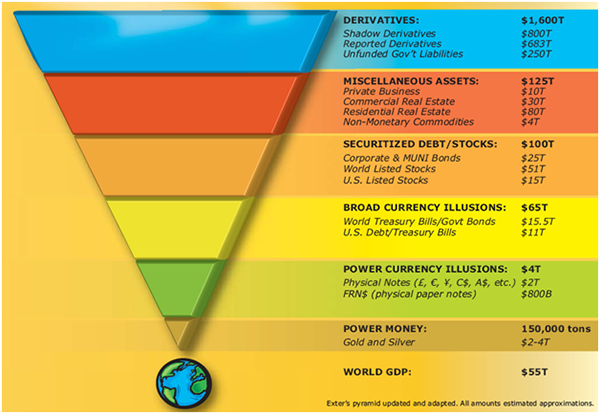
A "weak" interpretation of the pyramid says lower forms of money can be created ex nihilo, like cryptocurrency. There are higher and lower forms of money, but they aren't linked and its not necessarily clear which money in higher or lower based on its form alone. Example, fiat currency. Look at the list of existential hyperinflations and there is a recurring theme: the country or government issuing the fiat is facing or faced an existential threat such as war, foreign occupation after a war, lost a war, engaged in civil war and so on. Or the government engages in mass destruction and expropriation of wealth, such as communist governments (Venezuela the most recent example) or for other reasons (Zimbabwe's genocidal war on white farmers). Other fiat is more secure because the government still exists. All the currencies are fiat, but they have wildly different valuations. Some fiat may be superior to other assets. Would you prefer to hold a gold certificate from the Zimbabwe government or a Canadian government bond?
When Greece faced its sovereign debt crisis about a decade ago, the long-term government bonds didn't drop nearly as much as short-term bonds. It was believed Greece could not pay back its creditors today, but nobody thought Greece wouldn't exist in 10 or 20 years. Extreme hyperinflation is existential: the existence of the fiat issuing entity is called into down. Extreme hyperinflation is the nation-state version of the Bear Stearns and Lehman bankruptcies.
Now consider the stock market. What is the value of a company? In the marketplace, it is the last transaction multiplied across all the shares. What is that valuation though? It is a shared delusion once it exits from a cheap fundamental valuation. At some low price, someone could buy the whole company, finance the debt with cash flow and never have to re-IPO the company. Beyond a certain price, the valuation becomes ephemeral. It is based on the current risk appetite. Did Netflix and Facebook lose billions upon billions of dollars this year? No. The shared delusion that is their valuation collapsed towards fundamental value.
Bonds have a clear valuation because there is a known cash flow. However, the rate of interest and the value of capital itself can exist outside of this calculation. If suddenly people fear lending or refuse to lend at current rates of interest, all existing bonds are devalued. Holding a bond until maturity may produce no paper loss, but inflation could destroy the value of the money by the time it is return.
Which brings me to money heaven. Consider this example. Someone owns Netflix at $300 per share. They've owned it for a long-time and their risk tolerance is declining. Bonds are falling in price and a 5-percent yield on mortgage bonds looks good. They sell their Netflix and buy a mortgage bond. Money flows out of stocks and into bonds.
A quick look at the chart tells us both stocks and bonds are falling in 2022. Paper wealth can escape from stocks into bonds at the same time both keep falling in price. Only when the market rate of interest balances all the factors of inflation, risk appetite and so on, will bond prices stabilize.
Where is Czechoslovakia? Where is Yugoslavia? They still exist as a concept, but not one with any currency (pun intended).
No country wants reserve status and no fiat currency can take the place of the U.S. dollar.
The U.S. dollar supply expands with credit growth, it is the base of inflation.
If the world is rapidly inflating with credit growth, USD should fall. The dollar normally falls during economic booms for this reason. Nearly everyone wants a weaker dollar.
Most countries inflate against USD.
To get an isolated crash in USD where it collapses far more than foreign currencies requires removing the US economy from the world, via civil war or something similarly disastrous like a communist revolution.
In conclusion, falling USD is the system working as intended. A dollar-centric crash is highly unlikely. If the dollar implodes, all fiat implodes with it. The system survives, one could imagine all exchange rates stay constant, but all fiat is now worth far less compared to gold, oil and so on.
To destroy up the system requires breaking it. Extinguishing credit money and making USD fail to function.
Rising USD causes credit defaults and devaluations of foreign currencies. No govt wants this.
Devaluation wipes out foreign debts, cleans the balance sheet of non-USD economies.
If USD is still rising, defaulted countries must issue debt in local currency or some alternative money.
Default in one nation creates contagion that spreads to more nations.
The euro is an artificial currency with no national backing. The yen has inflated credit more than any developed nation on Earth.
China's financial system requires U.S. dollars and it has inflated as much as the US relative to the economy. It has a closed capital account to keep the currency from collapsing.
The path to the dollar losing reserve status flows from a deflationary collapse that wipes out Japan, Europe and China's credit bubbles.
These nations would be "freed" from the dollar at that point if they wish.
The US would become the most indebted nation in the world, with an unsustainably high currency. It could not afford to bailout Japan, China or Europe even if it wanted to.
The US economy would collapse along with the world economy.
At this moment, the U.S. will either let a 1930s-style deflation wipe out the debt, saving the dollar as a currency, or it would actually press CTRL-P. Not swap debt for debt like with QE, and not issue treasuries, but instead the U.S. Treasury would bypass the Fed, directly print fiat dollars into the economy and reflate the system.
The path to a collapsed dollar goes through DXY 140 or maybe 160 or higher. The higher DXY goes, the more likely and more spectacular the ensuing inflation/collapse. DXY 120 would probably constitute a near miss that causes a bigger panic than 2008 and bear market on par with at least the doctom bust of the early 2000s.
Almost everyone in the world is on the wrong side of this trade. They don't believe it can happen or don't expect it will happen, or they are too large. A billionaire cannot preserve their wealth, only their assets. Maybe Bill Gates understands because he's been buying up farmland. Wealth based on numbers will evaporate. Wealth measured in physical capital: farmland, oil wells, factories and so on, they will retain relative value in the transition. Gold and crypto are there for preserving some "number" wealth during the transition. The wealth gap will close because poor people with nothing will still have nothing, but everyone counting wealth in digits, in things like stocks, bonds and so on, will see their wealth converge with zero.
This is an extreme outcome if a series of events keep triggering. A lot of dominos have to fall in the same direction. China housing bubble has to burst for example, something they've avoided several times the past decade. Even if all these dominos start falling, the trend can be aborted at any time by governments doing good things and more likely, doing bad things. Wars could halt the deflation and cause inflation. But this process is getting started again and knowing how these dominos fall will keep investors one step ahead of what will largely be clueless competition. Most investors do not think any of this is possible. They think dollar devaluation is inevitable.
Even if all that happens is another mini-cycle like 2014-2016 and 2018 kicks off, most are wrong footed. Stocks will crumble, bonds rally. Things like gold and crypto fail in lower order versions of these events and then experience explosive rises in extreme, system-breaking scenarios. Crypto is far more vulnerable to losses than gold, a reflection of its speculative rise. If all that happens is a bear market, cryptos and NFTs could lose 90 to 100 percent of their value.

What's the next move from here? Will the Fed and the government begin an inflation so horrible that it has led to the rise of dictators? Or will they decide letting financial markets suffer a 50 percent haircut is a better option? The odds of the latter decrease the more incomptent the ruling class becomes. Baizuo are still openly pushing for more stimulus for example, revealing they have no concept of reality. They are the adult version of 6-year old kids who jump off the roof because they saw Superman fly on TV.

ZH: "We Are Hungry" - Violent Protests Erupt As Lebanon 'Hyperinflation' Accelerates
Despite the government’s attempt to crack down on illicit trading, Lebanon's currency collapse has accelerated and with it the economy and people's living standards. It appears the Lebanese people have had enough, and widespread protests pose the biggest threat to the nation's stability since the 1975-1990 civil war...If there is severe chaos in major American cities this summer, borderline civil war/urban chaos with body counts running into the hundreds by the day, then maybe we'll be talking about a tumbling dollar this summer. Otherwise, the fires are starting overseas and will slowly burn towards the core. The migrants already coming are nothing compared to what's coming if foreign currencies collapse and starving armed hordes pour across open borders. If you haven't prepared necessities and defense, and don't have an exit plan in a city (get out before the roads are jammed and public transit shuts), there's not much time to prepare. Democrats will pass gun control to prevent gun buying, ammo is already hard to come by. The missing items during the lockdowns will continue even with no lockdowns because inflation distorts consumer and producer behavior, such as preppers buying 1 year supply. Everyone starts hoarding ahead of and during inflation because it's one of the ways to preserve purchasing power.

It also means that Turkey is doing its best to burn bridges with all foreign investors, both bulls and bears, which for a country that for the past decade has been entirely reliant on outside capital inflows, could spell a death sentence.
Meanwhile, unable to express their negative views on the economy via the currency - for now - Turkey bears have found a different way of betting on a Turkish economy implosion, namely Credit Default Swap, which soared to 454bps on Tuesday, a 40bps spike, and the highest since last summer's crisis.
Of course, Eedogan's vendetta against the shorts, and the elimination of virtually all liquidity just to force an FX squeeze, means that the broader economic slowdown and raging inflation, which is the true reason behind Turkey's simmering crisis, is about to get much worse. Meanwhile, with local banks burning through reserves to defend the currency on the front-end, and with shorts no longer present, it is only a matter of time before the currency collapses once more, only this time driven not by a flood of shorts but as longs capitulate ahead of what increasingly looks like another Turkish crisis.
PC: How did being in Venezuela compare to what you were seeing in Western media?Hey, look how effective these authoritarians are at cleaning up the streets!
Carolina Graterol (CG): I am a journalist, I have family in Venezuela, and I knew the reality was very different from what the media is portraying, but still I was surprised. The first thing we noticed was the lack of poverty. Alan wanted to film homeless and poor people on the streets. I saw three people sleeping rough just this morning in London, but in Venezuela, we couldn’t find any, in big cities or towns. We wanted to interview them, but we couldn’t find them. It is because of multi disciplinary programmes run by the government, with social services working to get children off the streets, or returned to their families. The programme has been going on for a long time but I hadn’t realized how effective it was.
PC: Alan, what surprised you?Again, the authoritarian government supposedly has the streets safer than we've heard, but the economy is so bad that even the criminals have emigrated.
AG: We have to be realistic. Things look worn down and tired. There is food, there are private restaurants and cafes open, and you could feel the economic crisis kicking in but poverty is not as bad as what I’ve seen in Brazil or Colombia, where there are lots of street children. Venezuela doesn’t seem to have a homeless problem, and the favelas have running water and electricity. The extreme poverty didn’t seem as bad as in other South American countries. People told me before going I should be worried about crime, but we worked with a lady from El Salvador, and she said Venezuela was easy compared to her country, where there are security guards with machine guns outside coffee shops. They also say a lot of Venezuelan criminals left as there’s not that much to rob, with better pickings in Argentina, Chile or wherever.
PC: How have the US sanctions impacted Venezuelans?Leftists will never learn, or if they do, they cease being leftists. Anyone with a basic understanding of economics predicted doom and hyperinflation for Venezuela long before any sanctions showed up. Now that the U.S. is starting to pressure them, progressives and leftists are blaming nearly 2 decades of economic mismanagement on the United States. It's as it ever was, going back to the Cold War. If you give these people power, they will destroy your country and salt the Earth. They will never admit or understand why they are solely responsible for the destruction, instead they will always blame some third party. The response to failure will always be more socialism and repressive crackdowns on the remaining "capitalists" or whoever is the regime enemy of the day.
CG: Food is expensive, but people are buying things, even at ten times their salary. Due to inflation, you have to make multiple card payments as the machine wouldn’t take such a high transaction all at once. The government has created a system, Local Committees for Production and Supply (known by its Spanish acronym CLAP) that feeds people, 6 million families, every month via a box of food. The idea of the government was to bypass private distribution networks, hoarding and scarcity. Our assistant was from a middle class area in Caracas, and she was the only Chavista there, but people got together and created a CLAP system, with the box containing 19 products. Unless you have a huge salary, or money from outside, you have to use other ways to feed yourself. People’s larders were full, as they started building up supplies for emergencies. People have lost weight, I reckon many adults 10 to 15 kilos. Last time I was in Venezuela three years ago, I found a lot of obese people, like in the US, due to excessive eating, but this time people were a good size, and nobody is dying from hunger or malnutrition.
PC: So what are Venezuelans eating?
CG: A vegetarian diet. People apologized as they couldn’t offer us meat, instead vegetables, lentils, and black beans. So everyone has been forced to have a vegetarian diet, and maybe the main complaint was that people couldn’t eat meat like they used to do. The situation is not that serious. Before Hugo Chavez came to power, Venezuela had 40% critical poverty out of 80% poverty, but that rate went down to 27%, and before the crisis was just 6 or 7% critical poverty. Everyone is receiving help from the government.
PC: So food is the main concern?
CG: The real attack on the economy is on food. When you have hyperinflation everything goes up in price, but food has become the main source of spending because this is the variable going up in price at exorbitant levels. Bills like water, electricity, public transport haven’t gone up that much and represent a small percentage of any family spending. This is why the distortions in the economy are not intrinsic, but caused by external factors, otherwise everything should have gone up, no matter what it is.
Specifically, economists polled by Argentina’s central bank increased their end-2019 inflation expectations to 31.9% from 29%, according to the institution’s February survey.The inflation is always there. What's driving it higher is the stronger U.S. dollar. Last year, the Argentine peso began its collapse right after China implemented its RRR-cut and the subsequent U.S. dollar rally it ignited. Once again, Argentina is the canary in the fiat mine.

The mainland Chinese city of Guangzhou, one of the country’s largest, further eased housing restrictions on Monday, five days after it scrapped a ban on sales of apartments to individuals.The December 70-city NBS report is out and it shows home prices rose 3 percent in Guangzhou last month, before the easing restrictions kicked in. As I wrote a few weeks ago, Chinese policymakers are trapped because increased credit growth will be like a match to gasoline in the housing market.
The city authorities said in a document that Guangzhou residents who had paid towards a housing provident fund policy could withdraw money for buying homes for living in nearby cities such as Foshan and Dongguan.
The prices of new homes rose by 0.77 per cent last month across 70 cities monitored by the government, according to Bloomberg’s calculation of data released by the National Bureau of Statistics. This was slower than the 0.98-per cent gain in November, and was the slowest clip since April 2018.This is slower growth, but it is not slow enough for policy easing, particularly in the credit market.
“The continuous slowdown in prices suggests that some developers are cutting the prices of newly launched projects to boost year-end sales,” said Yan Yuejin, research director at E-House China R&D Institute.
Compared with the new home market, the price control of second-hand houses is relatively loose, and in many hot cities, second-hand house transactions have accounted for more than half of the market. The industry generally believes that the change in second-hand housing prices is more reflective of market trends.The real value of the renminbi for Chinese citizens is how much house it can buy. What will be the value in the yuan if a stimulus program causes Chinese homes to jump another 50 or 100 percent in price?
Some institutions believe that the reality of the decline in second-hand housing prices in 22 cities indicates that housing prices are moving toward a downward turning point. But this view is controversial. The Shell Research Institute pointed out that the just-needed groups that are more sensitive to price are choosing to enter the market after the price stabilizes, and more and more owners also choose to raise the price. These leading indicators mean that there is limited room for future prices to continue to fall.
Zhongxin Jingwei client August 15 (Luo Huanlin) Before entering the Beijing Film Academy officially, the graduate student Qi Ming needs to find the house first.
In mid-August 2017, at this time last year, he and his friends shared a 60-square-meter two-bedroom house in Jiandemen. The house is the landlord who is contacted by the intermediary, and the monthly rent is 6,500 yuan.
In mid-August of 2018, You Qiming finally succeeded in finding a new residence, which is also a 60-square-meter two-bedroom, this time also 6500 yuan per month. But the difference is that he originally went to Beijing Film Academy and only needed to ride 3 kilometers, which took less than 15 minutes. Now it takes at least 1 hour to get to the school by subway. The small two houses around BFA have generally risen to 7500 per month. Above that, he can't afford it.
Beijing rents top in the country
The excuse of You Qiming is not an example. According to a report compiled by the Shell Research Institute from the Real Data database, Beijing has taken the lead in a number of housing rental data. In the first half of 2018, the absolute value of rent in Beijing reached 76.1 yuan per square meter per month, while the second place in Shenzhen was only 68.8 yuan per square meter per month.
Beijing's rental income ratio reached 29.81%, and the total rent was as high as 137.63 billion yuan. Compared with this, although Hangzhou surpasses Beijing in the per capita annual rent to reach 16,375 yuan, the total rent is only 38.67 billion yuan. The Beijing housing leasing market is huge and the price is high, basically forming other cities in the country. "The situation."

Similarly, Yu Qiming issued a sigh of "prices all the way" and there is data to support it. According to a report compiled by the Shell Research Institute from the Real Data database, the average rent for rents from August 6 to 12, 2018 was sampled, and the average rent for rent in Beijing increased by 15.5% year-on-year. In the rental market Beijing and Shenzhen are leading the way.The first table below shows rising rents in Tiantongyuan. The second shows Beijing and Shenzhen leading the country with average rent increases of 15.5 and 16.1 percent.
And specific to individual communities, there is a greater increase. For example, Tiantongyuan [In Changping, North Beijing], which was dubbed by the netizens as “the largest community in Asia”, rented two houses in the East 2nd district for 4,300 yuan per month in the same period of last year. It has been rising since the end of last year and has risen to 6,000 yuan per month as of July 30. The increase is nearly 40%.


First-quarter of 2018 China white-collar labor market highlights:Back to the iFeng article:
The average monthly salary for white-collar workers fell to RMB7,629 in the first quarter of 2018, down 2.1% over the fourth quarter of 2017.
Beijing continued to be the city with the highest pay in the first quarter of 2018, with an average monthly salary of RMB10,197, slightly below RMB10,310 in the fourth quarter 2017.
Qian Gang is a “free housekeeper” who rents a room freely. He told the Zhongxin Jingwei client (WeChat public number: jwview): “The media reported that the Beijing rent increase of 10% in July is not new, in fact, Beijing. The rent has already risen for half a year.” He said that since Beijing’s efforts to regulate the housing rental market at the end of 2017, “Beijing’s rent from south to north has suddenly risen.”A couple of white collar workers would have a household income of about 15,500. If they keep housing costs to one-third of salary, they could only afford a 58 to 68 sqm apartment based on Beijing's average rental (going by the two different numbers above). Fertility crushed.
Qian Gang observed the housing data of the area he was responsible for. He believed that the rent increase from last year to this year was “very fierce. Many houses were originally priced at 5,000 yuan. It is difficult to find a house below 5,500 yuan.”
According to industry analysts, the current free-to-market, eggshell and other rental mediation platforms have begun to form a monopoly. Zhang Dawei also analyzed that more than half of the current rental market has been monopolized by various leasing agencies, and the largest leasing institution has controlled hundreds of thousands of suites. It is true that the fundamental contradiction is the tight supply and demand structure in the leasing market. In particular, some suburban housing units have been strictly regulated in the past year and cannot be rented out. In addition, the rental-to-sale ratio is too low, and there is a general expectation of rising rents. Fundamentally, there is nothing wrong with the intermediary.iFeng: 北京房租上涨背后的资本逻辑:房价是经济问题 房租是社会问题
"Intermediaries can't create panic, but they can amplify panic and use panic to make more money." Zhang Dawei said that from the perspective of capital, intermediaries are now generally engaged in investment business, generally locking in the 3-5 year lease period and earning the difference. In this case, the rising space for future rents is the intermediary's profit. From the perspective of the listing itself, the low-end and mid-range listings were packaged into medium-to-high-end rental listings, which also significantly increased the rent.
Each group has different needs for leasing. High-income groups, although they have the ability to buy a house, need to rent a house nearby because of changing jobs or going to school. The middle-income group is mainly composed of new graduates such as fresh graduates, freelancers, and migrant workers. It is the main demand group in the leasing market, with the largest base and increment. Low-income groups with housing difficulties are in desperate need of the most basic housing security.
These three groups have a common appeal, that is, the lease period is stable and the rent is reasonable.
House prices are an economic issue and rent is a social issue. The rise in housing prices affects economic stability, and the rise in rents is quietly damaging, damaging people's quality of life and willingness to consume, and laying a hidden danger to the competitiveness of a city. Rents are more scary than house prices.
Why is Beijing rent rising? On the surface, the supply is reduced, the simple houses with safety hazards are removed, and the group rent is forbidden; the demand has increased. Every year, new employment groups in Beijing want to rent houses, and a large number of young people with “Beijing Dream” come to the city. . The gap between supply and demand leads to rising rents, which is a concise economic logic.
But this time the rent has risen, there are still differences.
Driven by the policy enthusiasm, the participants of long-term rental apartments have a strong impulse to seize the track and market share. At present, many long-term rental apartments operate as “two-host mode”. Under the pressure of huge housing competition, aggressively expand housing and seize the market. The founder of an apartment once said that the company is about to complete a new round of financing, and that the money will be used for the company's nationwide expansion, even at no cost. Such radical listings will inevitably push up the market rent. The various parties in order to compete brand market share, high probability will select "financing - Get project - refinancing - and then get the project," added leverage development model to scale-oriented. Large-scale financing, aggressively grab the housing, seize market share at all costs, and strive for the pricing power of rent. Capital is eager to move from a money-burning model to a money-making model, and rising rents are an inevitable result.
And this is the capital-driven logic of this Beijing rent increase.
"Once the capital is selected, it will only continue to raise on it in the future. If the latecomer does not have a way to live, he will not be able to get the money." One founder once felt so. “burning money” burned out industry barriers and burned out the pricing power of the industry. Companies with insufficient capital strength could not enter the market or they could only stand by.
Along with the competition for housing and the rise in rents, it is the operational risk of the operating agencies. In the case of hoarding during the aggressive expansion period, the base rent may be too high, and the price of flour and bread may be upside down. Under the pressure of huge housing competition, there may even be some operating agencies, which are not perfect in preparation in the early stage. Long-term leases have houses with property rights. After entering the operation, they will face the change of property rights and the change of leases, and benefit the tenants. Caused great losses. From the perspective of externalities, the operational risks of an organization are also transmitted to competitors, and their operational risks are transmitted to the same institutions. Leasing institutions with poor management and high financing costs are likely to have insufficient cash flow to cover costs and constitute a substantial default. Eventually leave a local feather in the rental market.
Under the guidance of "the house is used for living, not for speculation," it is necessary not only to prevent speculation in the house, but also to avoid speculation in rentals. The regulation of the leasing market requires legal and institutional norms, and it requires more strong supervision. It must be bound by capital, and the policy orientation is people's livelihood. Rather than being in the jungle of capital, capital is king, and markets are sometimes out of order in the field of public goods supply.
The head-and-shoulders pattern of TUR has a target price in the low single-digits, a more than 90 percent drop from current levels. Given the price target, Turkey's increasingly religious government, Europe's growing nationalism, the United States potentially warming relations with Russia and Turkey's conflict with Russia, the geopolitical forecast points to Turkey potentially losing NATO membership. Or de facto loss of membership if NATO refuses to defend Turkey from Russian attack because it fingers Turkey as the aggressor. It's also possible the West could enact economic sanctions and send the Turkish lira into a death spiral.It appears Trump has done that with his sanctions on Turkey, the final backbreaking straw for the market.

nvestors need to prepare for a formal widening of the trading bands for the RMB relative to its basket and the problems such a move will create for all emerging markets. That first move in the RMB is inherently deflationary. This is no counter-punch in a trade war; it is the beginning of the creation of a new global monetary system.The main complaint I have with many in the dollar bearish crowd is their Amero-centric analysis. Most nations have managed their currencies far worse than the U.S. dollar. Although the PBoC is a well-run central bank, it is not independent. The political leadership used the banking system to force lending into state-owned enterprises, creating a distorted economy over the past decade as money and credit growth soared. For an American domestic critic none of this matters, but from a global perch, the U.S. is far from the worst actor.
While many investors now concede that an emerging market debt crisis is likely, few are prepared to concede that China will be caught up in it. China is always seen as different and of course, in many ways, it is. It may well manage its exchange rate against a basket of currencies, dominated by the USD, but it has tools to manage this relationship that most countries do not.
Its exchange controls allow it to manufacture a capital account surplus, although those controls are not a perfect dam for capital outflows. By creating a larger capital account surplus than would otherwise occur, China maintains the total external surplus that leads to rising foreign exchange reserves and hence growing domestic commercial bank reserves. It thus extends the period of growth. Also, the state owns the commercial banking system and so can force it to keep lending, thus continuing to create RMB, when the growth in commercial bank reserves would dictate more moderate credit growth in a truly private banking system. While these tools allow China to extend the business expansion within the managed exchange rate regime, they do not permit it to abolish the business cycle. If it were so, everyone would be adopting similar policies.
At least since the time of David Hume (died 1776) and probably since Richard Cantillon (died 1734), we have understood how the downtrend in the business cycle is enforced in an exchange rate management regime. It is inevitable, in such a regime, that the enforced excess creation of money leads to a deterioration of the external accounts, an end to money creation and slower growth, often accompanied by deflation. There are natural forces at work within a managed exchange rate that cannot be resisted. Nobody yet has found a way to obviate that cycle, though many have extended it. China’s ability to use its capital controls and commercial banks’ balance sheets to temporarily override those natural forces has now come to an end.
...And if that were not enough, it has come to an end because the US runs small current account deficits, by its own historical standards, and the President of the USA seems determined to make them even smaller. Investors now need to ask a bigger question when considering the future for Chinese, and thus emerging market, monetary policy. Why would anybody want to link their currency to the USD?
In the field of monetary policy, following tradition is both dangerous and unsustainable and doing it one way because we have always done it that way is not an option. Investors need to think not about the long tradition of the RMB link to the USD, but whether today such a policy makes sense. Indeed, one thing we can all forecast, with a very high degree of probability of being right, is that one day China will have an independent monetary policy as one of the world’s largest economies.The U.S. cannot finance the world:
It is of course a big call to say that the tradition of linking to the USD is ending now and a new independent monetary policy is in the process of being created, but that time has come. Japan, the Eurozone, the UK, Canada and Australia are just some countries that manage their monetary affairs free of any de facto or de jure link to the USD. China is now joining the club, and other emerging markets will either have to decide to move to a free float or, believing that China is now capable of running major current account deficits, move to linking their currencies to the RMB.
So why is it now that China is maturing into a country with an independent monetary policy? It is a combination of a change in the Chinese economy and also a change in the nature of the US economy, and what the US wants to be to the world economy. The US is a country where the current account deficit relative to GDP has been less than 2.5% since 2012 - compared to a deficit of almost 6.0% of GDP at the peak of the last business cycle. President Trump appears determined to reduce even this moderate deficit.The U.S. current account deficit is rising again.
If the US is not to run ever-bigger deficits, how can those linked to the USD run ever larger surpluses? Such surpluses force a rise in foreign exchange reserves and the creation of domestic base money thus facilitating higher economic growth.


At this stage nobody can really move onto a new monetary system until China moves on. If any form of managed exchange rate is to form part of EM monetary policy, then the most important thing to establish is who will run the world’s largest current account deficit. China has been a mercantilist since the death of Mao, and Japan and Germany/Eurozone are all bent on running current account surpluses. While President Trump’s policies may be contradictory in terms of what they will achieve, his resort to non-market mechanisms in terms of tariffs show it would be too dangerous to believe that he will ultimately fail to generate his desired US current account surplus.The U.S. dollar system dies by deflation, conversely currency collapse in China:
So, who can run the current account deficits necessary to make their currency an attractive anchor for smaller countries seeking to run current account surpluses?
That independence can only come from abandoning the exchange rate policy and generating the level of high nominal GDP growth, in a world of low nominal GDP growth, that will produce a major decline in the exchange rate. As argued above, structurally and cyclically it is time for China to move on and to take its full place with those independent nations that do not rely upon others to ultimately determine the price and quantity of money of their domestic currency.As I wrote in 2015: The Dollar Dies By Deflation
The initial shift to a more flexible Chinese exchange rate is deflationary and dangerous. The USD selling price of Chinese exports will likely fall, putting pressure on all those who compete with China - EMs but also Japan. The USD will rise, putting pressure on all those, particularly EMs, who have borrowed USD without having USD cash flows to service those debts. With world debt-to-GDP at a record high, such a major deflationary dislocation can easily trigger another credit crisis and The Solid Ground has previously focused on where such credit events are likely.
The U.S. dollar will die as a reserve currency because other currencies will collapse in value. It will become more attractive to borrow in foreign currencies and with the attendant debt destruction, foreign assets will become more attractive as well. The last phase is a collapse in the value of the dollar, but the transition to a new monetary system involves the appreciation of the greenback, not its collapse, assuming there isn't a war that determines the outcome. If the dollar were to start depreciation now, it would extend the life of the U.S. dollar system, not shorten it.In 2013 I wrote: Death of the U.S. dollar greatly exaggerated; Historic U.S. dollar rally still likely
The U.S. dollar is the core of the global financial system and global powers, including China, will seek to preserve it as long as possible. As each nation passes through hyperinflation, however, they become freed from the global financial system via devaluation. At that point, the cost of launching a new financial system have been paid up front. As each nation goes through hyperinflation, it puts the U.S. dollar in a more untenable situation and makes a nation more likely to defect to a new system. Since gold will likely be a part of a new financial order, even if there is deflation it is wise to obtain physical metal, but the ultimate denouement of the U.S. dollar may be years away.
The Central Bank of Argentina (BCRA) just hiked its 7-day repo reference rate to 40.00% - up a stunning 1275bps in a week - in a desperate attempt to stall the collapse of the peso (and ARG bonds) this week.
BCRA hiked this week three times:
4/27 +300bps to 30.25%
5/03 +300bps to 33.25%
5/04 +675bps to 40.00%
The central bank said it will continue to use all tools at its disposal to avoid disruptions in the markets and guarantee a slowdown in inflation. The bank is ready to act again if necessary, it said in the statement.
As The FT reports, appetite for Argentine assets has been waning in recent months as concerns grow over the country’s painfully high level of inflation and large trade and fiscal deficits. A severe drought is also complicating President Mauricio Macri’s efforts to revive Latin America’s third-largest economy. Agricultural exports are one of Argentina’s main sources of hard currency, but the worst drought in decades is expected to hit this year’s soybean and corn harvests. The country’s famed cattle industry is also predicted to rack up millions in losses.


"I think it might be necessary to encourage a discussion throughout all ministries about a wage target policy," Yamamoto told reporters in Tokyo on Thursday morning. The veteran lawmaker, whose formal job description is minister responsible for regional revitalization, has made it clear he won’t be tied down with a narrow focus.Every time I hear wage targets I think wage controls, but in Yamamoto is talking about targeting wage growth.
In pushing the notion of targeting specific increases in wages, Yamamoto, 67, is taking on one the key failings of Abenomics to date. Stagnation in wages is holding back household spending in Japan and undercutting efforts to generate the kind of steady gains in consumer prices needed for a healthy and expanding economy.If Yamamoto can get a wage targeting policy implemented and get it to work, the end game for the yen will soon follow.
The United States from 2001 to 2007, the balance of mortgage loans doubled (15 years ago was an increase of 1 times), but this situation did not last long, after the 2008 subprime crisis, the US balance of mortgage loans began to decline, from 2007 dropped more than 10%.Sina: 中国经济最大风险是房价不跌
In 2011 the balance of China's personal housing loans was 6.48 trillion yuan, now its nearly 17 trillion, five years increased by nearly three times. Remember in 2015 the stock markets were driven by "leverage cow" it lasted less than a year.
Real estate market liquidity is low, a longer period, but it is difficult to say which one because of credit-fueled housing boom began in what year, if you start in 2010, has gone for five years, but also for how long?
In addition to devaluation, urbanization and other reasons, to support China's housing prices subjective logic inside, there is always an "elegant" slogan, "The government can not let prices fall."
In fact, when the Titanic hit the iceberg, when perhaps you will know how the ocean is vast, large enough to swallow any ship built by humans. In the future, China's biggest economic risk is not falling house prices, but prices that do not fall.
It is reported that due to the confusion of hyperinflation, Venezuela now has the printing speed to keep up with the pace of price increases. Aside from oil, the country needs to import almost everything, paper for printing money is no exception. Therefore, after the collapse in oil prices cut the country's way of getting money, how to get enough paper to print money, it has become a problem.The Chinese consulate reported looting is out of control. A former president's grave was looted, possibly just for the marble.

June 11, "the People's Daily (Overseas Edition)" has issued Interpretation "Venezuela will not default on loans to China" issue. The official attitude is not.About that oil: Venezuela Starts Power Rationing, Oil Production Likely to Fall. Back to the Sohu article:
The main reasons are: 1) the country's rich oil reserves, oil production and sales as long as normal operation, do not face economic collapse; 2) So far, no breach of the intention of Venezuela, "even in this very difficult economic circumstances, and in the first quarter it repaid 5 billion dollars on schedule."
People's Daily said Venezuela is sitting on the world's largest oil reserves, has proven reserves of about 300 billion barrels, accounting for 18% of the global total, it can be mined at least 300 years. According to data released by OPEC, Venezuela's oil production is currently about 250 million barrels / day, exports remained stable cash flow generated by the oil trade every day there are more than $ 80 million. As long as the situation is generally stable, oil production and sales in normal operation, Venezuela has the money to repay.You'd think Chinese leaders would understand investing in actual socialism is a bad idea, given their experience. When Chavez died and was replaced by the bus driver, time was clearly running out.


