


FTAV’s Friday charts quiz
-
To those about to chart, we salute you

![[Most Recent Quotes from www.kitco.com]](https://lh3.googleusercontent.com/blogger_img_proxy/AEn0k_uR4fzdje74Wf9NFSGpIwMsercdloA5yqtdN0KU2uumpL5zMf-8MLNq27WAMP83r5EH04RD9UsjuBYQSj-n83KC374IHZvbvCGHu2rohRXHqqouYntk-JEPr3Q=s0-d)
|


Meanwhile, the number of foreign-born workers (i.e., immigrants) surged by 668K to a record 30.396 million
About 156 million people are employed in the labor force. About 1 out of 5 are foreigners and this isn’t counting illegal aliens who might run into the tens of millions. The total swung by 1.8 million people last month alone, or more than 1 percent of the workforce.
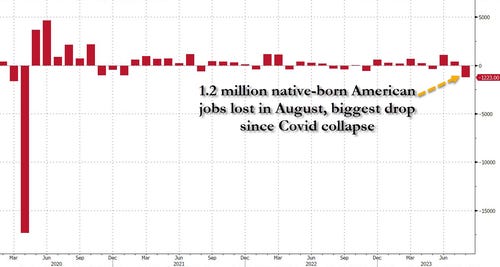

If an invasion of foreigners was good for the country, USG should be running massive budget surpluses as foreigners build companies and pay taxes. The opposite is the case: data from the Center for Immigration Studies shows foreigners use welfare at far higher rates than natives. Cities such as New York, Chicago and Los Angeles are now having political meltdowns over experiencing a small fraction of what Texas, Arizona and other border states experienced for decades. Many of these states were already on the brink of bankruptcy. They do not have the resources to deal with the problem.
It also isn’t really a result of busing from border states so much as the waves of illegal aliens finally overwhelming the United States. There isn’t enough housing, there aren’t enough doctors, there aren’t enough schools, there’s nowhere near enough money for tens of millions of new welfare cases adding to the burden of a rapidly aging society already going into inflationary-collapse over entitlement spending. If natives are quitting or losing jobs and being replaced with cheaper foreigners, they all qualify for welfare. The country is moving backwards, rapidly into Third World status.
Very short-sighted and clueless people think this is good for the country. It’s going to end up being good like atomic cornflakes, margarine and mRNA vaxxes. Unlike many problems, this one won’t get cheaper after people realize what happened. The country will first experience massive economic hardship. Only then, when natives suddenly cannot find jobs or have to take huge pay cuts amid rising inflation, or see their welfare benefits cut as is already happening in cities such as Chicago, will they realize they’ve been hoodwinked. Then we spin the roulette wheel and find out what form the dictatorship takes and how long it lasts. Even if its democratic, the man who emerges from this mess will rule as FDR and Lincoln did. Political enemies will be jailed., either the current regime hanging on or a new regime punishing the current one. Immigration will probably go negative for a time and then hit a number close to zero, staying there for a century or more.
The U.S. has been in similar situations before, but it was never pushed to this extreme. Foreign born population was high enough to warrant a major reduction or even near total ban on immigration back in 2000. Policy has gone in an extremist direction since then. The three prior periods: heading in the 1770s, the 1850s and the 1920s. Two out of three sparked wars and the third came ahead of World War II. Nothing good is coming in the short-term.


All of which is to say, there's no way this was going to end well. The Federal Reserve's rate hikes are arguably having very little effect on the markets and in hindsight, will merely be a symptom rather than a cause. Suppressing volatility is like adding dry wood to a forest floor year after year, while preventing all forest fires. Eventually, all it takes is a spark for a forest-killing fire. The governments of the world started helicopter dropping gasoline in 2020. Western governments and China haven't stopped.

ZH: New England's Power Crisis Set To Return, Regulator Warns
New England's power grid could be several cold snaps away from the start of an energy crisis that reappears whenever temperatures dip because of the state's heavy reliance on natural gas generation, delayed/blocked expansion/upgrades to energy infrastructure, and lack of grid diversification.Average temperatures across Massachusetts started to slope down in mid-August. Temperatures are between 55-60 degrees Freigheight, indicating the heating season could be just weeks away.
Another serious issue is the controversial US law, the Merchant Marine Act of 1920, more commonly known as the Jones Act. This law helps ensure the US merchant marine fleet remains busy by only allowing US vessels to transport goods from one domestic port to another, barring foreign vessels.This means New England can't receive LNG shipments from the US Gulf because the US shipbuilders don't build LNG carriers. So LNG facilities in New England have to rely on foreign shipments -- adding to the complexity of the region's issues.


The drought bearing down on Mono Lake and the rest of California picks up on a two-decade run of extreme warming and drying. It’s a product of the changing climate that has begun to profoundly reshape the landscape of the West and how people live within it.Nope. You live in a desert.
Phys.org: Ancient Southwest marked by repeated periods of boom and bust
This is particularly important as droughts of just five or ten years were enough to prompt major shifts in the small niches where Pueblo people grew maize, their major crop.Climate change is a big deal when you live in a place that has adequate rainfall and water supply for a few hundred years and then turns into a dry desert. Ignoring the reality of this cycle moves a society from one in deep trouble facing serious climate problems to one that exterminates itself with energy and economic policies that facilitate mass distribution of Darwin Awards.The niches, said Kohler, were "woven together with a web of ceremony and ritual that required belief in the supernatural" to ensure plentiful rain and good crops. When rains failed to appear, he said, the rituals were delegitimized.
"Then there's a point where people say, 'This isn't working. We're leaving,'" he said.
That starts a period of exploration in which people look for new places to live and develop new ways of living, followed by a period of exploitation in a new niche with different behaviors and values.
"There's a new period of wealth creation, investment in architecture and culture change," said Kohler.
The researchers said the first period of exploitation, known as Basketmaker III, took place between 600 and 700 A.D. It ended with a mild drought and was followed by a period known as Pueblo I, in which the practice of storing maize in underground chambers gave way to storage in rooms above ground.
The researchers think this represents a shift from unrestricted sharing of food to more restricted exchanges controlled by households or family groups. The period ended around 890 with a slightly larger drought.
The exploitation phase of the Pueblo II period ran from 1035 to 1145 and was marked by large shared plazas and great houses—what we would today call McMansions—in the Chaco Canyon area south of Mesa Verde, Colo.
"We're talking some of the largest—actually, the largest—prehistoric masonry structures in North America north of Mexico," said Kohler. "These things are huge."
Wood for roofs had to come from 50 to 75 miles away, requiring an unprecedented level of coordination. The mix of large and small buildings also suggests a more hierarchal social structure with someone in charge.
Chile’s Environmental Commission of the Constitutional Convention has approved a rule for inclusion in the new constitution to nationalise the exploitation and exploration companies of strategic assets, which includes lithium, copper and precious metals assets. The norm would result in, “passing to the national domain all the assets of said companies and their subsidiaries related to their activity in national territory. … The exploration and exploitation mining concessions constituted in favour of these companies will cease immediately once the nationalisation takes effect,” the document reads.Included in the law is no compensation for lost assets.
Very few countries run state industries efficiently. What happens most of the time is the nationalized industry is inefficient. It needs increased capital, but cannot obtain it on the world market. In the current world situation, China will probably be happy to colonize Chile's resource sector. Otherwise, as happened in Venezuela, the country will go down the tubes as one of its main sources of wealth is systematically destroyed by a parasitical ideology.
For the rest of the world, the result is higher resource costs. If they do not print money and create inflation in response, the result will be slowing growth, recession and stagnation until substitutes are found. Copper won't be replaced outright, but as the price rises, projects that use it will cease, and where it can be substituted it will be. Over time, countries will make do with less of whatever resources has become expensive. In this case, the green revolution is rapidly dying, although most of the West doesn't realize it yet because they're blinded by an apocalyptic religion.
The other trend to note is nationalism. Nationalist socialism, nationalist populism, nationalist capitalism and so on are rising. The nationalists will defeat the globalists.
If you're going to manipulate markets, might as well manipulate them all the way. Stress relieving rallies are necessary if they have in their mind to "go all the way" and lift the Fed funds rate above the CPI if necessary. The current pace is pointing to a crash that will force the Fed to choose destructive QE again or allowing something like a 2008 market crash to proceed without any help.
It gets worse in the intermediate category, which I remind you takes six to 12 months, minimum, to work through the system to the store shelf.


He is not wrong in what he says, but the example of 2008 shows that price increases don't have to make it through to the consumer. If instead demand collapses, these high costs will turn into losses for the businesses.
The average price for oil in July is $105 through yesterday, down nearly 10 percent. Not enough to really dent inflation yet, but a start. The drop to the low $90s the past two days could double the percentage drop if it holds through the month.


I'm overdue on updating the fed pivot indicator, and frankly it's showing we have arrived already
— TheHappyHawaiian (@ThHappyHawaiian) July 11, 2022
We are at the point where the fed would usually halt rate hikes and begin easing again
As they gear up for 75bp in a couple weeks, they would be knowingly blowing up the system pic.twitter.com/u20NsnvhNH


My view: the Fed has a lot of leeway on what constitutes a pivot. Markets are now pricing in a 75 bps hike with the gamblers betting on a 100 bps hike. This looks like lunacy to me given developments in commodity and currency markets, plus incoming economic data. Odds of a 50 bps hike were at 50 percent a month ago (before the market priced in more hawkishness). Since then commodities have cratered, gold-copper screams deflation, U.S. dollar is breaking out again and Fed models show a recession and rapid disinflation. Everything is telling me 75 bps will be a coup de grâce for inflation and financial markets.

At least one Fed official sees the risk. Esther George today (PDF): Tightening Monetary Policy in a Tight Economy


Contra 2021 screaming inflation, markets are screaming caution and deflation here. Maybe it's a momentary fit of madness and will pass. The Fed can't afford to take that risk though. If the markets are right, they're saying something very large could break. Better to wait and see, then to be the impetus for triggering a global meltdown.
HAMBURG GERMANY IS REPORTEDLY PLANNING TO RATION HOT WATER ***
— The_Real_Fly (@The_Real_Fly) July 4, 2022
Well, today the data officially confirms that Germany’s [trade balance] turned negative in May for the first time since reunification (1991).When people talk about the dollar dying, they're talking about the euro. Rising energy will kill the euro. The U.S. consumer and businesses will be hurt, but money that would have gone into buying Chinese imports will instead go to buying oil and gas from Texas, Oklahoma, South Dakota, Pennsylvania...
If a larger rally unfolds this summer, it will happen because two conditions will be satisfied. First, investors are sufficiently pessimistic such that they've priced in much worse news than is coming. This upcoming earnings season could be that. I wouldn't bet on it, but it is possible. Evidence would be provided by a bad earnings report by a major such as Apple resulting in a gain in the stock price. The other catalyst will be actual positive news, be it a Fed pivot (likely positive in the short-term only) or legitimately good news such as peaceful developments in Ukraine.
The downside scenario is that the market simply doesn't understand how bad the situation is here and ever more negative news continues rolling out. There's some risk there with Western governments behaving like Hitler in the bunker. The Biden admin has modeled for $200 oil and $10 gasoline, which would unleash a depression the likes of which hasn't been seen since the 1930s. I think that outcome is unlikely, but I also see no sign that the government cares in the slightest. These are the same people who did the lockdowns after all. Assuming they're sadistic people trying to maim and kill their own citizens has been a fairly good predictor of their policy choices. Becoming too political with economic and market forecasts is always a losing move, but then I've never in my life or U.S. history seen a government this destructive. I assume at some point they'll cry uncle on some issue, but they haven't yet. Here's the latest headline: Biden proposes limited drilling leases off Gulf of Mexico and Alaska
Administration officials said fewer lease sales — or even no lease sales at all — could occur, with a final decision not due for months.
I expect the U.S. dollar will weaken as inflation falls because interest rates would fall too, yet the chart below is a good indicator of how far oil prices could drop. A $1.50 plunge in gas prices is a guess, but a conservative one if the sanctions lift.

The winner in a prolonged war between two near-peer powers is still based on which side has the strongest industrial base. A country must either have the manufacturing capacity to build massive quantities of ammunition or have other manufacturing industries that can be rapidly converted to ammunition production. Unfortunately, the West no longer seems to have either.The U.S. has depleted its reserves of weapons and ammunition, is flushing much needed reserves down the drain in Ukraine, and cannot hope to ramp up and meet Russian weapons reserves even without assuming China starts supplying Russia.Presently, the US is decreasing its artillery ammunition stockpiles. In 2020, artillery ammunition purchases decreased by 36% to $425 million. In 2022, the plan is to reduce expenditure on 155mm artillery rounds to $174 million. This is equivalent to 75,357 M795 basic ‘dumb’ rounds for regular artillery, 1,400 XM1113 rounds for the M777, and 1,046 XM1113 rounds for Extended Round Artillery Cannons. Finally, there are $75 million dedicated for Excalibur precision-guided munitions that costs $176K per round, thus totaling 426 rounds. In short, US annual artillery production would at best only last for 10 days to two weeks of combat in Ukraine. If the initial estimate of Russian shells fired is over by 50%, it would only extend the artillery supplied for three weeks.
The US is not the only country facing this challenge. In a recent war game involving US, UK and French forces, UK forces exhausted national stockpiles of critical ammunition after eight days.
Unfortunately, this is not only the case with artillery. Anti-tank Javelins and air-defence Stingers are in the same boat. The US shipped 7,000 Javelin missiles to Ukraine – roughly one-third of its stockpile – with more shipments to come. Lockheed Martin produces about 2,100 missiles a year, though this number might ramp up to 4,000 in a few years. Ukraine claims to use 500 Javelin missiles every day.
The expenditure of cruise missiles and theatre ballistic missiles is just as massive. The Russians have fired between 1,100 and 2,100 missiles. The US currently purchases 110 PRISM, 500 JASSM and 60 Tomahawk cruise missiles annually, meaning that in three months of combat, Russia has burned through four times the US annual missile production. The Russian rate of production can only be estimated. Russia started missile production in 2015 in limited initial runs, and even in 2016 the production runs were estimated at 47 missiles. This means that it had only five to six years of full-scale production.
Rapid, and inflationary, reindustrialization is needed if a war is coming.
Jeff Snider of Alhambra has some discussion here: Sorry Chairman Powell, Even FRBNY Now Has To Forecast Serious and Seriously Rising Recession Risk
The DSGE model is here with discussion and links to explainers if you want more info.
If nothing else, understand this: the Federal Reserve can't print a government that doesn't start a nuclear confrontation with Russia, that doesn't lockdown businesses, that doesn't force experimental mRNA therapy on citizens, the doesn't let criminals out of prison, that doesn't ban trading for oil or fertilizer, that doesn't restrict energy production. If they try to do something via money creation it will result higher prices and accelerated economic decline in these conditions.


