Showing posts with label stocks. Show all posts

2022-12-08

Unemployment and Stocks

Very simple formula for 2023 in my opinion. If unemployment rises, stocks are going to new lows.

The first chart below shows claims and stocks positively correlated because myopic, QE-addicted bulls think higher unemployment is good for them, because the Fed will ease off hikes.

If unemployment starts rising sharply, then we'll know what form the Black Rabbit will take.

2022-06-05

30-Year Bonds Beat Stocks for 20 Years

Granted I'm cherry-picking a bit here, but an investor who put everything into long-term treasuries after the 2000 bubble had burst would not have underperformed stocks on their return until January 2018, and they would not have underperformed consistently until January 2021. This underperformance is up for debate since we haven't completed the cycle yet. It's possible this outperformance won't end for a few more years.

How many people know that long-term treasury bond funds beat stocks for 20 years?
It would make sense if stocks beat bonds over the coming years, but here's the scary thought for anyone holding financial assets: this ratio goes up if stocks lose less than bonds. Stocks will lose a lot if bonds go down. If the 10-year yield gets back to around 5 to 6 percent, the 30-year bond should be 6 percent or higher, which would approximate (ballparking it for simplicity) to a 50 percent drop in the price of the bond.

2022-05-09

Investors More Bullish Than Normal

I see a lot of talk about sentiment. Based on what I saw on social media and financial sites, plus the charts, sentiment struck me as very bullish. The bearish corners of the market were noisy, but they're louder than their membership. The SlopeOfHope has a notoriously bearish orientation and the comment section can be quite bullish most of the time. Bullish analysts keep putting out higher targets, they say to buy the dip, they say the selling is overdone, others warn of bear market rallies. There's AAII survey showing members bearish, but again, the charts. Where's the evidence of selling? AAII members aren't loaded to the hilt in ARKK. No, the bull market rests on the shoulders of BigTech giants such as Apple and Amazon.

There are some indexes that track investor dollars. One is the IMX from TD Ameritrade. It shows their customers are more bullish then they've been most of the past 5 years. There was a blow-off in sentiment in December 2017. Within a month the market made a short-term top and a week later was Volmageddon. Another peak was in June 2021, four months after the ARKK-growth complex had peaked and about six months before what is now looking like a major bull market top. Aside from those blow-offs, current dollar-based action looks bullish relative to the prior years.

That comports with what I've witnessed and heard from bulls in real life. They didn't think and may still not think this is a bear market, they haven't really sold off assets and gone to 20 to 40 percent cash or higher. Rather they're bearish the same way they were bearish in prior corrections. They expected the market could drop, but have a buy-the-dip mentality that has become don't-sell-the-drop. They might be extremely bearish, but don't think it'll last more than a few weeks before the Fed will bail them out or it will naturally rebound. Most watched all the way down and are only now taking action or considering it.

Depression Risk is Higher Than Ever

The Federal Reserve fears the 1930s depression. Their actions since are based on this crisis. The panic in 2008, quantitative easing and all the bailouts are motivated by fear of deflation. When prices collapse, the Fed steps in to prevent "runaway" deflation. Runaway in quotes because deflations can't keep running. They terminate rather quickly, albeit brutally.

A deflationary depression was always a system-failure risk in this environment. An event becomes large enough such that even central banks cannot stop it. Smaller events will be stopped as they have been in the past.

This history created a blind spot: inflationary recession. Central banks, and here the ECB and BOJ are far worse offenders than the Federal Reserve, are moving slowly because they don't fear inflation the way they fear deflation. They will tolerate far more economic destruction then they would in a deflationary recession. Stopping this destruction will reveal the full extent of it via a far deeper deflationary recession.

By GDP measures, the economy barely dipped in 2008 because of central bank intervention. See GDP Stands For Garbage Data Point for a look at gross output, which did show the economic damage.

Major economic devastation is already happening beneath the surface, but the surface data doesn't reveal it. The stock and bond markets sense it though...

Money Heaven

A lot of money is about to go to heaven.

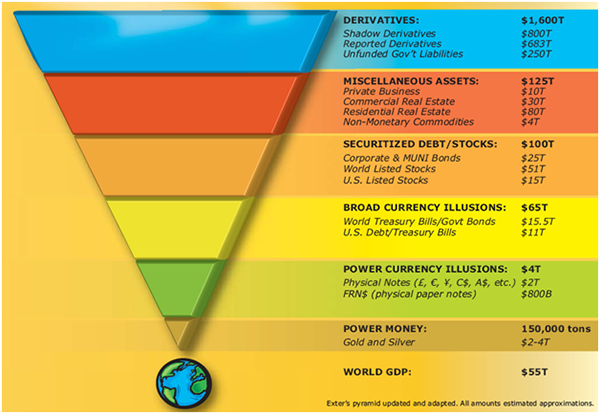
Almost everyone in the precious metals space knows the Exeter pyramid. Most investors have heard the term hard money. A "strong" pyramid would be one where all money is a derivative of the money below it (higher order) on the pyramid. Similar to the idea of fractional reserve lending. Bubbles collapse, credit is destroyed as wealth tries to escape into more secure, stable, higher order money.

A "weak" interpretation of the pyramid says lower forms of money can be created ex nihilo, like cryptocurrency. There are higher and lower forms of money, but they aren't linked and its not necessarily clear which money in higher or lower based on its form alone. Example, fiat currency. Look at the list of existential hyperinflations and there is a recurring theme: the country or government issuing the fiat is facing or faced an existential threat such as war, foreign occupation after a war, lost a war, engaged in civil war and so on. Or the government engages in mass destruction and expropriation of wealth, such as communist governments (Venezuela the most recent example) or for other reasons (Zimbabwe's genocidal war on white farmers). Other fiat is more secure because the government still exists. All the currencies are fiat, but they have wildly different valuations. Some fiat may be superior to other assets. Would you prefer to hold a gold certificate from the Zimbabwe government or a Canadian government bond?

When Greece faced its sovereign debt crisis about a decade ago, the long-term government bonds didn't drop nearly as much as short-term bonds. It was believed Greece could not pay back its creditors today, but nobody thought Greece wouldn't exist in 10 or 20 years. Extreme hyperinflation is existential: the existence of the fiat issuing entity is called into down. Extreme hyperinflation is the nation-state version of the Bear Stearns and Lehman bankruptcies.

Now consider the stock market. What is the value of a company? In the marketplace, it is the last transaction multiplied across all the shares. What is that valuation though? It is a shared delusion once it exits from a cheap fundamental valuation. At some low price, someone could buy the whole company, finance the debt with cash flow and never have to re-IPO the company. Beyond a certain price, the valuation becomes ephemeral. It is based on the current risk appetite. Did Netflix and Facebook lose billions upon billions of dollars this year? No. The shared delusion that is their valuation collapsed towards fundamental value.

Bonds have a clear valuation because there is a known cash flow. However, the rate of interest and the value of capital itself can exist outside of this calculation. If suddenly people fear lending or refuse to lend at current rates of interest, all existing bonds are devalued. Holding a bond until maturity may produce no paper loss, but inflation could destroy the value of the money by the time it is return.

Which brings me to money heaven. Consider this example. Someone owns Netflix at $300 per share. They've owned it for a long-time and their risk tolerance is declining. Bonds are falling in price and a 5-percent yield on mortgage bonds looks good. They sell their Netflix and buy a mortgage bond. Money flows out of stocks and into bonds.

A quick look at the chart tells us both stocks and bonds are falling in 2022. Paper wealth can escape from stocks into bonds at the same time both keep falling in price. Only when the market rate of interest balances all the factors of inflation, risk appetite and so on, will bond prices stabilize. 

Where is Czechoslovakia? Where is Yugoslavia? They still exist as a concept, but not one with any currency (pun intended).

2021-07-28

Capital Flight From China Has New Destination, Institutions Become Day Traders

China's capital flight took a new turn in July with the BigTech crackdown sending money to heaven. The assault on U.S. listed Chinese companies finally turned back on China and shaved trillions off teh A-share market valuation. Retail and institutional investors are daytrading now as they are unsure of what the immediate future holds.

iFeng: 风暴眼|机构彻底“韭化” A股直上直下震惊资本大佬 官媒:以改革应对挑战 (A-shares go straight up and down, shocking capital tycoons official media: reform challenges)

Core Aspects:

1. After experiencing an "avalanche" plunge in China's concept stocks last Friday, A-shares also plunged in the first few days of this week. On the two trading days of July 26 and 27, A-shares lost more than 4 trillion yuan. Northbound funds flowed out nearly 17 billion yuan in two days, and more than 3,000 stocks fell by their limit.

2. Behind the dramatic volatility of the stock market is that institutions and large funds have gradually become "retail accounts" and "leeks". Institutions have begun to follow suit, and large funds have frequently flown in and out.

3. Hu Xiaohui, chief investment officer of the Federal Reserve Securities, told Phoenix.com "Eye of the Storm": "The intuitive reason for this round of decline is due to the plummet of education-related listed companies, but the core logic is not only this. It should be seen that the release of consumption, The combination of factors such as domestic economic growth, central bank monetary policy, unfriendly international environment, and high market valuations has become the driving force for the merger."

4. On the evening of July 28, in response to the recent fluctuations in the capital market, Xinhua News Agency published an article stating that the fundamentals of China’s economic continued improvement have not changed, the foundation for the development of China’s capital market remains solid, and industry regulatory policies are conducive to China’s long-term development. . Responding to challenges through reforms is the meaning of the question.

The violent market volatility has also caused many private equity, public offerings and investors to ask questions: Do A-share companies need to be revalued? Has the logic of the capital market changed?

On the evening of July 28, an article by Xinhua News Agency answered the recent volatility in the Chinese stock market and the worries that existed in the market.

Xinhua News Agency believes that the fundamentals of China's continued improvement of the economy have not changed, the foundation for the development of China's capital market remains solid, and industry regulatory policies are conducive to China's long-term development.

The latter is the same bullshit all politicians and bureaucrats the world over say when things are going poorly. Financial markets respond to fundamentals in the very long-term, but in the short-term they are psychological. The CCP just nuked two of its most impressive industries that attracted foreign capital. Chinese investors are wondering what industry will be targeted next? Investors in the U.S. and elsewhere should pay close attention because this is what the public is baying for: anti-trust action against BigTech companies and corporations.

Taking a step back, perhaps this isn't a big news item for China in the long-term. The policy isn't a total shock for long-term China watchers. That opens the door to a bigger issue looming in the background: a Chinese and global economy that is in fact not on sound footing and perhaps vulnerable to a major shock. Worth remembering that it was the month of August in 2015 when China shocked global markets with the sudden depreciation of the yuan.

2021-06-21

Put-Call Ratio and SKEW

Investors have to pay a premium for puts, but it looks supply-driven rather than demand-driven.

2021-03-18

The Dow 36,000 Market

The Dow 36,000 market is setting investors up for destruction:
One of the unfortunate bits of financial illiteracy that Wall Street has pushed into the heads of investors is the idea that extreme valuations are “justified” by low interest rates. Now, it’s certainly true that, holding future cash flows constant, raising the price of an investment will lower the embedded rate of return, and vice versa. If you pay $32 today for $100 a decade from today, you can expect a 12% annual return. If you pay $82 for the same security, you can expect a 2% annual return. If you pay $100 today, you can expect nothing. So it’s clearly true that, holding future cash flows constant, a lower rate of return implies a higher level of valuation.

The reason the statement “low interest rates justify high valuations” contributes to financial illiteracy is that the statement has been learned entirely out of context of the arithmetic. As a result, investors seem to imagine that, as long as high valuations can be “justified,” stocks can be expected to provide historically normal rates of return in the future. Likewise, investors seem to have no concept that if interest rates are low because growth rates are low, no valuation premium is “justified” for stocks, because the lower growth is already sufficient to bring future stock returns down to levels that are commensurate with the low level of interest rates.

The truth is simple but uncomfortable. If interest rates are low and expected growth is held constant, higher valuations imply lower long-term returns. If interest rates are low because expected future growth is also low, higher valuations are not required. Long-term returns will be lower anyway. A valuation premium just makes future returns even worse.

Saying that extremely low interest rates “justify” extremely high stock valuations is identical to saying that extremely low future returns on bonds “justify” extremely low future returns on stocks. I don’t really think that’s something Wall Street cares to clarify when it tells investors that stock market valuations are “justified.”

How to Spot a Bubble

2020-01-27

Market Top Update

I'm partial to the melt-up theory, that a top is not in yet. The bond price is the denominator, thus a rally in bonds along with stocks could maintain a topping H&S pattern.