Showing posts with label government. Show all posts

2023-08-01

Bear Rally Over? Yield Curve and VIX Turn Higher

It has been a long and winding road in this bear market. Yes, I still believe a bear markert is underway until new highs are made. I haven't been tactically bearish on the market over the preceding months, onyl taking some small swings when setups looked good. Until those old highs are taken out, my bear market call from November 2021 remains intact.

First, the classic bubble chart pattern hasn't been violated:

A double-top is a valid expression of the "return to normal" phase. Bullish sentiment and speculative behavior return to near peak levels, propelling the major indexes or stocks into double-tops. Anecdotal, but cryptocurrency speculators believe a new bull market is underway. Bitcoin BTC has a pattern that is consistent with the classic top though:
Tesla, Google, Amazon and Meta all sport the classic pattern with no hint of an imminent double-top. The paradox stocks are Apple and Microsoft. Both have achieved new all-time highs. Their massive weight in the S&P 500 technology sector (nearing 50 percent at times) propelled that sector to a new all-time high in July. If I'm correct in my assessment, this will turn into an overthrow of a double-top pattern and not an extension of the bull market.
Industrials also achieved new all-time highs this year. Energy and materials made new highs in the second-quarter of 2022 and remain within striking distance of new highs.
I'll digress here and give the bullish argument over the longer-term. Assume for a moment the U.S. was primed for a recession around the time the coronavirus hit. The government then wrecked the economy and then flooded it with far too much stimulus. Even though there's no official recession in 2023, the U.S. government is running deficits on par with the fallout from 2008:
There's nothing bullish about that chart long-term. Growing deficits will increase inflationary pressure. Falling deficits could trigger deflationary pressure. Since stocks are priced for perfection, deviation out of the Goldilocks Zone will trigger price declines in all sectors at least for a time, barring an explosive move higher in energy as we saw in early 2022.

I don't want to belabor the valuation topic, but here is the price-to-earnings ratio divided by the growth rate (PEG) and the spread between investment grade corporate bonds and the Federal funds rate.

Going back the to the bull thesis: what if the government front-loaded stimulus and the bear market/recession doesn't materialize? In that case, either an extension of the bull unfolds or the transition occurs without the bear move. Both EFA and EEM, the developed and emerging market ETFs, bottomed in October 2022, with EEM having a little overthrow this year:
To wrap up the bull case: the government flooded the economy with stimulus, triggering a temporary inflation surge. Inflation settles back into the Goldilocks Zone, as does GDP growth, sub-2 percent for both. In the short-term bull scenario, stocks enjoy an extension with tech and other speculative assets resuming leadership. In the longer-term scenario, the transition to new leadership such as industrials, energy, commodities and foreign markets takes place without a major bear.

Back to the bear scenario, one of the strongest signals for a recession has been the inverted yield curve. It doesn't indicate an imminent recession, rather it signals the pre-recesesionary stage. The actual recession comes when the yield curve steepens. Going back the past four decades, this has always occurred when the Federal Reserve slashed rates. Right now, the yield curve is steepening because long-term bond yields are rising faster than short-term yields. It is a small move at the moment, but the spread has made a higher low, indicating the final low might be in.

The 10-year treasury yield has a bullish formation that may or may not complete. If it completes, then higher long-term rates will sink financial asset valuation and could indicate a stagflationary recession. The 30-year mortgage would be on its way towards 10 percent, a level that would almost assuredly kill home prices too. On the flip side, a traditional steepening via Fed rate cuts would be another bear market and recession like we've seen in 2000 and 2008.
The decline in the VIX has been a hallmark of this bull market. The VIX has fallen below the level reached at the November 2021 peak, indicating fear is gone. Here's the VIX overlaid with the 2s10s spread:
VIX isn't a great indicator in that it tends to be coincident with the 2s10s, but a rising VIX indicates rising fear, likely because there's bearish action in parts of the market ahead of the full-blown bear. Here's a look at when the VIX bottomed ahed of prior bearish periods:
There will be bearish trades emerging very soon if the yield curve has finished inverting and moved into steepening. Ditto if the VIX follows it higher. With September and October coming up, the calendar supports a market top scenario here. New highs on the major indexes will invalidate the bear scenario, as will a falling VIX. If the 2s10s inverts further or moves sideways, it will indicate no imminent economic pressure. If the 10-year yield fails a breakout for instance, the yield curve might invert further while the broader stock market interprets the falling yield as disinflationary and therefore bullish.

2023-07-18

Nasdaq Rebalance

US funds hit limits on holdings of high-flying tech stocks
Major asset managers and mutual fund specialists such as Fidelity, BlackRock, JPMorgan Asset Management, American Century and Morgan Stanley Investment Management have run into strict regulatory limits that determine whether a fund can be categorised as “diversified”. The trend is a further sign of how a lopsided rally powered by just a handful of big companies is creating unexpected issues for investors and index providers, and follows news that even the Nasdaq 100 — the index most closely associated with high-flying tech groups — will be rebalanced to reduce the dominance of the largest groups such as Apple, Microsoft and Nvidia. The S&P 500 has added 18 per cent so far this year, but seven large tech stocks have accounted for the majority of the gains. Mutual funds that register with the Securities and Exchange Commission as “diversified” cannot put more than 25 per cent of their assets into large holdings — with a large holding defined as a stock that represented more than 5 per cent of the fund’s portfolio at the time of investment. Funds are not punished if the value of their existing large holdings naturally rises past the 25 per cent limit, but once it is hit they cannot buy any more of the affected stocks. At the end of May, Fidelity’s $108bn Contrafund, for example, could not buy any more shares in Meta, Berkshire Hathaway, Microsoft and Amazon, because they made up a combined 32 per cent of its portfolio.
I covered this topic several times last year, most recently here: Why You Shouldn't Own Apple Stock and even more recently on the Substack: Me in April: Microsoft Done, QQQ Fails Diversification Rule

The Nasdaq 100 will undergo a rebalance because of this issue. My view is this is the sign of a massive market top. Last time this became an issue, the market solved it in March 2000. That this is going for almost 5 years now, going back to the 2018 major sector shuffle, indicates this could be a far larger top in time and price. The alternative explanation is the United States is becoming a techno-fascist country with emerging market qualities. For example, Taiwan Semiconductor is around 40 percent or more of the Taiwan market capitalization.

2023-02-05

Peak FBI

American Greatness: Planned New FBI HQ Is Twice the Size of the Pentagon

If you're familiar with Socionomics, you know that many economies peak around the time the "world's largest skyscraper" is being built. Major new HQs for corporations can also mark a top. In essence, these are prideful projects that also distract from core missions or show it believes the core mission is in hand. The FBI is spiking the football after subverting the Trump presidency, interfering with the 2020 election and jailing enemies of the Deep State. A new HQ doesn't mean it will peak like a business or country though. Government institutions don't really have competitors. They expand and expand and expand over time. They will only be stopped by a willful effort by their opponents.

The FBI should cease to exist. All their functions can be farmed out to the state police with an overarching cooperative body run by the states. Everything the FBI does can be done by other agencies and institutions such as Secret Service, federal marshalls and state police. They plan on turning America into a total police state with their agency at the center. A new HQ is their way of announcing their power to the nation. Let's see if anyone can knock them off their perch.

2022-12-26

Lockdown to "Pandemic:" Covid, Flu and Cold Cases Go Wild in China and the USA

WSJ: China to Open Borders Despite Surge in Covid Cases
A sign outside the Peking Union emergency room warned patients it could take more than four hours to see a doctor. A nurse at Peking Union’s fever clinic said that for weeks patients had been forced to wait in the hallways for beds to open up. One elderly patient, unable to secure a bed, was lying on a metal bench just inside the entrance of the fever clinic.

A nurse at Peking University First Hospital’s emergency room said beds there were all full and the wait time at the internal medicine department was roughly six hours. The hospital public address system announced that nearly 50 patients were waiting to be seen.

A Beijing taxi driver said Monday that most of his recent passengers were traveling to hospitals.

I don't know if China is suffering a pure covid wave or an everything wave, but the USA is suffering a cold and flu wave. Many stores are out of cold and flu medicine, in particular children's. During lockdowns, flu and cold viruses continued spreading and mutating, but in smaller numbers. This prevented normal herd immunity. China didn't have nearly as much mRNA vaccine, so the lack of immune system challenges is clearly a factor.

Chinese were paranoid about covid a month ago. I think experience is the best teacher and they will be over this fear quickly. If the lockdowns damaged immune systems and herd immunity though, then perhaps China will suffer several waves of illness stretching into the next cold and flu season at the end of 2023.

The scientists promoting lockdowns were fools, the governments were fools and the doctors were fools for going all with it all. Whatever you may or may not be suffering, this is the direct result of lockdowns. The total bill for these totalitarian, anti-common sense, anti-science policies still hasn't been finalized.

2022-12-15

If California Didn't Exist, Austrians Would Have to Invent It

Clownifornia delivers another lesson in central planning and interventionism gone wrong. Retail sales spiked in October when California issued a stimulus check. Retail sales fell in November.
If America chose a pet rock for president, it would be a successful term because the pet rock would not intervene. Unfortunately, there are bad policies that do constant intervention that must be unwound, but a pet rock would come up with no stupid ideas, which it seems is the only thing the Baizuo ruling class can come up with.

2022-12-07

Denmark's Identity Program in Focus

Quality immigration becoming a little more of a rare commodity every day, the key to success for Western countries will probably be like Denmark: being able to raise the birth rate, to accomplish the transition to modernity in a sustainable, to resolve the errors of past immigration policies, to propose a viable social model for active couples, to be able to preserve the identity and integrity of the population of origin.
Overview of Denmark's identity model

2022-11-30

Jiang Zemin Dead at 96

The Western press has more detailed obituaries for Jiang, who led China during the most important phase of its rise in the 1990s. Making the leap from a rising power to a potential global hegemon during a period when the United States was at the apex of its power, Jiang integrated China into the American system while simultaneously laying the foundation to displace it as the premier economic power. He came to power with China an outcast following the Tiananmen crackdown and left with China in the WTO, rapidly gutting what was left of the West's industrial advantage.

AP has a long biography: Former President Jiang Zemin, who guided China’s rise, dies

Chinese coverage is remarkably terse.

China Daily: Jiang Zemin passes away

The letter says that Comrade Jiang Zemin was an outstanding leader enjoying high prestige acknowledged by the whole Party, the entire military and the Chinese people of all ethnic groups, a great Marxist, a great proletarian revolutionary, statesman, military strategist and diplomat, a long-tested communist fighter, and an outstanding leader of the great cause of socialism with Chinese characteristics. He was the core of the CPC's third generation of central collective leadership and the principal founder of the Theory of Three Represents.

My take: this is probably a non-event for China because Jiang wasn't heavily involved in current politics. He also isn't a beloved figure among the people. The June 1989 protests were sparked by the death of Hu Yaobang in April because he was a popular figure for people who wanted China to open up politically. Given the current state of affairs, disgruntled citizens or CCP insiders could his death as a vehicle for criticizing the state.

I still don't think these protests have legs. I'm not basing that on superior on the ground knowledge, but the fact that I've seen this show play out before and it always ends the same way. Jiang's death adds a new variable that could fuel something larger, but that something hasn't happened yet.

2022-11-05

Commodities Signal Something Wicked

Preface: I'm all set whichever way the market goes and I'll change positioning as necessary. Even if you're bearish, it makes sense to have real assets, some physical precious metals and you should have a small watchlist of lotto-ticket junior mining stocks in case things change in a hurry.

Commodities exploded higher on Friday. Market participants and more so financial media, always create an explanation for what happened. The story for Friday's move was China re-opening. 

Another explanation is that the money printers take power away from the Federal Reserve. There is a growing rumor that the Treasury Department led by former Fed chair Janet Yellen will seize monetary power. She has floated the idea of doing a "twist" where the treasury issues new debt and buys back older debts. This would squeeze shorts and shock the market in the short-term, though maybe not. First, if this is done, it is the financial equivalent of draining the SPR for votes. How many votes will the Biden administration get for the SPR policy? It looks like a negative number to me. I bet this move is a larger negative number. It wants to "drain" the treasury market of very favorable debt (from the view of the U.S. government) and replace it with more volatile short-term debt that will reset at higher interest rates. As with the SPR drain, they refuse the simple solution: issue less debt. Instead of sending $30 billion to Ukraine, issue $30 billion less in treasuries. What a concept! As with the SPR drain, if the policy fails and the future is worse, then they've screwed the country. Interest on the debt will bring forward the date when massive cuts in welfare and warfare spending will be made.

It's possible the gambit will fail immediately too. In addition to worsening the government's fiscal position, they are crossing a red line by interfering in monetary policy. As someone who opposes central banks for economic and political reasons, it nonetheless is a superior economic arrangement to a U.S. treasury run by literal money printing MMTers. It is possible the market reaction to this treasury move will be a collapse in treasuries, the U.S. dollar and an outbreak of inflation so bad that there are inflation riots in the streets. For this potential risk alone, it is insane for a Democrat administration to effectively take 100 percent responsibility for the nation's fiscal woes built up over generations, but that is what will be the "narrative" if they do it.

The above scenario is a valid explanation for a sustained explosion in commodities of which Friday was merely the start. Another is that for all the whining by degenerate speculators and gamblers, the Federal Reserve still has interest rates at negative 2 percent measured by core CPI. What if I and others who expect lower inflation are wrong? If neutral policy includes rates of positive 2 percent, that argues for an 8 percent Fed funds rate right now. That would mean mortgages above 10 percent. What if the move on Friday was the market calling bullshit on the Fed and inflation is about to rip higher? Say hello to 10 percent on the 10-year and 15 percent yield on mortgages. 

Intuitively it makes sense. There is no hope of a soft landing given the amount of debt-financed stimulus and lockdowns that preceded it. At the very least, the 30 to 50 percent rise in home prices, more than 100 percent in many places, should reverse nearly 100 percent if the inflation comes out. Factor in lockdowns and the economy should be at a lower level than it was in February 2020. There was a great deal of economic destruction carried out by politicians and then hidden by massive stimulus. The electoral guillotine that will drop on Tuesday November 8 is the public reaction to the tip of an iceberg of destruction that the ruling class sent our way in 2020.

Alright, there's your commodities bull case. How about the bear case? First, the Fed gets serious about inflation if the runaway inflation scenario is real. They do whatever it takes to get inflation down, including the hardest landing for stocks since 1929. You will hear screeching like never before if the Fed does an emergency rate hike, but it is the appropriate move if commodities are taking off. Copper is begging for a 100 basis point emerging hike if it has one more day like Friday.

More likely, the big move is the end of a speculative wave. Whenever I'm writing one of these posts, something big usually follows. Markets get to the starting line of a major phase change many times before they go through with the change. If this isn't the phase change yet, then history says Friday was a great shorting opportunity.

Prior spikes in copper, outside of the Ukraine war pop, came at the end of rallies:

Huge spikes in and of themselves can be bearish outside of V-bottom type moves preceding them. If China doesn't unleash massive stimulus and/or the U.S. treasury isn't dumb enough to trash the currency and treasury market, then that spike is unwarranted.
Friday's move still leaves assets such as gold and copper with their crash analogs intact. Gold did pop up, but that candle could still end up looking like April 2013 before the month is out.
Silver had a similar spike with similar volume in the futures market at the start of October.
That also came within the context of a stock rally. Using the the stock market for context and relative weakness in stocks last week, the pop in commodities looks like it could be an outlier move.

As for the broader market, it can be distilled down to one stock: Apple. The stock has a bearish topping pattern that has yet to break. The measured move off the topping pattern gives a target of below $80 per share. There is a gap at $95 per share. If it fell as much as the rest of BigTech, it would trade down around $110 at minimum. Long-term support is around $124 per share. Apple is the largest stock in the S&P 500 Index at more than 7 percent of the index. It is nearly 25 percent of the technology sector. It is 14 percent of the Nasdaq 100. Finally, it broke the AAPL/SPY uptrend ratio. While not a necessarily a trade signal, it does indicate Apple is officially losing its status as the largest company in the stock market. I doubt this will be a painless transition. It is possible Apple collapses alone, but unlikely. 


We'll find out soon enough what the market has in store. One thing I'm relatively certain of: if commodities go up, then stocks like Apple are going to crumble. If commodities reverse lower, it'll probably be for a bad reason that is also bad news for Apple. It's possible both stocks and commodities rally for a time, but I don't see them rising together for long. 

2022-11-04

China Going Supply Side

Yicai: China’s Local Governments Should Put State Assets to Better Use, Ministry Says
Chinese local governments should make better use of state-owned assets, such as houses, land and cars, in order to help plug the gap between fiscal revenue and expenditure, the Ministry of Finance said.

Local governments should conduct a thorough inventory of the assets that they occupy and use to make sure that they are being used efficiently, such as through the sharing, swapping, leasing or selling of these resources, and that none are lying idle, the ministry said in a document released yesterday.

Liu He had a widely-discussed editorial calling for supply side reforms: 刘鹤人民日报撰文:把实施扩大内需战略同深化供给侧结构性改革有机结合起来Hong Kong shares jumped 5 percent and A-shares more than 2 percent with more rumors of reopening. These two hotpot chains sport higher lows.
The emerging market ETF will open up near the gray line this morning.
Since everything is tied together, it still all boils down to the U.S. dollar. Copper is up 5 percent today, crude oil 4 percent for the same reason as the above. Will the Federal Reserve ease policy if the CPI reverses and goes vertical on a China reopening? Or are we headed for 10 percent interest on 30-year mortgages
FWIW, I'm looking for a reversal in the stock market today because none of these moves are good for U.S. equities. Short-term anything can happen though.

2022-07-26

It's Not a Recession. It's a Depression.

The ruling class is out in force with redefining a recession. Here's why it's a waste of time.

AP: EXPLAINER: How do we know when a recession has begun?

By one common definition, the U.S. economy is on the cusp of a recession. Yet that definition isn’t the one that counts.
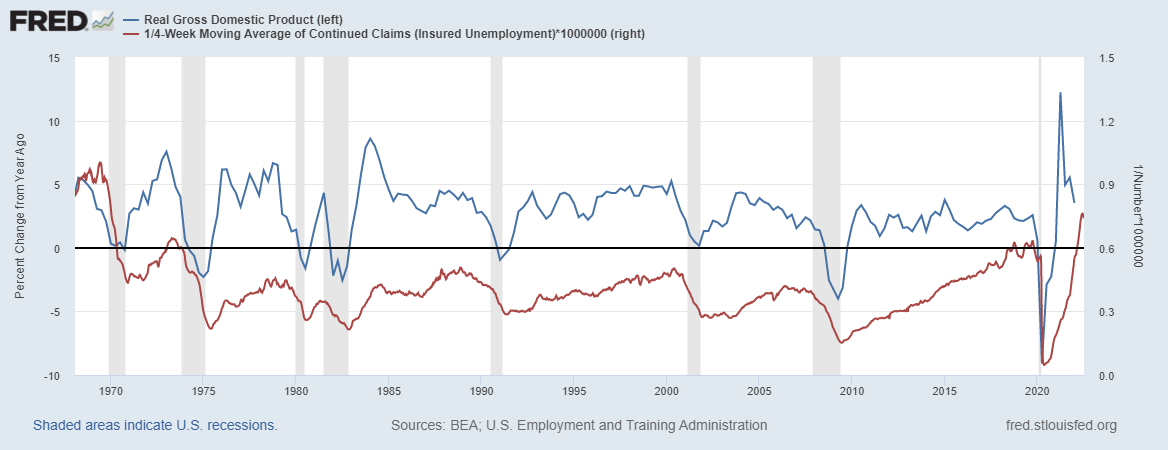
The U.S. isn't on the cusp of recession. By the common definition of negative growth in two consecutive quarters, a recession is already six months-old if BEA reports a negative number on Thursday.

As for definitions, they can be flexible. I don't think a bear market is a 20 percent drop in stocks. Every correction from 2009 to 2021 was a correction, not a bear market, even though stocks fell 20 percent or more at times. What's the quibble with the recession definition?

But economists say that wouldn’t mean that a recession had started. During those same six months when the economy might have contracted, businesses and other employers added a prodigious 2.7 million jobs — more than were gained in most entire years before the pandemic. Wages are also rising at a healthy pace, with many employers still struggling to attract and retain enough workers.
(long string of expletives)

Excuse me FRED, can you drop some tactical nukes for me?

FRED: Sure thing boss!

Great, let's start with rising wages. Adjust those for inflation would ya Freddie?

FRED: Incoming!

Real wages are plummeting. Seems consistent with ye olde recession.
The job market’s strength is a key reason why the Federal Reserve is expected to announce another hefty hike in its short-term interest rate on Wednesday, one day before the GDP report. Several Fed officials have cited the healthy job growth as evidence that the economy should be able to withstand higher rates and avoid a downturn. Many economists, though, are dubious of that assertion.
Shall we drop another tactical nuke on their critical meme infrastructure?
At best, labor is a coincident to lagging indicator. If the recession is already six months old and labor didn't start turning down until April, there could be a lot more pain ahead. As in, this recession isn't going to be some dip in activity, but something that at minimum will be a three to four quarter protracted contraction. Looking back, I see they revised GDP to make the 2008 recession much longer than originally recorded. It had been a mild contraction, barely scoring as a recession. I have contended for months that even if not a recession now, the BEA would eventually revise this year into a recession.
The Fed is also trying to combat raging inflation, which reached a 9.1% annual rate in June, the worst mark in nearly 41 years. Rapid price increases, particularly for such essentials as food, gas and rent, have eroded Americans’ incomes and led to much gloomier views of the economy among consumers.
Inflation creates a price illusion. Only looking at wages, revenues or GDP makes one think there's growth. The number is going up. Adjusting for inflation reveals the more activity you engage in, the more money you lose because it's happening with devalued currency. .

Look at the imploding retail stocks as an example. Retailers bought goods expecting to sell them amid high demand, but demand was fake. It was inflation. Supply chains helped disrupt the timing, but also the economy rapidly shifted as inflation came out of the economy. They should have never ordered the inventory. 

Nobody knows how deep this incoming economic malaise could get because it is still wholly distorted by a CPI still running at above 8 percent over the past 12 months. The CPI is rapidly decelerating though. The Cleveland Fed's Nowcast for July is down to 3.3 percent annualized. I don't annualize to forecast, but merely to show how fast the monthly CPI numbers can collapse. If highly efficient companies such as Wal-Mart report department "growth" that could be more than 100 percent price gains (I don't know that this is true, I've only see reported sales figures for various firms that are below the CPI), it indicates the collapse of inflation could reveal widespread economic losses. Wal-Mart is probably a winner in this environment too, keep that in mind.
It did in the first three months of the year, when GDP contracted 1.6% at an annual rate. Economists have forecast that on Thursday, the government will estimate that the economy managed to grow at an annual rate of just below 1% in the April-June quarter, according to data provider FactSet. If accurate, that forecast would indicate that the economy isn’t technically in recession by any definition.

Even if growth does go negative for a second straight quarter, Fed officials and Biden administration economists point to a lesser-known measure called “gross domestic income.”

GDP calculates the value of the nation’s output of goods and services by adding up spending by consumers, businesses and governments. By contrast, GDI, as the name implies, seeks to measure the same thing by assessing incomes.

Over time, the two measures should track each other. But they often diverge in the short run. In the first quarter, GDI grew 1.8% — much better than the 1.6% decline in GDP.

As part of its judgment of whether an economy is in recession, the NBER considers an average of the two measures. In the first quarter, the average was 0.2%, suggesting that the economy expanded slightly.

This isn't an argument devoid of logic. There have been near-miss recessions in the past. The flaw here is inflation. It assumes these numbers are accurate and won't be revised in the future. Given the high rate of inflation, I'm highly confident future revisions will be negative.

Consider these charts and comments from Jeff Snider:

In two weeks, the spread between the 30-year and 3-month treasuries has been cut in half. The 3-month is only pricing in a 50 bps hike too. If the Fed goes ahead with 75 bps, my hunch is the curve could invert tomorrow or quickly after the initial chaotic frenzy in markets.
Arguing over the definition of recession is missing the forest for the trees. Something wicked this way comes.

2022-07-20

Economic Reclosing? U.S. Gasoline Demand Below 2020-2021 Levels

That 2008 Feel: Henan Rolls Out the Tanks to Protect PBoC

See Banking Failures in Henan Persist for background on the ongoing saga of Henan banking problems. Protests escalated this month and it is claimed this is video of that same People's Bank of China building where large protests took place a couple of weeks ago.
Back in 2008, everyone took their eye off China for the 2008 Olympics in Beijing, but in reality the country was sending a strong warning about the health of the global economy. Once again, we're rolling into August with a rally in stocks (indexes bounced in late August in 2008) while China shows signs of severe economic stress.

2022-07-18

Chile Kicks Off Nationalization Stage of Nationalism Wave

Resources will become more scarce as more countries go down this path. Mining Journal: Chile Constitutional convention votes to nationalise mining
Chile’s Environmental Commission of the Constitutional Convention has approved a rule for inclusion in the new constitution to nationalise the exploitation and exploration companies of strategic assets, which includes lithium, copper and precious metals assets. The norm would result in, “passing to the national domain all the assets of said companies and their subsidiaries related to their activity in national territory. … The exploration and exploitation mining concessions constituted in favour of these companies will cease immediately once the nationalisation takes effect,” the document reads.
Included in the law is no compensation for lost assets.

Very few countries run state industries efficiently. What happens most of the time is the nationalized industry is inefficient. It needs increased capital, but cannot obtain it on the world market. In the current world situation, China will probably be happy to colonize Chile's resource sector. Otherwise, as happened in Venezuela, the country will go down the tubes as one of its main sources of wealth is systematically destroyed by a parasitical ideology.

For the rest of the world, the result is higher resource costs. If they do not print money and create inflation in response, the result will be slowing growth, recession and stagnation until substitutes are found. Copper won't be replaced outright, but as the price rises, projects that use it will cease, and where it can be substituted it will be. Over time, countries will make do with less of whatever resources has become expensive. In this case, the green revolution is rapidly dying, although most of the West doesn't realize it yet because they're blinded by an apocalyptic religion.

The other trend to note is nationalism. Nationalist socialism, nationalist populism, nationalist capitalism and so on are rising. The nationalists will defeat the globalists.

2022-07-10

Climate Scam: Greens BTFO'd in 1-Minute

It's all fake folks. The whole damn thing, from ESG to the rest. The modern political world is built upon lies all the way down. The only thing to do is maybe let the scam go on a little longer to hijack it for nuclear power, which otherwise faces public resistance. Then once the nukes are being built, reveal it was all a scam. But oh by the way, we now have energy independence and enough power for the next century of development.

2022-07-07

Dutch Govt Stealing Land for Globalist HQ?

If this proves true, the total collapse of Western governments is coming because they're almost all in on this agenda with a few exceptions such as Hungary.

Governments Start Collapsing

The Great Reset is fun until it comes for its masters.

2022-07-05

2022-06-30

The End of the Baizuo

Whom do you serve? Who are you loyal to and who is loyal to you? Who are your people? Russia is fighting for the preservation of humanity
Before we talk about the image of our future, I would like to draw your attention to the patterns of long-term socio-economic and political development. We – I mean a group of scientists from the Academy of Sciences who work in long cycles of economic and social development-first of all, we managed to foresee this particular war in 2022. Back in the 14th year, it was clear that the challenge that we faced and the result of which was reunification with the Crimea, will necessarily affect the entire Russian world, including the territory of Ukraine. I even published a book, "The Last World War: The United States Starts and Loses."

Somewhere, what we see today was absolutely and almost precisely formulated, including the number of Ukrainian Armed Forces and the role of the Americans and the British in this occupation of Ukraine, as well as the cultivation of Ukrainian Nazism. All this was predicted almost to the last detail. We are continuing our research. According to which the peak of the confrontation falls on 2024. This is the forecast that my colleague gave 10 years ago, even before the current military operation and even before 2014. And then there were no new political seven-year cycles.

Why 2024 and why are we in such a situation of hybrid warfare? The fact is that the modern period is characterized by two simultaneous revolutionary events. The first is the technological revolution, which used to be talked about a lot. It is called differently, we say that it is a change of technological structures. And always this change in technological patterns occurs through the economic depression, which in this cycle began in the world in 2008 – with the beginning of the global financial crisis.

After the collapse of the Soviet Union, which was the first to fail to meet the demands of scientific and technological progress, we now see the collapse of the United States. The United States is no longer a world leader. In an attempt to overcome the global financial crisis by pumping money, the United States eventually led the situation to the breakdown of the entire financial system and increasing inflation, which is already reaching 30% at enterprise prices.

We saw the self-discrediting of the American system in the last presidential election, which was virtually rigged. America is not a more attractive image. In addition, compared to China and India, which have been doing brilliantly over the past 15 years, both the US and the EU, despite a fourfold increase in the monetary base, have not been able to embark on sustainable economic development. The efficiency of the Western management system — here, if we take the efficiency - the money issue is 20-25%. Only every 4th or 5th euro that is issued gets into the manufacturing sector.

In China and India have developed a fundamentally different management system that combines strategic central planning with market competition, where the state plays a dominant role in organizing money circulation and provides private businesses with unlimited access to money if this leads to an increase in public welfare.

All forecasts show that by the end of this decade, the old world economic structure will be reduced by more than half by now, and the core of the Asian accumulation cycle - China, India, Indochina, Japan, and Korea - will already be absolutely dominant in all macroeconomic indicators.

This process is irreversible, but the closer this obvious transition is, the less forces remain in the core of the old world economic system, the more aggressive they become. This is where the same hybrid warfare mechanism that the British used in both World War I and World War II works. We called them hybrid wars because they were fought over territory.

The bit about China and India reminds me of how I'd like to see credit reformed. There should be unlimited credit, as the market can bear and with no bailout provision, for self-extinguishing debt. That is, companies should be allowed to take on unlimited amounts of debt provided they pay it back, as in borrowing to repay funds is illegal. If a company borrows to build a factory, profits from the factory must repay the debt. Consumer credit is outlawed. Mortgages would have to be strictly regulated if they are allowed to exist at all.

The piece also compares Chinese, Russian and Western concepts of profit and goal of the economy. It is a fair criticism of the West that is now extractive in its pursuit of profit, but this is also a result of the planned diversity. By making the country diverse, it breaks communities that are tied by religion, ethnicity and so on. The link between worker and owner is severed. The owner doesn't care for your welfare because he doesn't have to, but also because in many cases, he isn't you. He is, effectively, a foreigner. Whereas is homogenous communities, one can still find smaller scale industries that treat their employees like their family. The piece touches on this:

That is, the main ideological vector is the deprivation of people of any collective identity. National identity, gender identity. In general, the human identity even. People begin to perceive themselves as anything-cyborgs, animals, plants.

Dehumanization is underway, and this kind of posthuman material is embedded in easily manipulated and artificial intelligence, replacing ideologues, in general, imposing their own behavior models on this posthuman world and forcing people to behave as the world's artificial oligarchic management needs.

The future is going to be more religious, whether it moves in a Christian socialist direction or in a Christian capitalist direction:
The question is, what should be the ideology here? Obviously, it should be based on traditional values. In short, this should be the image of Christian socialism that has already been largely vulgarized in Europe. With the understanding that we have not only Christian socialism, but also Islamic socialism, Buddhist socialism. I would call this ideology a socially conservative synthesis. A combination of traditional moral values that grew out of the great religions, with the demands of social justice, the social state and the development state.
Russia is very open about what they are opposing. As I said many years ago at the start of Russiagate, I can see how Baizuo would imagine an alliance between Russia and a subset of right-wing Americans because we share the same enemy. And many who were anti-communist, but not anti-Russian, have been horrified by the U.S. conduct towards Russia since the fall of the Soviet Union. An era of great change is underway. Decades are about to be compressed into years.

H/T: The War for the Future of Man

2022-06-28

5-year Covid Lockdown Plan

UPI: Quote from Beijing official on '5 years' of COVID-19 restrictions causes stir
A story first posted in the Beijing Daily, the official publication of the capital's ruling party, quoted former mayor and current party chief Cai Qi as saying the city will uphold the controversial "zero-COVID" policy "for the next five years," the Guardian and CNN reported.

2022-06-17

MSN Deletes Covid-Vaxx Story

Napo: MSN Quietly Deleted a Story Revealing That Severe COVID-19 is Rarely Found in the Unvaccinated
A research paper found that people who did not receive a COVID-19 vaccine had a lower rate of suffering a severe case of the virus amidst the pandemic.

The article, which has been uploaded to the preprint server ResearchGate, relied on data from over 18,500 respondents across 175 countries. Analysis revealed that individuals unvaccinated against COVID-19 reported fewer instances of hospitalization in comparison to their vaccinated counterparts.

MSN – a news website launched by vaccine enthusiast Bill Gates’s Microsoft in 1995 – covered the study, titling its article “Severe COVID-19 ‘Rare’ In Unvaccinated People,” but appears to have taken down the story since its publication. Archived versions of the article are still available, however.

No surprise. Unvaccinated tend to be younger, healthier and according to this self-reported study:
They used natural products like vitamin D, vitamin C, zinc, quercetin, and drugs, such as ivermectin and hydroxychloroquine.
It's an important story only because the media, doctors, governments and pharmaceutical companies lied about it and falsely hyped the danger. It matters because corporations and govermnents forced their employees and citizens to be vaccinated regardless of risk.