




FTAV’s Friday charts quiz
-
To those about to chart, we salute you

![[Most Recent Quotes from www.kitco.com]](https://lh3.googleusercontent.com/blogger_img_proxy/AEn0k_uR4fzdje74Wf9NFSGpIwMsercdloA5yqtdN0KU2uumpL5zMf-8MLNq27WAMP83r5EH04RD9UsjuBYQSj-n83KC374IHZvbvCGHu2rohRXHqqouYntk-JEPr3Q=s0-d)
|


AP: EXPLAINER: How do we know when a recession has begun?
By one common definition, the U.S. economy is on the cusp of a recession. Yet that definition isn’t the one that counts.The U.S. isn't on the cusp of recession. By the common definition of negative growth in two consecutive quarters, a recession is already six months-old if BEA reports a negative number on Thursday.
As for definitions, they can be flexible. I don't think a bear market is a 20 percent drop in stocks. Every correction from 2009 to 2021 was a correction, not a bear market, even though stocks fell 20 percent or more at times. What's the quibble with the recession definition?
But economists say that wouldn’t mean that a recession had started. During those same six months when the economy might have contracted, businesses and other employers added a prodigious 2.7 million jobs — more than were gained in most entire years before the pandemic. Wages are also rising at a healthy pace, with many employers still struggling to attract and retain enough workers.(long string of expletives)
Excuse me FRED, can you drop some tactical nukes for me?
FRED: Sure thing boss!
Great, let's start with rising wages. Adjust those for inflation would ya Freddie?
FRED: Incoming!

The job market’s strength is a key reason why the Federal Reserve is expected to announce another hefty hike in its short-term interest rate on Wednesday, one day before the GDP report. Several Fed officials have cited the healthy job growth as evidence that the economy should be able to withstand higher rates and avoid a downturn. Many economists, though, are dubious of that assertion.Shall we drop another tactical nuke on their critical meme infrastructure?
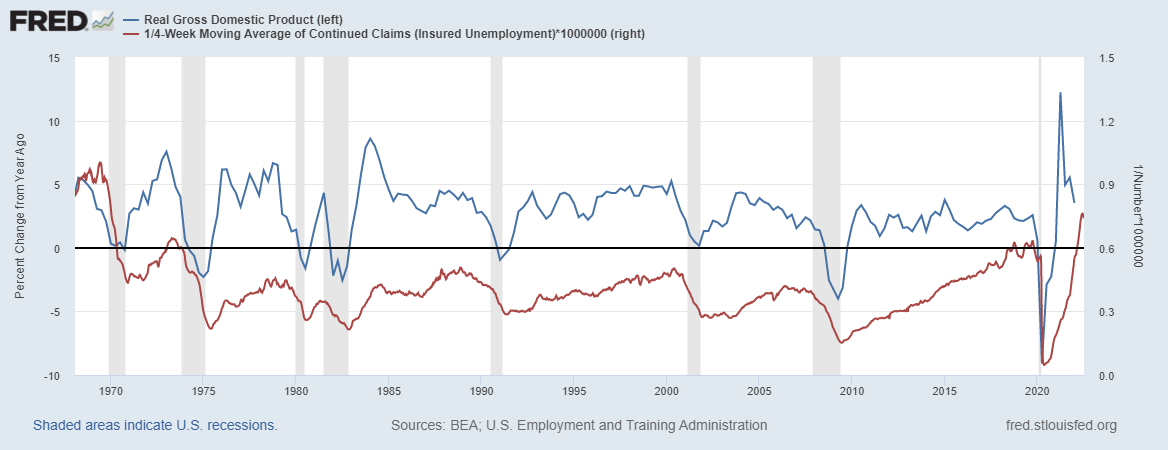

The Fed is also trying to combat raging inflation, which reached a 9.1% annual rate in June, the worst mark in nearly 41 years. Rapid price increases, particularly for such essentials as food, gas and rent, have eroded Americans’ incomes and led to much gloomier views of the economy among consumers.Inflation creates a price illusion. Only looking at wages, revenues or GDP makes one think there's growth. The number is going up. Adjusting for inflation reveals the more activity you engage in, the more money you lose because it's happening with devalued currency. .
It did in the first three months of the year, when GDP contracted 1.6% at an annual rate. Economists have forecast that on Thursday, the government will estimate that the economy managed to grow at an annual rate of just below 1% in the April-June quarter, according to data provider FactSet. If accurate, that forecast would indicate that the economy isn’t technically in recession by any definition.This isn't an argument devoid of logic. There have been near-miss recessions in the past. The flaw here is inflation. It assumes these numbers are accurate and won't be revised in the future. Given the high rate of inflation, I'm highly confident future revisions will be negative.Even if growth does go negative for a second straight quarter, Fed officials and Biden administration economists point to a lesser-known measure called “gross domestic income.”
GDP calculates the value of the nation’s output of goods and services by adding up spending by consumers, businesses and governments. By contrast, GDI, as the name implies, seeks to measure the same thing by assessing incomes.
Over time, the two measures should track each other. But they often diverge in the short run. In the first quarter, GDI grew 1.8% — much better than the 1.6% decline in GDP.
As part of its judgment of whether an economy is in recession, the NBER considers an average of the two measures. In the first quarter, the average was 0.2%, suggesting that the economy expanded slightly.
Consider these charts and comments from Jeff Snider:

Inverted curves aren't about what just happened. They've already discounted the (likely) 2 qtrs of negative GDP. IOW, the "technical recession" is already in there.
— Jeffrey P. Snider (@JeffSnider_AIP) July 26, 2022
The deep inversion is about what's still coming. And if what already did is half a year of lower output... pic.twitter.com/QGl8KNiezI
The market can't be discounting something like dot-com recession, because that scenario would mean we've already had the recession (Q1/Q2 '22). Can't be something like H1 '08, either. Inversion *has* to be something like 81-82 or 2d part of 08-09.https://t.co/EH7guxTKpo pic.twitter.com/iwE3bxruVq
— Jeffrey P. Snider (@JeffSnider_AIP) July 26, 2022

The rise of the U.S. dollar exchange rate this year has made monkeys of all the dollar bears. Cyclically, the U.S. dollar was primed for a decline, yet instead it has broken with four decades of cycle history and moved higher. The U.S. economy is shrinking as a share of the global economy, yet as a reserve currency and unit of account, creation of simulacra dollars (Eurodollars) exceeds that of the base money. Base money growth in the U.S. rises, but demand on that base money rises faster because of overseas credit creation. Hence demand for the base money rises when expansion of the credit money (Eurodollars) slows or contracts.
I predict that, if the U.S. dollar loses reserve currency status, avoids going the way of Zimbabwe and something like SDRs replace it, the U.S. dollar will eventually appreciate versus the SDR. For the same reason the German deutschmark would appreciate versus a rump euro. Whenever there is a shared resources such as a common currency, he who prints most will drive the value of the currency lower.
Mises.org: ECB’s Long Journey into Currency Collapse Just Got a Lot Shorter
The new instrument, born under the name “transmission protection instrument” (TPI), will be the catalyst to the accelerated full transformation of the ECB into a bloated European “bad bank” fund. This entity enjoys a giant privilege. Its liabilities are in large part the designated money (whether as banknotes or as reserves of banks) enjoying huge protections as such (most importantly legal tender) in all member countries of the European Monetary Union.The euro is weak because it allowed countries such as Greece to issue "deutschmark" bonds in the 2000s. The euro was strong because of Germany, rather than weak because of Greece. Economic policy in Germany looks even worse than that of Greece in 2022, hence the rapid decline in the euro. The breakup scenario for the euro, however, has always been a German exit because the common currency exchange rate trends towards the most profligate borrowers over time. As soon as the European Union passed on kicking Greece out, it guaranteed the most likely breakup scenario is a German exit.In effect, since the EMU crises of 2010-12, the ECB has been the agent which has “communalized” much of the bad state and bank debt of Italy (also Spain, Portugal and Greece). It has done this by issuing euro money liabilities against giant purchases of government paper and long-term lending (called LTROs) into the corresponding weak banking systems (again most of all Italy).
This communalization has created three big problems for the future of the euro:
Third: the tolerance of the German public for this transformation of the ECB and its money could snap in a way which means that the Federal Republic pulls out of the union. Germany has been critical in keeping the ECB humpty dumpty together. Partly this critical role depends on public perception (that Germany stands behind the ECB and all its potential losses), albeit there is much wishful thinking here rather than legal fact.The same logic can be applied to an SDR, special drawing rights from the IMF. Whether it is formal or not, a move to a world with no dominant reserve currency is not that different from one with the SDR as the main reserve asset because in both cases, countries will be using currency baskets. The U.S. losing its reserve currency status would look more like a German exit from the euro than not in terms of the domestic economy. A costly adjustment period followed by the U.S. "decoupling" from the global economy as it becomes free to pursue a mercenary America First national economic plan. Placing tariffs on Chinese goods and on Chinese purchases of U.S. assets is fraught with economic costs today because it threatens the reserve currency status of the U.S. dollar....If, for whatever reason, the Italian spread (Italian government bond yields vs. German) suddenly widens – perhaps because markets distrust the political direction or sense that Italian credit institutions are in a new bleak situation – then the ECB can turn on the taps. Yes, it will sterilize the new lending, that means presumably disposing of German and Dutch paper in the ECB balance sheet to make room for Italian for example, becoming even more of a bad bank.
There are decisive moments in monetary history. The aftermath of July 21 is likely to be one of them as regards the European monetary future. These problems have become a lot worse
In the near-term though, it is the breakup of the euro that is helping lift the U.S. dollar because the (formerly?) dominant Germany economy is being pulled down by green idiocy, Baizuo foreign policy and the deficit spenders in Southern Europe. Declining social mood makes a total breakup increasingly likely. Keeping the euro together will require printing money much faster than in the United States. Investors and businesses that leverage themselves on the assumption of a relatively weak dollar will experience deflationary collapses as happened in 2008, 2011, 2014, 2018, and again in 2022.
1. Inflation is a rise in money and credit. The biggest force for inflation this cycle was...federal deficit spending and stimulus. Mostly over. "Real" money supply is falling. "True" money supply is falling.
2. Rising commodity prices are not inflation. They can be inflation, and they can help create inflation if the central bank or government "finance" the increase instead of accepting slower growth. That was the Fed in the 1970s. That was the Fed until May 2022.
3. Markets don't care about the CPI, they care about first and second derivatives. When the inflation starts starts turning, markets reprice. Understand that gasoline quickly dropping to $3.50 per gallon is still relatively high for U.S. consumers, but that it represents a deflationary bomb in the financial markets.
4. Consumer prices can keep rising. When I say disinflation/deflation is starting, I always get pushback of "have you been to the supermarket lately?" Don't trade on this information. Consumer prices probably won't drop much. If they drop, it could take months. Gasoline is a prominent exception.
5. The yield curve is inverting. The market is starting to price in rate cuts.
There it is; Dec '22 Euro$ futures inversion.
— Jeffrey P. Snider (@JeffSnider_AIP) June 22, 2022
Only a matter of time, tho it didn't take much time which should scare the pants off people.
It's amazing just how many people are in denial about this. Euro$ futures nailed 2019, predicted 2008 & got dot-com recession b4 dotcoms pic.twitter.com/xYy9PYtk8d
On to the charts...
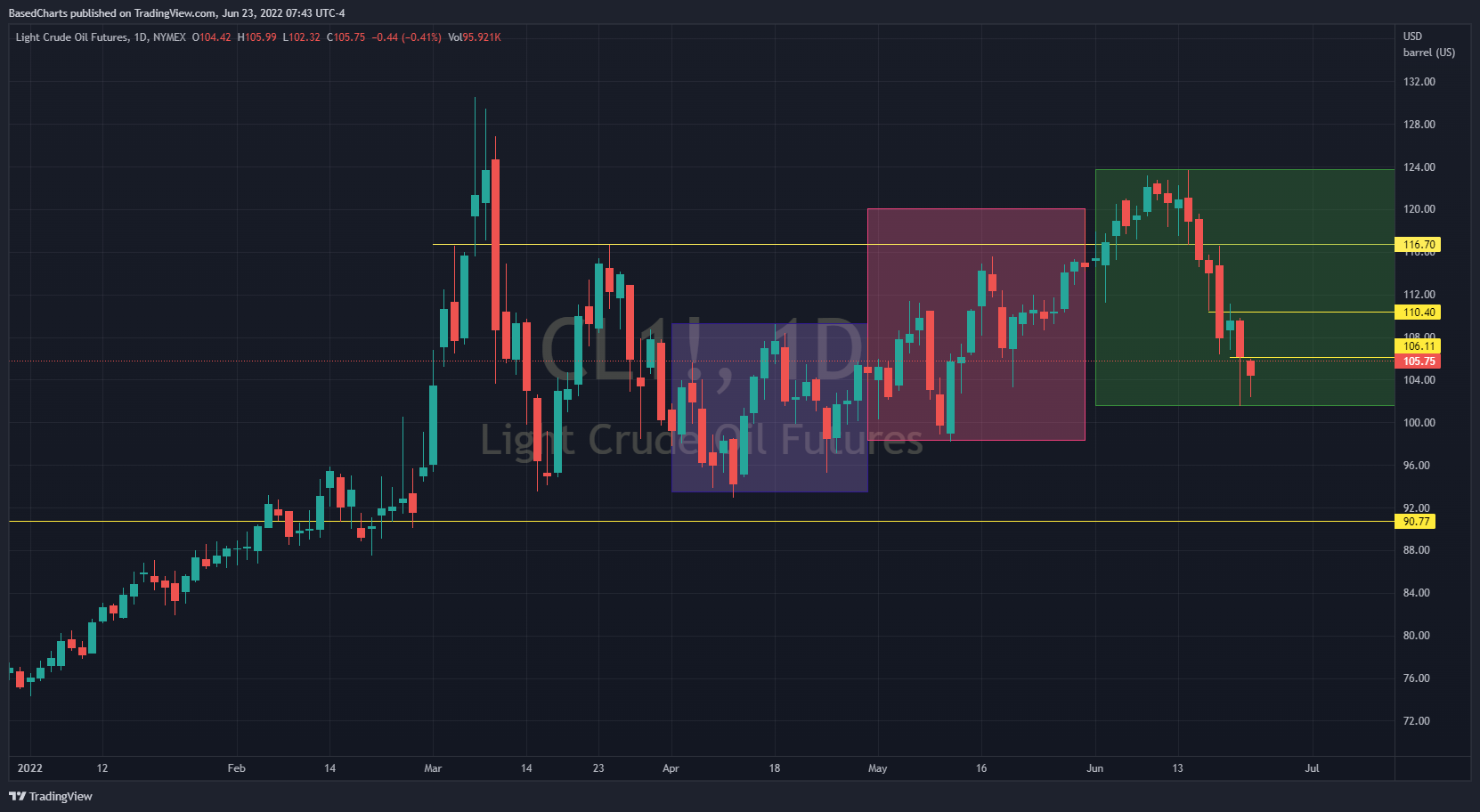
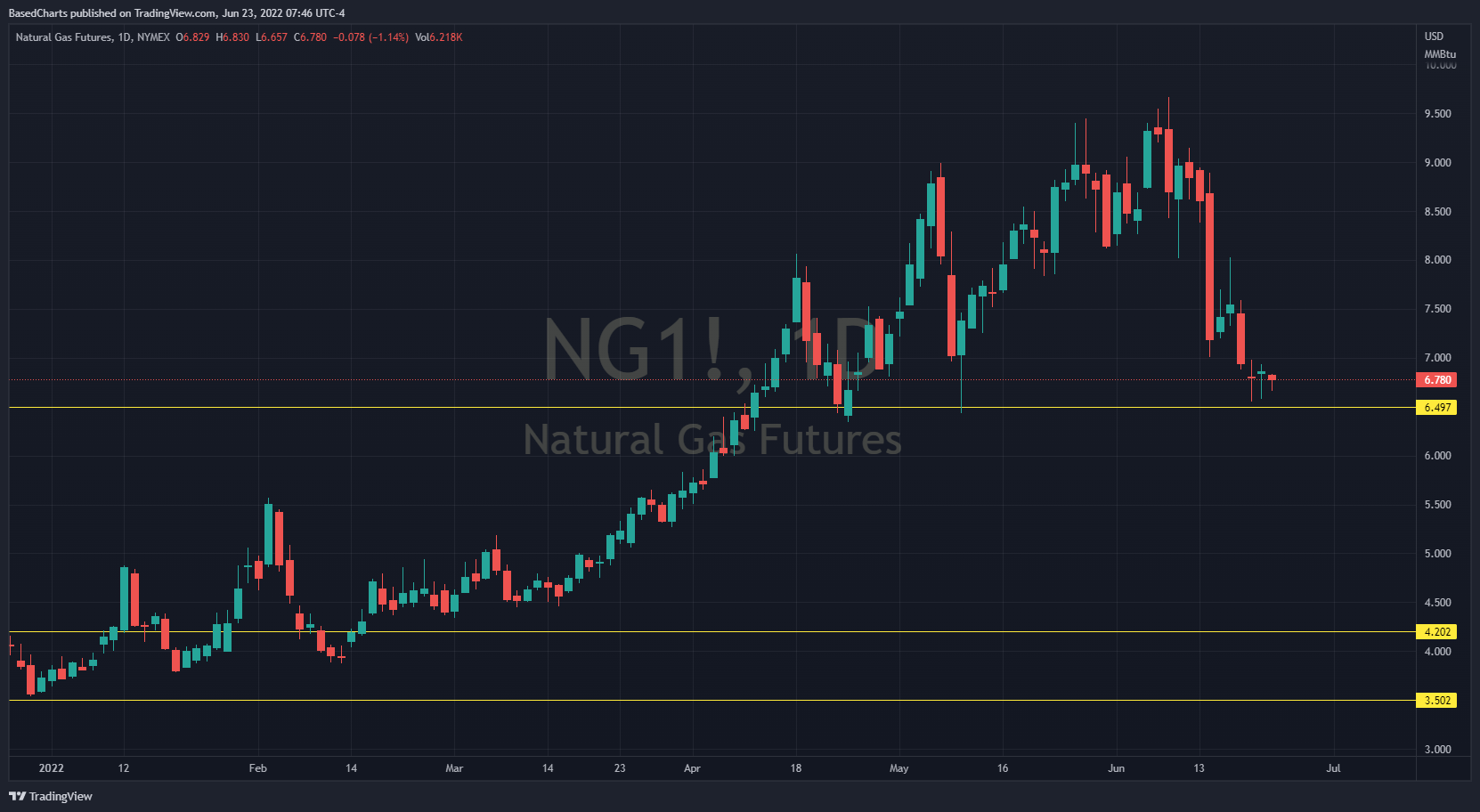
Wheat





Nomura became only the second bank to join DB in calling for a recession as its base case, and also became the first bank expecting this outcome to hit some time in the second half (unlike DB's generously delayed forecast of a "late 2023" recession).Q1 GDP was negative and Atlanta Fed is at 0.0 percent for Q2. I'm calling a technical recession right now and it started in January 2022. Technical recession means two quarters of contraction of any size. I also think the contraction is larger than reported and that the BEA will revise the deflator higher next year. I also expect Nomura could be right that the worst of it will be coming later this year, in which case there may be 4 consecutive quarters or more of contraction.
"The Federal Reserve will have to cut interest rates to fight the [stagflationary] recession." -various retards
"The Fed is hiking rates into a recession!" -various ignoramuses who never looked at a chart of the Fed funds rate and recessions in the 1970s
"The Fed can't do X!" -various bulls...with X being what will make stocks go down. The Fed will do some multiple of X.

People will be ordered to work from home in the event of a major fuel crisis sparked by the war in Ukraine, under secret Government emergency plans.The market can instantly solve the problem of high fuel costs because people will ration it themselves. High prices, unfortunately, are the best cure for high prices sometimes.The Irish Independent has learned confidential details of an emergency planning exercise held 10 days ago between all the major state agencies and the Government.
...Delegates were given a scenario of a 20pc diesel supply deficit in September and a 35pc drop in supply in December. The third and most extreme scenario proposed for February 2023, is where gas and oil supplies cannot meet the demand for electricity generation or farmers preparing to cut silage.
The Irish Independent can reveal that in the event of a national fuel crisis, emergency contingency measures discussed at the high-level meeting include:
:: All non-essential workers will be ordered to work from home
:: A limit will be placed on all non-essential car travel
:: A strict limit on the amount of fuel motorists can buy at any one time
:: The implementation of an immediate and strict reduction in the speed limit on motorways.
The plan also includes the introduction of an emergency scheme whereby motorists with an odd number at the end of their car registration will only be allowed to drive or refuel on alternate days.
Socialism aka scientific socialism aka communist are all forms of the Fatal Conceit (PDF link).
The book attempts to conclusively refute all forms of Socialism by demonstrating that socialist theories are not only logically incorrect but that the premises they use to form their arguments are incorrect as well. To Hayek, the birth of civilization is due to the start of societal traditions placing importance on private property leading to expansion, trade, and eventually the modern capitalist system, also known as the extended order.[1] Hayek argues that this demonstrates a key flaw within socialist thought, which holds that only that which is purposefully designed can be most-efficient. Moreover, statist ("socialist" is Hayek's terminology) economies cannot be efficient because of the dispersed knowledge required in a modern economy. Additionally, since modern civilization and all of its customs and traditions naturally led to the current order and are needed for its continuance, any fundamental change to the system that tries to control it is doomed to fail since it would be impossible or unsustainable in modern civilization. Price signals are the only means of enabling each economic decision maker to communicate tacit knowledge or dispersed knowledge to each other, in order to solve the economic calculation problem.Below the entry on The Fatal Conceit has "see also Dunning-Kruger"
In 2011, David Dunning wrote about his observations that people with substantial, measurable deficits in their knowledge or expertise lack the ability to recognize those deficits and, therefore, despite potentially making error after error, tend to think they are performing competently when they are not: "In short, those who are incompetent, for lack of a better term, should have little insight into their incompetence—an assertion that has come to be known as the Dunning–Kruger effect".Every socialist suffers from this, from those who want government run healthcare to those who think they can lockdown an economy, to those trying to solve problems caused by government policies of inflation and central planning with more inflation and central planning, to the communist governments that tried planning all aspects of the economy. It's one giant Dunning-Kruger all the way down. Socialism fails, along with other forms of centralization, from it's underlying assumption: that planning is possible, let alone superior to the market. The market here meaning, the individual freely choosing how to spend their money and not some euphemism for corporate control, itself a form of central planning once it becomes too large and begins behaving like, or merging with, government.
The wise man knows there is no more efficient allocator than the market. The wise man knows that, in the case of say education or healthcare or housing, that even seemingly simple interventions such as subsidies for the poor can have wildly destructive effects on the economy. See the current U.S. healthcare system which has been tinkered with by government for the past 80 years. There are many economic problems in society, but most of these fall into the category of nature (the lazy are poor) or law. They are either "permanent" problems or can be solved without any ideology.
The fatal conceit isn't limited to socialist ideology, even if nearly all socialists are planners at heart. It doesn't necessarily have to be socialist in outcome, but the term "scientific socialism" exists for a reason. It can begin with the idea that the "wise" or "learned" can control the economy. When this idea takes hold in a democracy it creates a Dunning-Kruger feedback loop where the dumbest voters think that someone can plan the economy and vote for people who are dumb enough to try. Society spirals down through various levels of Hell on Earth as this feedback loop feeds on itself.
The key word being science. "Trust the science." The CCP often uses the term scientific socialism, not to describe socialism as much as their "scientific" approach to managing the economy. Now they are running covid tests on Alaskan king crabs being cooked in restaurants...(unfortunately I didn't grab the video I saw on Twitter, but that link goes to an India Today report that reports on China doing covid tests on cray fish...) Point being, if you can recognize the insanity of testing crabs being fried or boiled for covid-19, then you can eventually recognize that this is "socialism" and "trust the science" all the way down. The fatal conceit begins the moment one believes they can control nature. Hundreds of millions of people were killed directly and indirectly by socialists in the 20th Century who were trying to do the equivalent of covid tests on boiling lobsters. Their plans are insane or doomed to fail from the start.
We can contain most inflation. We can make housing more affordable. We can raise wages. We can eliminate energy and food shortages. We can make healthcare more affordable and widely available. We can do many things, but none of these will be accomplished with "science" or "socialism" or "corporatism" or any people who think they can plan society beyond the broadly general sense of things like tax policy. Should government fund itself with sales tax, income tax, property tax, tariffs or capital gains tax? All? One? In what proportion? This decision alone has massive impact on society. There are arguments for and against all of them. What's going on today is not government policy in this broad general sense, but a government trying to micromanage the economy right down to restricting the movement of people, restricting their healthcare options and restricting their speech online, the latter two often farmed out to corporations...
Almost all the Greens are planners, the entire climate hoax is like the covid hoax, taking a small problem and using it as justification for the takeover of the global economy. Our crisis is not caused by covid or the climate, it is caused by people who lie about the size of these problems and use that lie to justify their own power, and the increase of that power to the point where a totalitarian government can shut off your car, your healthcare, your job, your Twitter account.
We got lucky, I think, by the covid collapse revealing the plans of the Greens. It's all the same people, the same class of planners. They wanted to do exactly what happened in 2020, but they planned on doing more slowly and making it appear more natural. That they're out there celebrating high inflation, energy and food shortages finally knocked their masks off.
Elites Begin to Flee in Preparation for TOTAL COLLAPSE and Worldwide Social Unrest

Central planning is stupid. People who promote centralized control over allocation of resources are morons with no business being anywhere near political power. The lockdowns were a failed idea. I thought we needed it at first because I expected a wave of cases, hospitalization and deaths. By May 2020 at the latest, it was obvious the lockdowns were unnecessary. Anyone who promoted lockdowns beyond May 2020 is an incompetent unfit for public office or public decision making. Probably wouldn't want them working in a decision-making capacity at your company either.
The lockdowns retarded children's learning and social development. Now babies are being starved of their formula because of the ongoing fallout from those lockdowns. The ruling class has earned 100 percent of the blame for this disaster.
Yet, many people give inflation a pass. Inflation is not simply higher prices! Prices are the most important information in an economy. It tells us what is being demanded by the public. Anyone with basic economic education knows price controls are disastrous because they interfere with the signal. If you set prices too high (minimum wage, price supports) you get oversupply. High unemployment, constant bankruptcy in the industry such as airlines. If you set prices too low (rent control, food and energy controls) you get a shortage because suppliers will only deliver as much as the price calls for. When the government and/or central bank engage in massive monetary creation, it is not evenly distributed in the economy. Money doesn't flow everywhere at the same time, it is concentrated in some goods and industries first. This causes more capital to flow into this sector. Businesses will invest in more production. This turns into a crash later when it turns out demand was unsustainable.
Here is an article from 2008: The Cause of the Food Shortage
First, the underlying cause of any shortage is the lack of a free market, since genuine shortages cannot appear in a free market. Instead, while prices of goods would likely rise at the onset of reduced supplies, the goods in question would always be available at some price—and the higher the price, the more the supply would increase to meet demand, which would then of course reduce the price.
...The second issue Krugman fails to mention is that high food prices are a manifestation of current worldwide price inflation. World governments have been printing money at very high rates this decade. While the United States has been expanding the money supply by “only” about 10–15 percent per year, many countries have printed money at rates exceeding 50 percent per year. This money, which had been previously contained mostly in world stock markets, has now also spread to commodity markets, from which the prices of food are derived. Since money is now being created faster than goods are being created, prices are rising.
As another example of this phenomenon of the increase of money exceeding the increase in supply of goods, we may cite the rise in oil prices. Although this has been attributed in the press and other public forums to speculation, greedy oil companies, and increased demands of oil from China, the real cause is the increasing disparity between available money and available oil.
The same thing has been happening repeatedly for the past 15 years, and long before that. It's the same thing over and over and over and over because many people who like to cite Lord of the Rings never figured out the message.
With baby formula, the government shut a production facility that makes 40 percent of the U.S. supply. Maybe that was the correct decision, but they didn't get the plant up and running as fast as possible. As of yesterday, the plant is still closed three months later. Meanwhile, the economy is still experiencing price surges caused by government stimulus and Federal Reserve policy. As a result, money can quickly flow into baby formula (demand) and buy it up.
Whenever you hear someone use the words hoarding and price gouging, you are almost 100 percent of the time dealing with a manmade or natural disaster. The Biden administration tried blaming parents for hoarding formula, but why wouldn't they when they see it disappearing from the shelves? Why is it disappearing from the shelves? Unsustainable demand fueled by inflation and the fact that they shut down the factory. Plus, they're hoarding formula themselves and giving it to illegal aliens.
The point I'm trying to drive home is that inflation and the lockdowns alone were enough to wreck supply chains and cause all the disasters unfolding. That a uniquely incompetent regime won political office in 2020 adds fuel to the fire, but the current extreme troubles all originated in March 2020 and have been getting worse ever since.
If there is a conspiracy, coordinated action creating accidents at food processing plants, my first guess would be foreign agents. China and Russia want the Biden administration out of office. China's lockdowns, along with perhaps Iranian sleeper cells or other foreign saboteurs coming through the open U.S. border, could be hitting a plant and then going home. Many of these are regular industrial accidents and a few more incidents sprinkled in can go unnoticed.
It may not be a conspiracy though. Lockdowns took people out of work. Labor supply is messed up. Negative social mood is also associated with increased industrial accidents. It's likely that some of the increase is caused by inexperienced and distracted workers.
Finally, it could be that the ruling class is really that evil or incompetent, or both. For myself though, that is something for the justice system. For the inflation and lockdowns alone, they should be removed from power. Whether they are engaged in behaviors that could warrant jail or worse is something to sort out later.
Most countries on Earth are not that wealthy. Most engage in some form of economic intervention that damages their economies. Some are smarter about it, such as Scandanavian countries. China went from maximum stupidity to much less stupid and became far more wealthy in the process. The trend is very clear and there's only so much stupid an economy can take before it goes straight down the tubes. The U.S. has achieved the tipping point of stupidity with Wokeism and the Baizuo administration. I do not see Republicans offering anything better at this point except that they will stop some of the stupid.
America is weighed down by a useless, overeducated class of busybodies who subtract value from the economy. The economy would be vastly improved if it paid these people to dig ditches and fill them in again, if that meant the rest of us could go about our business. Is this ruling class of retards intentionally or unintentionally destroying the U.S. economy? I care not. It is a question without immediate significance because my goal is getting the U.S. economy back on track. They must be removed from power ASAP. Pray that the ballot box works. Pray that a majority of your fellow Americans aren't so retarded as to think this government and central bank aren't to blame for all the calamities that have struck the past two years because many more calamities will follow if they remain in power.
If this is true, it could deal a significant propaganda blow to the cryptocurrency market because one of the selling points is the deflationary, anti-bank qualities of a purely digital fiat currency. The real loser may not be cryptocurrencies however, but the exchanges. The current exchanges are a vulnerability for cryptocurrencies and a step backwards, introducing counter-party and cyber-security risk. ...The greater irony is that if this is all true, what happened to Bitcoin is happening to the entire global economy in real time. The Chinese yuan is to eurodollars as Bitcoin is to Tether.I daresay BTC would be doomed to a guaranteed drop of 95 to 100 percent if it turns out the price is propped up by credit inflation via stablecoin because the whole rationale behind BTC has become its "digital gold" properties. While those would technically still exist, the fact that the price could be manipulated by credit inflation would make it less attractive than gold. The narrative would be destroyed.
With no central bank or government backing of any import, a stablecoin fiasco would reveal cryptos are not like digital gold, but more like wildcat banking of the 1840s.
Wildcat banking refers to the practices of banks chartered under state law during the periods of non-federally regulated state banking between 1816 and 1863 in the United States, also known as the Free Banking Era. This era, commonly described as an example of free banking, was not a period of true free banking, as banks were free of only federal regulation; banking was regulated by the states. The actual regulation of banking during this period varied from state to state.According to some sources, the term came from a bank in Michigan that issued private paper currency with the image of a wildcat. After the bank failed, poorly backed bank notes became known as wildcat currency, and the banks that issued them as wildcat banks.[1] However, according to others, wildcat meant a rash speculator as early as 1812, and by 1838 had been extended to any risky business venture.[2] A common conception of the wildcat bank in Westerns and like stories was of a bank that left its safe somewhat ajar for depositors to see, in which the banker would display a barrel full of nails, grain or flour with a thin sprinkling of cash on top, thus fooling depositors into thinking it was a successful bank.
The traditional view of wildcat banks describes them as distributing nearly worthless currency backed by questionable security (such as mortgages and bonds). These actions ended when note circulation by state banks was stopped after the passage of the National Bank Act of 1863. Mark Twain, in his autobiography, refers to the use of such currency in 1853, "The firm paid my wages in wildcat money at its face value".
Coindesk: UST Stablecoin Loses Dollar Peg for Second Time in 48 Hours, LUNA Market Cap Falls Below UST's
TerraUSD (UST) has lost its dollar peg for the second time in three days, falling to as low as $0.65 on Monday, according to the most recent price estimates from CoinMarketCap.My gut tells me this is all a giant Ponzi at worst and a giant case of fractional reserve lending at best. Money market funds "broke the buck" in 2008 and the financial system almost crashed. This is like the dark days of September 2008. If you forget what was going on at the time:As UST has "depegged," the price of LUNA, its sister token, has dropped over 44% to $35 in the past 24 hours according to CoinMarketCap.
UST, a so-called algorithmic stablecoin, works with LUNA to maintain a price of $1 using a set of on-chain mint and burn mechanics. In theory, these mechanics work to ensure traders can always swap $1 worth of UST for $1 worth of Luna, which has a floating price and is meant to serve as a kind of shock absorber for UST's price.
Luna's price decline puts its market cap below that of UST's. That potentially throws the foundation of UST's entire stabilizing mechanism into jeopardy, because it means a Terra bank run could lead to some users no longer being able to redeem their $1 of UST for $1 of LUNA.
...Today’s depeg comes after the Luna Foundation Guard (LFG) announced Sunday night that $1.5 billion of its massive bitcoin reserves would be “loaned” out to professional market makers to proactively defend UST’s dollar peg.
How much of the system is backed by BTC that can itself collapse? I'm not worried about a single stablecoin going down, I'm worried about a systemic run on the entire industry if BTC is propping up multiple stable coins (as I suspect is the case with Tether).
We have never witnessed a sustained bear market and recession in the age of crypto. The last honest-to-God bear market was about 40 years ago. Every one has been bailed out. If inflation stays high though, the Fed's hands will be tied. It won't matter even if they try to help. Lending rates will keep rising, meaning debtors who need capital will go bust if they cannot finance those ever rising rates of interest. If they're backing their own assets with BTC...there's no central bank issuing BTC to stop the collapse the way the Fed can issue more FRNs to banks...and while they probably could bail it out if they wanted to, I'd bet USG would rather see all the private cryptos fail and then unveil the central bank digital currency or US Treasury Coin. Update: Here's UST/USDT


Since all renewable energy projects were cancelled when Premier Doug Ford was elected, the province currently has no other way to compensate for the looming shutdown of a major nuclear reactor in Pickering, responsible for roughly 16 per cent of province-wide power. Only natural gas is available to meet rapidly growing demand for electricity, according to the IESO projections.The projections show that the province’s natural gas plants — which only operate about 60 per cent of the time now — will run non-stop by 2033.
“The province has ignored energy planning for the last four years because there was no need. We had an energy surplus,” said Gord Miller, Ontario’s former environment commissioner — an independent watchdog position eliminated by the Ford government. “But now we’re in an energy squeeze. When Pickering turns off, we have no plans … and the default option is to up the gas.”Green ideology is retarded because it is infested with central planning mentality and functions more like a religion. It fails on so many levels because it is irrational, faith-based and anti-scientific. Even if they were correct on the threat from CO2 emissions, which they wildly overstate, they are politically incompetent. Physics, logic, politics, on every level the plans are ludicrous.The story of how Ontario went from being a polluter to a beacon of green energy and back again is a political one that spans almost two decades and three premiers.
It starts in 2003, when then-premier Dalton McGuinty went out on a political limb to announce the complete phaseout of coal-fired generation. Over the next 12 years, carbon emissions from the electricity sector dropped precipitously — from more than 35 megatonnes of carbon in 2005 down to six in 2014, when Ontario became the first jurisdiction in the world to completely wean itself off coal.
But the cost of this achievement — a tripling of electricity rates — demanded a political price.
Because so much of what was bought (and put into inventory) at the margins came from those outside sources, Real Final Sales of Domestic Product, everything which was made or served by Americans and American businesses sold to anyone anywhere, also dropped like the headline in Q1, underscoring just how much all that stuff shown above really is propping up the public’s visualized sense of the overall economic situation.Below is the repo fail chart from the article, along with two earlier ones to put it into context.As has been the case since the last recession, spending on goods may be up though spending on services is not. Therefore, combined, consumer spending adjusted for prices (and seasonality) is barely keeping up with the pre-2020 trend. This lackluster outcome the clear result of Americans having to pay more for goods in order to get fewer of them, leaving them unable to complete the services recovery.


BEA: Gross Domestic Product, First Quarter 2022 (Advance Estimate)
Real gross domestic product (GDP) decreased at an annual rate of 1.4 percent in the first quarter of 2022 (table 1), according to the "advance" estimate released by the Bureau of Economic Analysis.
Has the Recession Already Started?
As of April 5, 2022, the Atlanta Fed's model projects 0.9 percent GDP growth in Q1. Government economists don't have to be massively undercounting inflation for this to be a recession already. At an 8 percent CPI, it would only take a 12.5 percent error rate to wipe out all the growth. The nominal GDP climbs 9 percent and 8 percent of that is price increases, there is 1 percent real growth. If inflation is 9 percent, zero growth. If inflation is 10 percent, the real economy contracted 1 percent. I'm not making a call one way or another. I merely wish to point out that a small error wipes out small growth. That prices are experiencing volatility unseen in 50 years. That price, economic and geopolitical changes are happening faster than models can account for.The BEA announcemnt shows this is exactly why the economy contracted:
Current‑dollar GDP increased 6.5 percent at an annual rate, or $379.9 billion, in the first quarter to a level of $24.38 trillion. In the fourth quarter, GDP increased 14.5 percent, or $800.5 billion (table 1 and table 3).Why is Inflation Bad?The price index for gross domestic purchases increased 7.8 percent in the first quarter, compared with an increase of 7.0 percent in the fourth quarter (table 4). The PCE price index increased 7.0 percent, compared with an increase of 6.4 percent. Excluding food and energy prices, the PCE price index increased 5.2 percent, compared with an increase of 5.0 percent.
Everyone focuses on prices during inflation, but prices under inflation are the least valuable. They are distorted by the inflation, but they do not capture the inflation properly. It's not like everything goes up in price by 5 percent. By creating price distortions in the economy, people chase after things rising faster in price. If food prices go up, what do they do? Hoard food. So the price goes up faster. Yet, there is actually no problem with the food supply. The move is a created by price distortions.There are some real problems with food supplies, but the fact remains that inflation alone can cause food shortages. It destroys price signals that allow the trasmission of important economic information. This crisis is wholly the responsibility of the Federal Reserve, along with USG for both its spending and lockdown policies.
In The Price Illusion, I discussed Jeff Snider's work showing Japan's imports and exports are terrible once price is taken into account.
The stats out of Japan put a giant exclamation point on the price illusion caused by inflation. Exports rose 15 percent, imports 30 percent. Back out price effect and exports fell 2 percent, imports unchanged from a year ago. They're paying 30 percent more for the same volume of imports...now the tumbling yen makes perfect sense, right?Way back in December, the odds of recession were high. All spikes in inflation produce recession, it's a 100-percent guaranteed signal: High CPI Screams Recession and Bear Market
Here's another similar chart, but with different variables: PPI minus CPI. Every spike like the one underway now (and this one is the biggest) produced a recession and major bear move in the stock market.Another important post was this one on the Restoration Hardware earnings call: Wall Street Ignores Margin Collapse Warning....People say the Fed is walking into a policy error. Their errors were already made when they pumped the market. The question, as always, is the one asked by Von Mises: will they voluntarily abandon the inflation or will they eventually destroy the currency system? Right now, the Federal Reserve is signaling voluntary abandonment. For however long that lasts, look out below. My expectation, my forecast, is that the Federal Reserve is going to wait longer than the bulls expect because it does not want to launch QE5 with the PPI still running hot. Whether that is in time or price, I cannot say. IF it takes longer, maybe crude at $50 is good enough for the Fed (an exmaple). If crude plummets to $40 by February, maybe they will reverse course much sooner. Either way, when Powell's "printer" is away, the bears will play.
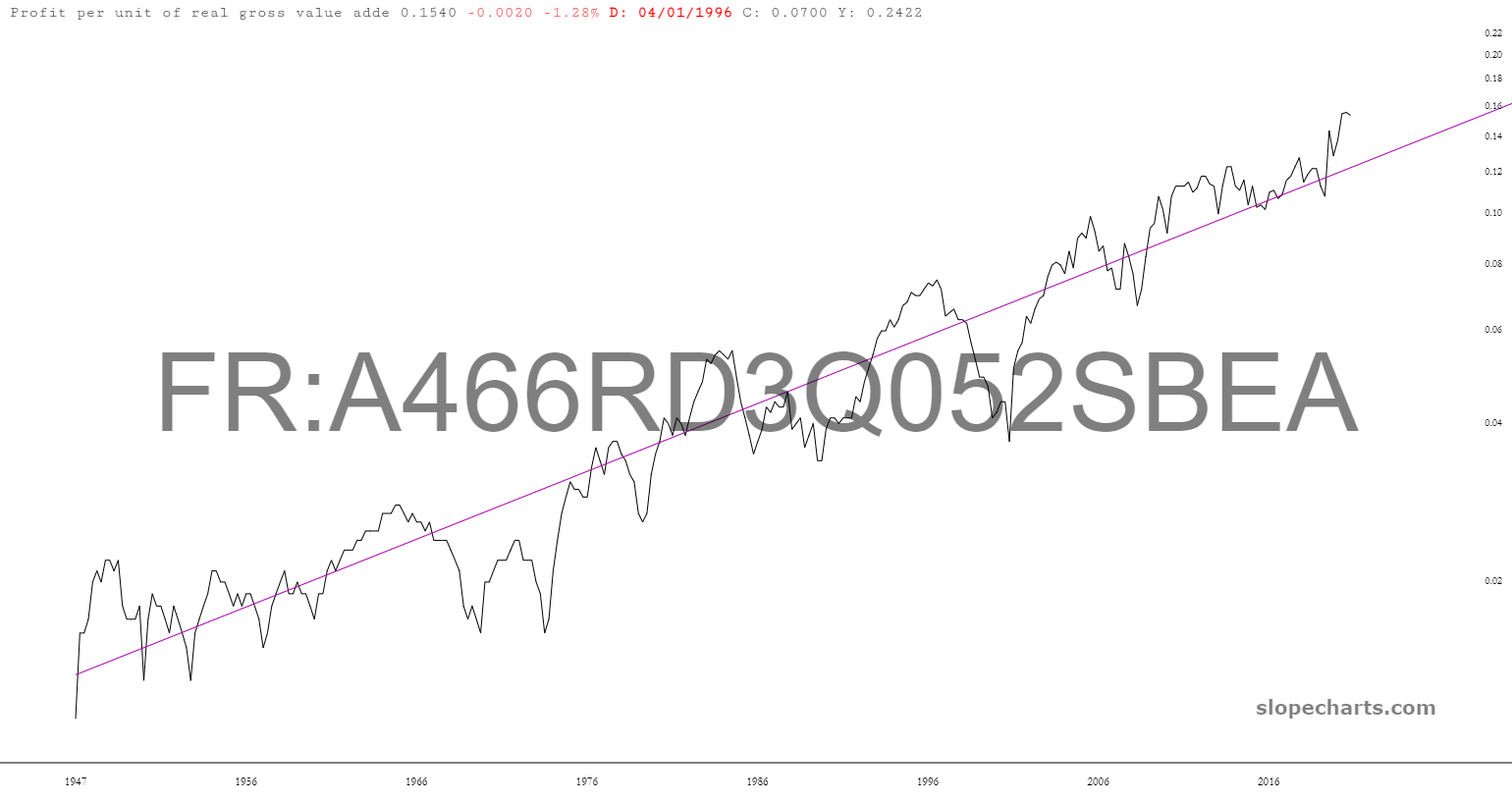
I didn't expect the recession would be visible yet, but it was. Most of Wall Street and economists, if they even predicted a recession, were saying much later this year or next year. I said Q1 2022. I was right.Here are profit margins with a regression line. Notice the surge following the pandemic. Inflation always looks like a boom at first. Corporations appear more profitable because inflation hits them first, in a good way. The first impact is rising demand. Every producer benefits because supply is constrained in the short-term.
Here is profit margin versus the S&P 500 Index:The RH CEO tells us the benefit for the end stages of production is gone. Inflation is turning into a destroyer of value:There's already evidence the recession may already be underway in the distribution stage.ZH: Looming Freight Recession Sparks Plunge In Trucker Stocks, First Post-COVID Job-Losses
Now you're going to hear calls for rate hikes or the Fed to slow down. Here's what you need to understand: the inflation caused the recession. If the Fed pauses, then lower your forecasts for the economy. The recession will get larger and deeper down the road. If the Fed instead signals this GDP report changes nothing (what they should do), then odds are a major recession could unfold. That would be a great buying opportunity in the markets. If instead the Fed does back off on their currency policy stance, markets could rally for a time, but as with the economy, the eventual low for stocks will be much lower than it would be if the Fed kills inflation now.
In 2008, Wall Street almost blew up the world because home prices broke from history. Home prices never went down nationally. The quants created the correlation with their financial models though, they made it possible and it happened.
Today, I see similar setups throughout the market. Consider this discussion of yen weakness being a threat.
WSJ: Japanese Yen’s Drop Raises Potential for Broader Market Trouble
But the yen’s rout might cut into Japanese demand for Treasurys. That is because as the yen weakens, Japanese investors with dollar-denominated assets will have to pay more to hedge against the risk of currency fluctuations cutting into their returns.This is the exact opposite of reality, but there are models that assume this is how the market works because it has worked in the past. The model is not prepared for Turkey Day. At higher-order stages of collapse, money flows to higher-order monies, which in this case includes U.S. treasuries and U.S. dollars.
I like to say, somewhat teasingly as I am a fan of Austrian economics, that Austrian economics only works about once a decade. I'm referring here to forecasting for investment purposes, not for guiding a government or society over the long-term. During the boom periods, many economic models work because the system isn't stressed. The same way the CCP or any other central planner can appear genius during a boom. It is only when the system breaks that the model fails. Between the busts, the tail can wag the dog. The tail can wag the dog for so long than "everyone" thinks the tail is the dog, and the dog the tail. Or maybe the dog doesn't exist anymore.
The endgame is when the Japanese investor incinerates the yen by dumping U.S. treasuries, triggering a rise in yields than feeds back into a weaker yen. In the endgame scenario where European, Chinese and American investors join in, global rates rise to the point where the yen has to be defended by rate hikes...that trigger currency collapse. Japan's total debt to GDP exceeds 1000 percent. There's no need to be precise because we're playing global thermonuclear war. What is the increase in nominal GDP if the average yield on Japanese debt is 3 percent? At 1000 percent debt-to-GDP, it's 30 percent. Catastrophic deflation or inflation are the options when a system this stretched reaches the crisis point. The euro and yuan are toast in that scenario too. Then the dollar as the last domino when the system reflates.
I have been ever so slowly increasing the amount of time I spend researching Japanese stocks. Still very little time spent on it, but up from zero in recent years. At some point the Japanese market could warrant substantial attention, and better to pay that attention before everyone else figures it out.
The stats out of Japan put a giant exclamation point on the price illusion caused by inflation. Exports rose 15 percent, imports 30 percent. Back out price effect and exports fell 2 percent, imports unchanged from a year ago. They're paying 30 percent more for the same volume of imports...now the tumbling yen makes perfect sense, right?
It's worse, so much worse on Japan's import side. Total imports were up more than 30% (THIRTY!) yy in March. By value.
— Jeffrey P. Snider (@JeffSnider_AIP) April 21, 2022
Actual quantity imported was 0.0% yy. Zero.
The Japanese paid almost a third more than last year to get the same mostly raw materials. That's going to be bad. pic.twitter.com/6v6XmYSp0S
iFeng: 新华社刊文:破除“美国金融模式迷信” 中国金融要走自己的路
In recent decades, some people in my country's financial circles have been consciously or unconsciously taking the United States as a model of modern finance and showing a considerable degree of blindness. The root of this blindness is the influence of neoliberalism. And the chaotic performance of the United States in this pandemic has surprised the whole world, causing people with different ideologies and values to think, why is this?More at the link.Joseph Stiglitz, the American Nobel laureate in economics, said recently: "The United States has always moved along the ideas of neoliberalism...believe that the market itself can solve all problems. In the past half century, the United States has This experiment has been done, and now we should admit: the experiment failed.” Perhaps these changes that have taken place and continue to help some domestic financial circles dismantle the superstition of the American financial model.
Kerry Brown, a Chinese researcher at King's College London, believes that there is a mindset in Western society's understanding of Chinese culture, and the first thing that needs to be emancipated is the emancipation of the mind. In my opinion, today's Chinese financial circles also need to emancipate their minds and think about China's problems based on China's national conditions and socialist values. We must have a emancipation of the mind to break the "foreign superstition" and "foreign eight-legged" on the path of financial development.
Financialization of the economy is unsustainable
Since the 1980s, under the banner of neoliberalism, the United States has opposed the 40-year financial repression policy under Roosevelt's New Deal, and allowed the financial industry to deviate from the industrial service model of serving as a financing intermediary for the real economy. In the name of innovation, Through financial derivatives and financial leverage, speculative arbitrage, madly chasing profits, and gradually transformed into a naked financial transaction model. By 2008, this model had reached its peak, and then a global financial tsunami broke out, which severely damaged the global economy and affected it to this day.
Regrettably, it seems that we haven't had time to deeply analyze and think about the deep-seated causes and consequences of the global financial crisis in 2008. After a short pause, we accelerated the pace of imitating American finance and started the financialization of the economy.
People are rushing to invest in finance and join in finance, and a large number of new banks, insurance companies and other financial institutions are emerging. Before the US financial tsunami in 2006, there were a total of 238 commercial banks and insurance companies in my country. In 2019, the number of commercial banks and insurance companies in my country increased to 447, an increase of 88% in 13 years. Among them, insurance companies increased by more, an increase of 120%.
Private equity funds with the purpose of betting on listings and speculative arbitrage have sprung up. In addition, there are hundreds of thousands of unregistered similar enterprises. Shadow banking business, wealth management business of various financial institutions, P2P, "backdoor" and "speculation" of junk stocks of listed companies are rampant, and real estate and commodities are financialized.
In the name of financial innovation, and even in the name of serving the real economy, financial derivatives spread from on-market to off-market with greater risks, from financial futures to commodity futures. Algorithmic trading based on computer technology such as leveraged trading and high-frequency trading is popular, making the financial market more fragile and full of crises.
In recent years, no matter how the central bank releases water, it is difficult for funds to flow into the dry fields of the real industry. This is not a problem with the central bank's monetary policy, but the huge siphon effect of the financial and financialized real estate's demonstration effect of making money quickly and making more money.
On the one hand, these siphoned funds have been transferred to financial institutions to make a lot of money in the financial market. Just as a bank president said a few years ago: "The profit of the enterprise is so low, and the profit of the bank is too high, and I feel embarrassed. "On the other hand, the real economy is gradually shrinking, slowly blowing up the financial bubble. In recent years, China's economic momentum has weakened and gradually declined. An important reason is the financialization of the economy.
Here, I would like to use a set of data to briefly describe the trend of economic financialization in my country in the past ten years. I still use 2006 before the US financial tsunami as an example for comparison. In 2006, the total profit of my country's industrial enterprises above designated size was 1,878.4 billion yuan. In 2019, the total profit of my country's industrial enterprises above designated size was 6,199.6 billion yuan, and the latter was 2.3 times higher than the former.
In 2006, the total profit of my country's financial enterprises was 395.01 billion yuan. In 2019, the total profit of my country's financial enterprises was 2,961.274 billion yuan.
In 2006, the ratio of the profits of industrial enterprises above designated size to the profits of financial enterprises in my country was 4.8:1; in 2019, the ratio of profits of industrial enterprises above designated size to the profits of financial enterprises was 2:1. In just thirteen years, the weight of industrial enterprises' profits in the overall economic aggregate has shrunk rapidly and the proportion of financial enterprises' profits has increased significantly, indicating that the financialization trend of the economy has become very significant.
In the first quarter after the outbreak of the new crown pneumonia epidemic in 2020, China's economy suffered a setback and fell by 6.8%, but the net profit of Chinese listed banks increased by 5.62% year-on-year. This phenomenon is unimaginable. The financialized economy will be unsustainable from both historical laws and realistic models, which is worrying.
Manufacturing is the foundation of the economy
China is a big country with a vast territory, a large population, increasing influence and a complex geopolitical environment. Unlike a small country that relies on natural endowments for food, can passively or actively accept the international division of labor, and is a small country, China must establish a relatively complete, Self-contained, healthy and balanced industrial system and economic ecology.
We cannot over-think comparative advantages and fantasize about international division of labor. Otherwise, we will be "incapable of breathing", which will not only make economic development unsustainable, but will also seriously affect national security. The basic driving force of China's economic system is the manufacturing industry. The important position of manufacturing industry is unshakable in the pre-industrial era (handicraft industry), steam engine era, electrical era and today's Internet era.
Manufacturing is as important as agriculture, which provides food for people. It is the creator of real material wealth and the source and driving force of all economic activities. Other industries have a relationship of prosperity and loss. Without the support of the manufacturing industry, other industries will be unsustainable. The foundation of all virtual economies and all service industries is manufacturing, including the splendid Internet economy.
Manufacturing is the core and foundation of the entire economic system, and is in the most important key position. Whether the manufacturing industry chain is complete or not, and how mature it is, determines the national strength, national transport and national economic security, public health security and national defense security. Manufacturing is the foundation of China's economy. We must be mindful and do our best as a nation.
In order to maintain the foundation of the country made in China, it is also necessary to clarify the primary and secondary relationship between the service industry and the manufacturing industry. Over the years, some people have seen that in western countries, including some developing countries whose economies are lagging behind us, the proportion of service industry in GDP is much higher than ours, and they have put forward the idea of building a big country in the service industry. Is this view correct?
First, the increase in the proportion of the service industry in the economic structure is due to the fact that the development of the manufacturing industry has provided technical support for the field of social life and created demand. At the same time, the improvement of labor productivity and technological progress in the manufacturing industry also made it possible for labor to transfer to the service industry, which indirectly supported the development of the service industry.
In short, the development of the service industry is a natural change due to economic and technological progress and changes in social life. It should not be a goal that people deliberately pursue, and should not put the cart before the horse and blindly promote its development.
Secondly, the service industry, especially the life service industry, has relatively low labor productivity, and the development of the service industry alone will affect the level of economic growth.
We should not only develop a life service industry that meets the growing material and cultural needs of the people, but also guide the development of a more productive manufacturing industry and a producer service industry that provides supporting support for the manufacturing industry. On the issue of promoting the development of China's industry, it is necessary to establish a correct concept and guide the optimization and upgrading of the industry.
Kuznets, winner of the Nobel Prize in Economics, proposed that the key to upgrading the industrial structure is the transfer of resources from sectors with lower productivity to sectors with higher productivity, thereby improving the overall resource allocation efficiency of the economy. Therefore, when we formulate industrial policies, we should have the right direction and not move against the direction of Kuznets' optimal allocation of resources.
Finally, the United States and other Western countries have failed to pursue the policy of "de-industrialization" by blindly developing the service and financial industries in the past three decades. The implementation of the "de-industrialization" policy has not only led to industrial imbalance and softening of the US industry, which has seriously affected the normal cycle of the overall economic system, but also caused a large "rust zone", a widening gap between the rich and the poor, and social divisions. When the new crown pneumonia epidemic came, due to the lack of manufacturing, the United States, known as the world's number one developed country, could not guarantee even the most basic public health security, and it was in chaos.
Therefore, we must not blindly imitate the United States in our economic development strategy, and firmly and steadily build a manufacturing power and a strong country.
If the Fed actually wanted to do less, it could let Bullard's comments percolate and then come in dovish if necessary. Instead, it unleashed an extreme overreaction that indicates they are far, far away from what Bullard said.
ZH: Fed Scrambles To Push Back Against Damage Caused By Bullard's "Immature, Unprofessional" Comments(Archive link)
After yesterday’s shockingly hawkish post-CPI outburst by Bullard, which sparked the biggest US rate shock since Volcker’s October 1979 massacre...It's over folks. Nobody is in charge. The vast majority of the market has no clue what's going on. Evidence is right here in bond market volatility. I posted SRVIX recently, as I've been looking at shorting bonds. The chart has a clear base and was moving towards a breakout. If you've been paying attention, the breakout in bond volatility was expected. I'm not sure who RJ O'Brien is, but if its the financial firm, it only speaks to how clueless and corrupt financial institutions are, that they panic over someone stating the obvious:...and whose comments RJ O’Brien slammed as “immature and unprofessional” adding that “as a 2022 voter, the St Louis President — who has a history of verbal gaffes and inaccurate monetary proclamations — may have gone too far in his comments on immediate policy”, the bond market has gone on tilt with yields blowing up especially on the front-end in one of the most memorable one-day curve flattenings in history...


