
![[Most Recent Quotes from www.kitco.com]](https://lh3.googleusercontent.com/blogger_img_proxy/AEn0k_uR4fzdje74Wf9NFSGpIwMsercdloA5yqtdN0KU2uumpL5zMf-8MLNq27WAMP83r5EH04RD9UsjuBYQSj-n83KC374IHZvbvCGHu2rohRXHqqouYntk-JEPr3Q=s0-d)


FTAV’s Friday charts quiz
-
To those about to chart, we salute you
Showing posts with label agriculture. Show all posts
Showing posts with label agriculture. Show all posts
2023-01-31
2023-01-30
Jack Ma Triggers 73pc One-Day Rally
Jack Ma met with an agribusiness firm in Thailand. Their shares listed on the Hong Kong market jumped 73 percent on the day.
2022-10-18
ES Fills the Gap, Commodities Down, Bonds Flat, Dollar Up
Stocks are racing ahead of everything else if a rally is coming, or they've gotten overextended before a new low is made 10 to 15 percent lower, leaning towards 15 percent since there's much more fuel for a drop now. Conversely, the move to the gap was where I was expecting stocks could move on this rally. Beyond this and things are much more bullish than they appear. The entire market activity since June looks like a complex double bottom. Stocks will likely rally into the new year if this holds, possibly into spring. From a societal perspetive, this is almost a worst case scenario because I can only imagine how many people will be trained to hold no matter what, and I still expect a massive bear market has begun. The 3820 level is only a stones throw away and if that base completes, a rally up to the 4000 area is possible.


Finally, I do not foresee commodities such as oil rallying with stocks from here. If wrong about that, then seriously consider moving your assets into secure political jurisdictions and prepare for either far-left or far-right populist governments. The public is already at a breaking point, but continuation of an economy that shovels "wealth" into the pockets of the "1 percent" at the price of impoverishing the "99 percent" will eventually catapult the first guy who says he'll smash the 1 percent into power. The 1 percent of course being whatever he convinces the public they are, but as we've learned the past two years, people can be convinced to do anything including wearing useless masks 24/7 and cheering for nuclear war.


2022-07-25
Gold Bugs, Inflationists Body Slammed
What caused the spike from March 2020 to August 2020 in GDX? What caused the implosion since April 2022? 


 A generalized rise in prices is a hallmark of inflation. A localized increase in food and energy that triggers collapsing spending on everything from gold to consumer items, is the hallmark of not-inflation. If your monthly bills are going up and you don't have more money coming in via inflated wages or inflated credit usage, then there is no generalized rise in prices. There is a giant "food and energy tax" on the economy. The Federal Reserve's answer is to tighten monetary conditions such that rising debt costs join fuel and food in soaking up spending. Eventually, the Fed will stop tightening, but will they ease? Not as long as oil prices remain high. The economy could well be on its own, at least until a deflationary collapse similar to 2008 causes an implosion in food and energy prices.


Related:
Walmart Plunges, Drags Down Market, After Slashing Profit Outlook, Blames Fuel Costs
The increasing levels of food and fuel inflation are affecting how customers spend, and while we’ve made good progress clearing hardline categories, apparel in Walmart U.S. is requiring more markdown dollars. We’re now anticipating more pressure on general merchandise in the back half; however, we’re encouraged by the start we’re seeing on school supplies in Walmart U.S.” said Doug McMillon, Walmart Inc. president and chief executive officer.The plung on the chart includes the 8 percent after hours drop. Whether it holds, we'll find out tomorrow.


2022-07-18
Cycles Say Climate Trouble Coming
Weather volatility is only going to increase, and soon, with a 100-year drought setting in for the U.S. Midwest in 2024-25.Real Vision interview with Shawn Hackett: Why Weather Will Be the Greatest Disruptor
2022-07-09
Economic Highlights of 1973
Richmond Fed (PDF): FINANCIAL HIGHLIGHTS OF 1973
As the demand for credit rose in the third quarter, the Federal Reserve kept a tight rein on the available supply. M1 growth slowed by nearly two full percentage points over the period, contributing to unusually high short-term interest rate levels. Monetary policy was also directed toward controlling the growth of bank credit through the price mechanism. Although the Fed sought to moderate the pace of economic activity, it did not intend to bring it to a halt and accordingly was careful not to choke off completely the available supply of credit. For example, the suspension of interest rate ceilings on CD’s enabled banks to continue to obtain funds for making loans and investments. Late in the third quarter, when business loan growth at commercial banks slowed, and it was evident that M1 growth for the third quarter would be slower, the Fed was not unwilling to accept a downturn in interest rates and somewhat faster M1 growth over the fourth quarter. This adjustment was consistent with moderate monetary expansion and in no way indicated a retreat from the battle against inflation.Federal Reserve History: Oil Shock of 1973–74During the fourth quarter, monetary policy was designed to give the Federal Reserve a high degree of flexibility in responding to the effects of the Arab oil embargo over the ensuing months. Because of the large measure of uncertainty associated with the potential impact on the economy of the embargo, the Federal Reserve made no overt attempt either to ease or to tighten policy.
As Arthur Burns, the chairman of the Federal Reserve at the time, explained in 1974, the “manipulation of oil prices and supplies by the oil-exporting countries came at a most inopportune time for the United States. In the middle of 1973, wholesale prices of industrial commodities were already rising at an annual rate of more than 10 per cent; our industrial plant was operating at virtually full capacity; and many major industrial materials were in extremely short supply” (Burns 1974). In addition to these cost pressures, the U.S. oil industry had a lack of excess production capacity, which meant it was difficult for the industry to bring more oil to market if needed (Alhajji 2005). Thus, when OAPEC cut oil production, prices had to rise because the American oil industry could not respond by increasing supply. Additionally, non-Organization of the Petroleum Exporting Countries (OPEC) oil sources were declining as a percentage of the world oil industry, and OPEC was therefore gaining a larger percentage of the world oil market. These market dynamics, matched with the effect of OPEC nations’ greater participation rights in the industry, allowed OPEC to wield a much larger influence over the price setting mechanism in the oil market since their formation in 1960 (Merrill 2007).Rising oil prices are deflationary and recessionary when the central bank chooses inflation fighting over economic support. What is the Fed choosing here in the summer of 2022?The devaluation of the dollar that was experienced in the early 1970s was also a central factor in the price increases instituted by OAPEC. Since the price of oil was quoted in dollar terms, the falling value of the dollar effectively decreased the revenues that OPEC nations were seeing from their oil. OPEC nations resorted to pricing their oil in terms of gold and not the dollar (Hammes and Willis 2005). Due to the ending of the Bretton Woods agreement, which had pegged gold to a price of $35, the price of gold rose to $455 an ounce by the end of the 1970s. This drastic change in the value of the dollar is an undeniably important factor in the oil price increases of the 1970s.
...Economists have since come to understand that a central bank can influence the extent to which supply shocks affect inflation, but they face a trade-off. Higher oil prices, because of the widespread effect they have on commodities throughout the economy, will tend to generate both inflationary pressures and slower growth. In the short run, these forces tend to have an inverse relationship, meaning when one rises, the other falls and vice versa. Ben Bernanke for example, discussed this in 2004: “How then should monetary policy react? Unfortunately, monetary policy cannot offset the recessionary and inflationary effects of increased oil prices at the same time. If the central bank lowers interest rates in an effort to stimulate growth, it risks adding to inflationary pressure; but if it raises enough to choke off the inflationary effect…it may exacerbate the slowdown in economic growth.” He goes on to explain that the decision to tighten or ease monetary policy ultimately depends on how policymakers balance the risks inherent in pursuing employment and price stability objectives (Bernanke 2004).
New York Fed (PDF): Monthly Review, August 1973, Business Situation.
Alternate Fraser link, doesn't open a PDF
The expansion in economic activity has slowed in recent months, but inflationary pressures have remained extremely severe. In view of the persistent buildup in the backlog of unfilled orders, continued pressures on capacity, and rather widespread shortages of materials and skilled labor, much of the slackening in real growth probably reflects supply limitations. While consumer spending for durable goods and new housing moderated in the second quarter from the very high levels experienced earlier this year and in 1972, it is not possible at this time to determine whether a significant easing of consumer demand is under way. In any event, the price freeze may be temporarily boosting consumer expenditures, and further gains in business inventory and capital spending seem likely in the months ahead. During July the unemployment rate dipped to 4.7 percent, the lowest in more than three years, but both employment and the labor force were essentially unchanged from their June levels.I suspect oil could be the culprit this July...Price behavior remains a source of very serious concern. Over the first half of the year, both the implicit price deflator for gross national product (GNP) and the consumer and wholesale price measures climbed at the fastest rates in more than twenty years. While some improvement in the statistics as a result of the price freeze has already materialized, demand pressures remain excessive. The Phase Four controls program should serve to spread out the rise in prices as the freeze is ended, but inflation will remain a serious problem so long as aggregate demand continues overly strong.
...After skyrocketing over the first six months of the year, wholesale prices in July fell at a 17 percent annual rate, the steepest drop in twenty-five years. The first decline in the wholesale index in almost two years reflected a sharp plunge in the prices of farm products and processed foods and feeds. In turn, a drop in the price of soybeans, which have been subject to export controls, accounted for much of the decline in the agricultural commodities component. However, since the survey of wholesale prices was taken, the prices of many farm goods have climbed again, so that the improvement in the index is likely to be short-lived. The price freeze apparently has had some success in holding wholesale prices of industrial commodities steady; industrial prices rose at just a 0.7 percent annual rate in July.
2022-07-07
Dutch Govt Stealing Land for Globalist HQ?
If this proves true, the total collapse of Western governments is coming because they're almost all in on this agenda with a few exceptions such as Hungary.


2022-06-29
The One Weird Trick Baizuo Are Using to Destroy the Middle Class and Financial Markets
Three main indicators to watch. Sell NQ below the line, along with the rest of the stock market. If BTC breaks down, aggressively short high confidence targets. If high yield funds such as HYG and JNK drop and treasuries keep rising, (look to IEI for a duration proxy) the sell line will be hit. After that, the odds of a major credit event and financial market collapse accelerate to the upside. 

 USDJPY looks ugly for Japan and the world financial markets. Nothing good comes from a higher yen.
 How are the Baizuo destroying the world? Via their sadistic anti-Russia obsession. Commodities are cratering, the latest being cotton:
 Oil should be much lower already, but it is not because of Baizuo foreign policy obsessions. Their green idiocy already laid an inescapable recession, but their foreign policy could be the difference between recession and depression. Everything is more expensive because the oil price continues rising. As long as oil stays high, there's no escaping economic decline. The Federal Reserve has to keep tight monetary policy because if credit or spending starting taking off, it would unleash the inflation seen in the 1970s, when the Fed chickened out on controlling inflation because it though the recession was worse. There's no good option here because high oil prices are like a huge tax on the economy.
 This is also feeding into financial markets. The Japanese yen is being crushed by the rise in interest rates in countries such as the U.S. Japan desperately needs a lower oil price, which would stabilize bond markets and let the Fed ease its tightening approach. If instead the Baizuo escalate their psychotic green policies along with antagonizing Russia and, no doubt, encouraging China to join in with supply chain damage aimed at the U.S., then all the pieces are in place for a deflationary, depressionary collapse in the financial markets. Wholly owned, wholly owned by the Baizuo admin and their supporters. The Federal Reserve cannot remake foreign policy and undo the green agenda. They are bystanders. They screwed up a lot, but the collapse is on the Baizuo.


Prepare for a 1929-style implosion of stock and bond markets imminent if these policies are changed very soon.
2022-06-23
Adios Inflation
Here a quick and oversimplified primer on inflation and financial markets, with notes on this cycle.

![]()
 Copper

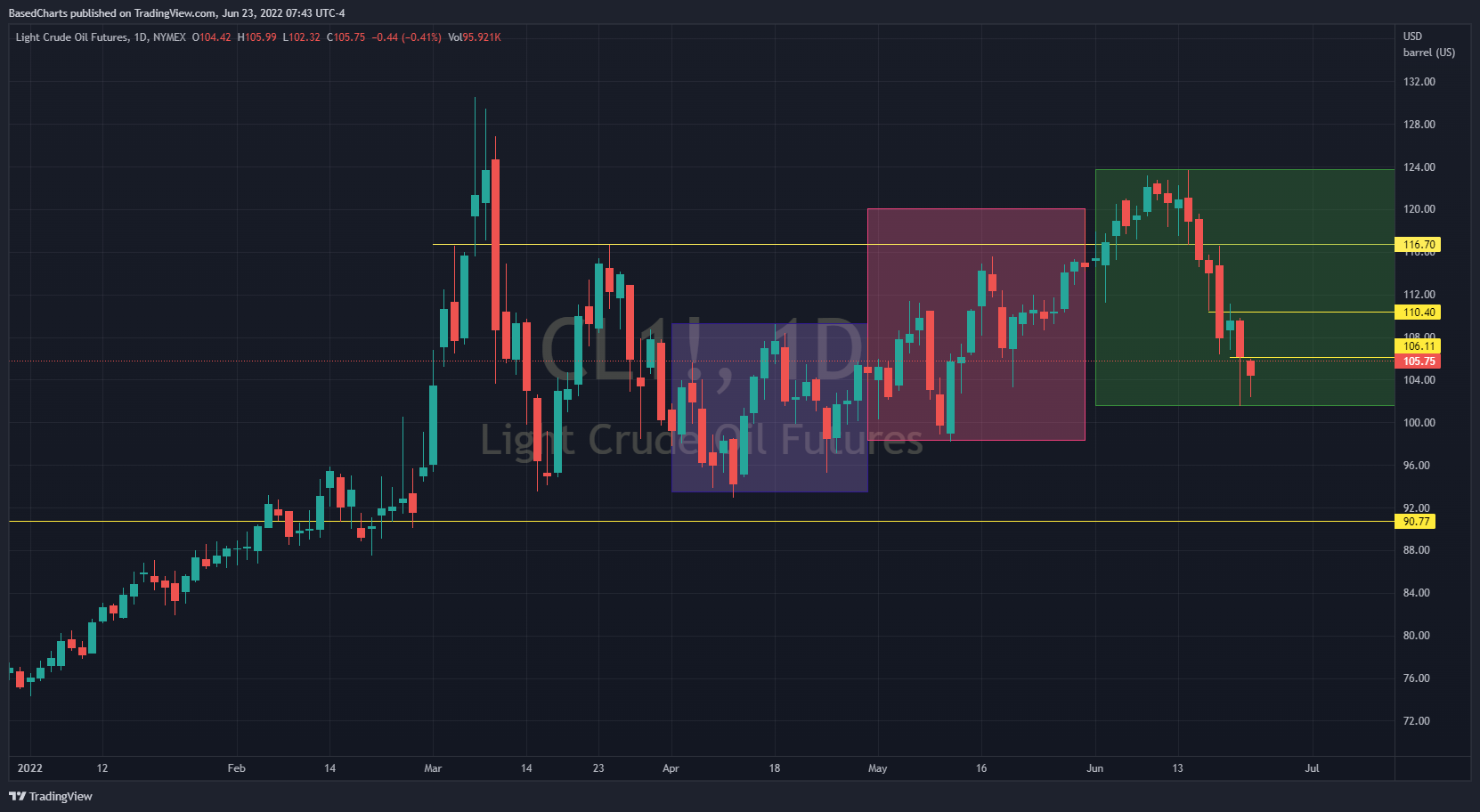
 Oil
Oil

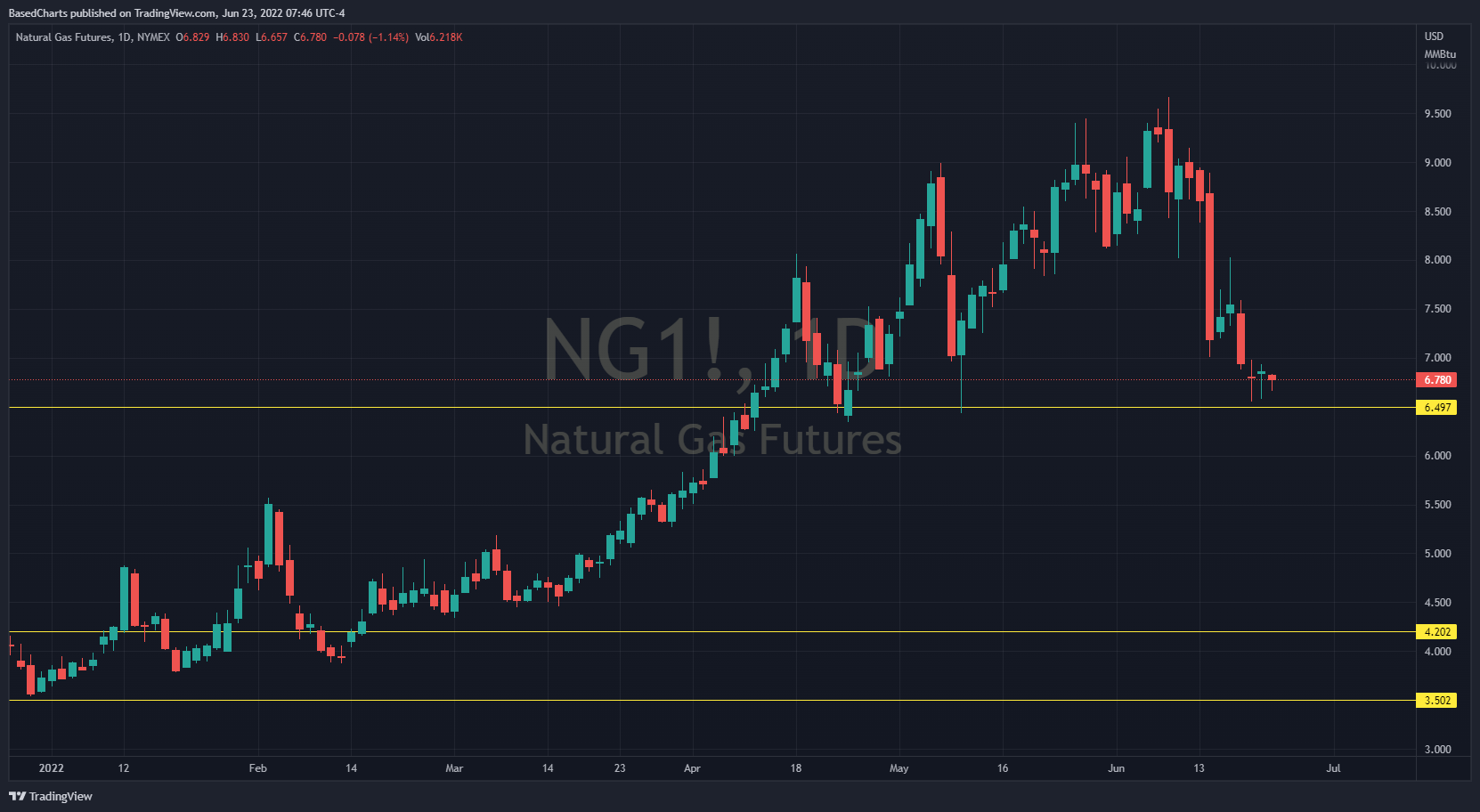
 Natural gas

 Corn
Corn

 Soybeans


1. Inflation is a rise in money and credit. The biggest force for inflation this cycle was...federal deficit spending and stimulus. Mostly over. "Real" money supply is falling. "True" money supply is falling.
2. Rising commodity prices are not inflation. They can be inflation, and they can help create inflation if the central bank or government "finance" the increase instead of accepting slower growth. That was the Fed in the 1970s. That was the Fed until May 2022.
3. Markets don't care about the CPI, they care about first and second derivatives. When the inflation starts starts turning, markets reprice. Understand that gasoline quickly dropping to $3.50 per gallon is still relatively high for U.S. consumers, but that it represents a deflationary bomb in the financial markets.
4. Consumer prices can keep rising. When I say disinflation/deflation is starting, I always get pushback of "have you been to the supermarket lately?" Don't trade on this information. Consumer prices probably won't drop much. If they drop, it could take months. Gasoline is a prominent exception.
5. The yield curve is inverting. The market is starting to price in rate cuts.
There it is; Dec '22 Euro$ futures inversion.
— Jeffrey P. Snider (@JeffSnider_AIP) June 22, 2022
Only a matter of time, tho it didn't take much time which should scare the pants off people.
It's amazing just how many people are in denial about this. Euro$ futures nailed 2019, predicted 2008 & got dot-com recession b4 dotcoms pic.twitter.com/xYy9PYtk8d
On to the charts...
Wheat





2022-05-25
Greens Celebrate Skyrocketing Food Prices and Shortages
All planned. First the psyop, psychologically breaking down resistance to insanely destructive policies. Now we're in the rollout phase. Enjoy the collapse everyone!


2022-05-24
We Didn't Think...
Western institutions have grown soft because they haven't faced hard choices in decades. Need more money for wars, welfare or tax cuts? Print up more treasury bonds! Financial markets in trouble? Engage in central bank intervention. Economy weakening a bit? Bailouts! "We didn't think supply chains would be damaged for going on two years...," "We didn't think Russia would invade Ukraine...," "We didn't think....We didn't think....We didn't think...."


2022-05-19
Not Buying It
Maybe it's time to short wheat (alogn with most of the ag complex). I do see problems on the horizon, but maybe it's all overpriced in and food supply won't be as bad as expected.


2022-05-14
Who Screwed Up the Food Supply?
This is not normal and no one in their right mind believes this is a coincidence.
 In this post from May 2: Federal Reserve and USG Sabotaged Food Supplies, I discussed why I think the rate of incidents wasn't remarkable. The chart above is remarkable, but I don't see any source for it. I am open to the above being accurate, but it is not central to the problem.
Elites Begin to Flee in Preparation for TOTAL COLLAPSE and Worldwide Social Unrest

Central planning is stupid. People who promote centralized control over allocation of resources are morons with no business being anywhere near political power. The lockdowns were a failed idea. I thought we needed it at first because I expected a wave of cases, hospitalization and deaths. By May 2020 at the latest, it was obvious the lockdowns were unnecessary. Anyone who promoted lockdowns beyond May 2020 is an incompetent unfit for public office or public decision making. Probably wouldn't want them working in a decision-making capacity at your company either.
The lockdowns retarded children's learning and social development. Now babies are being starved of their formula because of the ongoing fallout from those lockdowns. The ruling class has earned 100 percent of the blame for this disaster.
Yet, many people give inflation a pass. Inflation is not simply higher prices! Prices are the most important information in an economy. It tells us what is being demanded by the public. Anyone with basic economic education knows price controls are disastrous because they interfere with the signal. If you set prices too high (minimum wage, price supports) you get oversupply. High unemployment, constant bankruptcy in the industry such as airlines. If you set prices too low (rent control, food and energy controls) you get a shortage because suppliers will only deliver as much as the price calls for. When the government and/or central bank engage in massive monetary creation, it is not evenly distributed in the economy. Money doesn't flow everywhere at the same time, it is concentrated in some goods and industries first. This causes more capital to flow into this sector. Businesses will invest in more production. This turns into a crash later when it turns out demand was unsustainable.
Here is an article from 2008: The Cause of the Food Shortage
First, the underlying cause of any shortage is the lack of a free market, since genuine shortages cannot appear in a free market. Instead, while prices of goods would likely rise at the onset of reduced supplies, the goods in question would always be available at some price—and the higher the price, the more the supply would increase to meet demand, which would then of course reduce the price.
...The second issue Krugman fails to mention is that high food prices are a manifestation of current worldwide price inflation. World governments have been printing money at very high rates this decade. While the United States has been expanding the money supply by “only” about 10–15 percent per year, many countries have printed money at rates exceeding 50 percent per year. This money, which had been previously contained mostly in world stock markets, has now also spread to commodity markets, from which the prices of food are derived. Since money is now being created faster than goods are being created, prices are rising.
As another example of this phenomenon of the increase of money exceeding the increase in supply of goods, we may cite the rise in oil prices. Although this has been attributed in the press and other public forums to speculation, greedy oil companies, and increased demands of oil from China, the real cause is the increasing disparity between available money and available oil.
The same thing has been happening repeatedly for the past 15 years, and long before that. It's the same thing over and over and over and over because many people who like to cite Lord of the Rings never figured out the message.
With baby formula, the government shut a production facility that makes 40 percent of the U.S. supply. Maybe that was the correct decision, but they didn't get the plant up and running as fast as possible. As of yesterday, the plant is still closed three months later. Meanwhile, the economy is still experiencing price surges caused by government stimulus and Federal Reserve policy. As a result, money can quickly flow into baby formula (demand) and buy it up.
Whenever you hear someone use the words hoarding and price gouging, you are almost 100 percent of the time dealing with a manmade or natural disaster. The Biden administration tried blaming parents for hoarding formula, but why wouldn't they when they see it disappearing from the shelves? Why is it disappearing from the shelves? Unsustainable demand fueled by inflation and the fact that they shut down the factory. Plus, they're hoarding formula themselves and giving it to illegal aliens.
The point I'm trying to drive home is that inflation and the lockdowns alone were enough to wreck supply chains and cause all the disasters unfolding. That a uniquely incompetent regime won political office in 2020 adds fuel to the fire, but the current extreme troubles all originated in March 2020 and have been getting worse ever since.
If there is a conspiracy, coordinated action creating accidents at food processing plants, my first guess would be foreign agents. China and Russia want the Biden administration out of office. China's lockdowns, along with perhaps Iranian sleeper cells or other foreign saboteurs coming through the open U.S. border, could be hitting a plant and then going home. Many of these are regular industrial accidents and a few more incidents sprinkled in can go unnoticed.
It may not be a conspiracy though. Lockdowns took people out of work. Labor supply is messed up. Negative social mood is also associated with increased industrial accidents. It's likely that some of the increase is caused by inexperienced and distracted workers.
Finally, it could be that the ruling class is really that evil or incompetent, or both. For myself though, that is something for the justice system. For the inflation and lockdowns alone, they should be removed from power. Whether they are engaged in behaviors that could warrant jail or worse is something to sort out later.
Most countries on Earth are not that wealthy. Most engage in some form of economic intervention that damages their economies. Some are smarter about it, such as Scandanavian countries. China went from maximum stupidity to much less stupid and became far more wealthy in the process. The trend is very clear and there's only so much stupid an economy can take before it goes straight down the tubes. The U.S. has achieved the tipping point of stupidity with Wokeism and the Baizuo administration. I do not see Republicans offering anything better at this point except that they will stop some of the stupid.
America is weighed down by a useless, overeducated class of busybodies who subtract value from the economy. The economy would be vastly improved if it paid these people to dig ditches and fill them in again, if that meant the rest of us could go about our business. Is this ruling class of retards intentionally or unintentionally destroying the U.S. economy? I care not. It is a question without immediate significance because my goal is getting the U.S. economy back on track. They must be removed from power ASAP. Pray that the ballot box works. Pray that a majority of your fellow Americans aren't so retarded as to think this government and central bank aren't to blame for all the calamities that have struck the past two years because many more calamities will follow if they remain in power.
2022-05-02
Federal Reserve and USG Sabotaged Food Supplies
There have been 17 food plant fires and incidents (this older article notes 16 of them), including one being hit by a plane.
Media can create any narrative by focusing the news on a target. 24/7 media coverage of Columbine and other mass shootings (mainly by whites to push a racism agenda), making a white cop killing a black suspect national news (to push a racism agenda), wall-to-wall coverage of missing children creates fear of kidnapping.
Unsuprisingly, when the narrative is against them, Snopes actually does some research! Wow just wow, they checked some facts.
Snopes: Are Fires at Food Processing Plants a ‘New Trend’?
Industrial accidents are all reported and they have a list from 2019:
I do not see evidence of sabotage yet. Instead, the main threat to the food supply is inflation. By disrupting price signals in the economy, supply chains have been damaged. Adding to that are U.S. sanctions on Russia blocking fertilizer supplies and materials, and driving up natural gas prices, an input for some fertilizers. China's counter-sanctions via "coronavirus lockdowns" are adding to the mix.Here are a few of the news stories we found about fires, explosions, and other accidents that occurred at food manufacturing businesses in 2019.
- Conveyor Belt Fire Evacuates Snack Production Plant in Iowa
- Three Workers Injured in Explosion and Fire at Soybean Oil Facility
- Cocoa Dust Fuels Fire at Conagra Cake Mix Plant
- ADM explosion kills Clinton firefighter
- Hamlet chicken processing plant fire
- Fire Damages Wisconsin Potato Chip Production Plant
- Beef Plant Cited After Employee Suffers Severe Burns
- Videos: Chicago 5-11 Food Factory Fire
- Fire Causes $2,000 in Damage at Washington Fruit Processing Facility
- Fire Forces Evacuation of Food Factory in Nova Scotia
- UPDATE: Batesville Meat Processing Business Destroyed By Fire
- Massive fire destroys Newly Weds Foods factory on Chicago’s Northwest Side
- Montezuma Fire Chief: Machine malfunction may have caused plant fire
- After destructive fire, baby-food company rebuilds business and switches to plastic packaging
- Northern Peninsula fish plant wiped out, but company has jobs, relocation money ready for workers
- Investigators probe cause of large fire at Sacramento Blue Diamond factory
- Chickens lost in Herbruck’s Poultry Ranch fire
- Over 3,800 workers at Tyson Foods beef plant in Kansas out of work after fire
- Shreveport firefighters fight a commercial fire at Buckelew’s Food Service Equipment
- Firefighters battle blaze at F&S Produce plant in New Jersey
- Two Employees Injured In Explosion At Kansas Meat Packing Facility
- Ammonia leak causes evacuation of food processing plant
- More than a dozen people evaluated after hazmat situation in Fort Worth
- Fire destroys Michigan’s largest deer processing facility ahead of hunting season
- Machinery Fire at Wisconsin Cheese Plant
- Fire destroys Cal-Maine Foods hen house
The claim of a new “trend” is just simply incorrect.
When you realize the U.S. has more than 36,000 food and beverage processing establishments in operation (according to a report from the USDA in 2019), you see that the 26 news articles listed above refer to less than 1% of these facilities. Furthermore, when you recognize that operations at the majority of these facilities were only temporarily suspended, and that many of these stories refer to smaller facilities, you can see that this “threat” is far less than the threat some social media users assert.
We reached out to the North American Meat Institute, the National Pork Producers Council, and the National Chicken Council (three organizations that represent food production facilities) for more information about this rumor. While we have yet to hear back from NAMI or NPPC, Tom Super, the Senior Vice President of Communications with NCC, told us that these rumors did not document an “alarming trend.” Super said:
I can only speak for chicken, but like any manufacturing plant, there are generally a few fires that occur each year across the country. Most of them are contained rather quickly. And certainly not enough to affect the chicken supply. There are about 200 federally inspected chicken slaughtering plants in the US and thousands more that further process chicken. I would not categorize this as an “alarming trend.”
If Snopes would do this type of research on crime statistics as one example, they would be able to report that systemic racism is false. Do the same type of research on climate "science" and they would report climate alarmism is false. The media tried pushing the "anti-Asian violence caused by white supreamcy" narrative but stopped when most of the videos showed black suspects.
I will try posting this information on right-wing areas to see if I get pushback. I expect some will tell me that Snopes is a bad source, even though all the Snopes article links to industrial accident data.
The media can create a false narrative in any direction by focusing attention on it. This ties back into their panic over censorship. They know what they're doing and they know that anyone, be it Trump or some anonymous Twitter account, can create viral narratives too. That the playing field is leveled by the Internet. For the liars, their greatest fear is the Truth because that is the most difficult narrative to combat. For those of us who want to defeat the liars, we must defend and spread truth. I do not yet see any evidence that food plant incidents are out of the ordinary. The main cause of any disruptions in inflation, with political supply-chain disruptions a secondary cause.
2022-04-29
Assume Everything is a Psyop
Scary Mommy 2020: From A Doctor: We Need To Talk About Gas Stoves And Indoor Air Pollution
E&E 2022: N.Y. governor backs nation’s first statewide gas ban
Scary Mommy 2022: Researchers Are Ripping The Gas Stoves Out Of Their Houses For Their Kids’ Health
The anti-nuclear movement caused the most climate destruction over the past 40 years by permanently damaging nuclear power. From the same well of stupidity came anti-coal, anti-oil and anti-gas movements, some of them funded by Russia (the irony is *chef's kiss*). Economic mistakes of the past 50 years were repeated. Nw teh two are fusing into food and energy supply problems.
The big mistake America made was psyopping itself on equality. People are equal to the extent we all have a right to be treated equally under the law and to make our own choices. You do not let stupid, emotional and irrational people have political power though. Since everyone is irrational to some degree, political power should be strictly limited as the Founders intended. Instead, modern American went "communist" and lets people who will rip stoves out of their homes, wear useless cloth masks and fall for fake and lame "Red Scares" make decisions for all of society. Or more to the point, these people allow the modern authoritarian technocracy have a fig leaf of legitimacy.
Meet the Biden DHS national head of censorship, America. Please DO NOT RT this video as it may upset your new internet overlords pic.twitter.com/FoEKlEmziH
— Jack Posobiec 🇺🇸 (@JackPosobiec) April 29, 2022
DHS is standing up a new Disinformation Governance Board to coordinate countering misinformation related to homeland security, focused specifically on irregular migration and Russia. Nina Jankowicz will head the board as executive director. She previously was a disinformation fellow at the Wilson Center, advised the Ukrainian Foreign Ministry as part of the Fulbright Public Policy Fellowship and oversaw Russia and Belarus programs at the National Democratic Institute.If you are red-pilled you see that resume and immediately know you're dealing with a professional liar. All the worst people in the American govt have been involved with "helping" Ukraine and working against Russia the past 10 years or so. Now they've created something straight out of 1984 to silence all political dissent.
2022-03-24
2022-03-13
Commodity Reversals and Copper Gold Update
Price collapse: who's expecting it?


 Gold-copper is at an important juncture. It has been rising, but hasn't broken out yet. However, with recent volatility being what it is, the ratio could break out any day. the breakout delta from the current level is 6 percent. That is, if gold rises by 3 percent and copper falls 3 percent, the ratio breaks out. An upward breakout in gold/copper signals deflation or possible stagflationary recession that is a monetary crisis, hence gold outperforming.

Subscribe to:
Posts (Atom)


