2022-10-02
Greece Still Leading Germany
2022-09-03
S&P 500 vs Shanghai Composite and DAX
2022-07-19
The Running of the Bears Begins
Once ES clears 3950, the target off the base is 4250 area. Another 8 percent rally ahead.
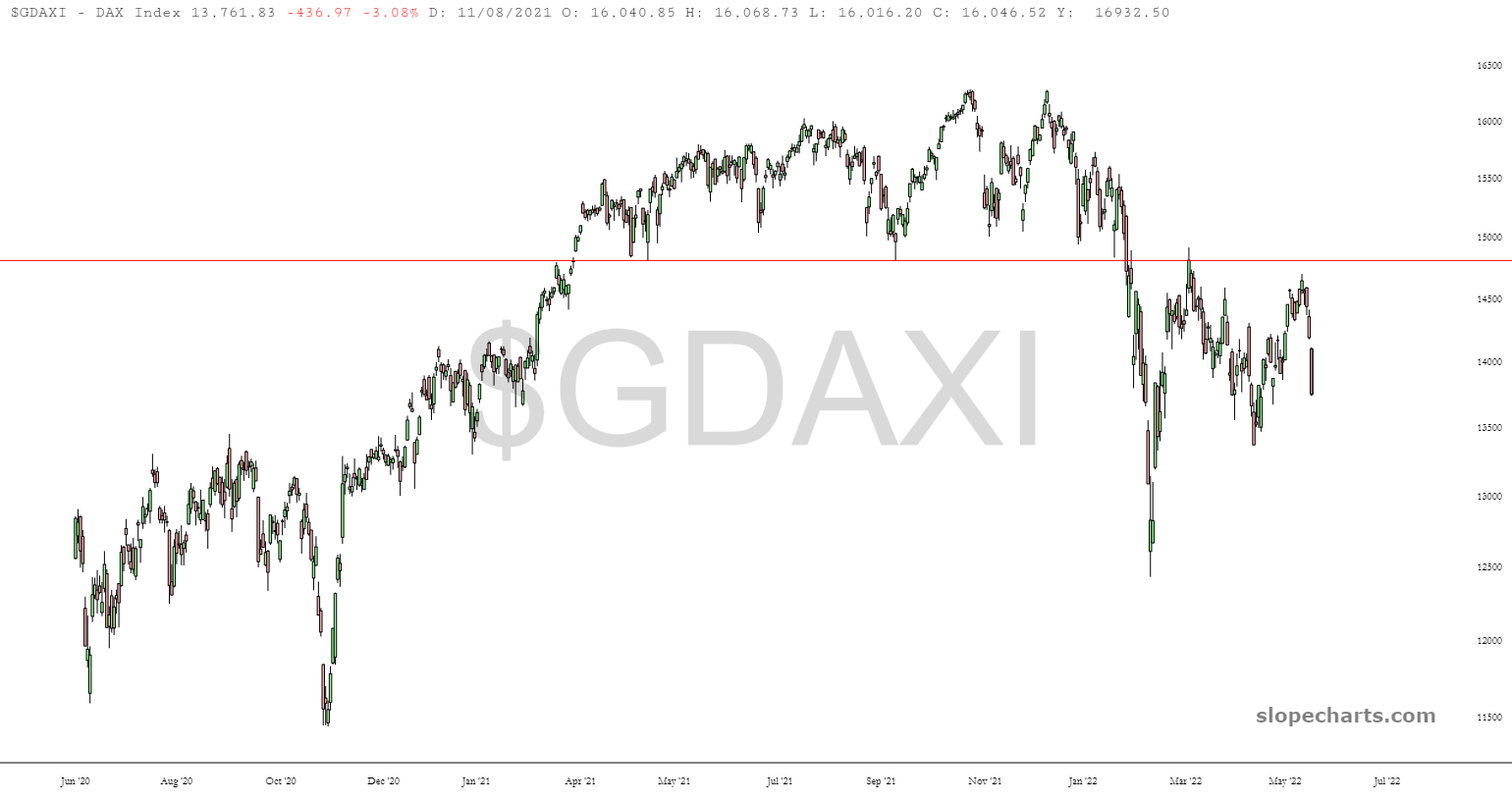
NQ has a target of 10 percent off the base, taking it to around 13500. That takes it into spitting distance of clearing the consolidation zone in late April and early May. It would only need another 3 percent from there to tag the 25 percent rally line I drew on the chart. Bonds aren't cooperating yet, but they might struggle until the Fed meeting next week. This is my biggest loser in the portfolio. I bought puts on $USO when CL was at $99 and got out before that surge, then shorted again when it was in that consolidation pattern. I think there's only risk up to around $102 or $103 from here. Stocks can get squeezed for no reason at all except the prices rises, but my assumption is that oil will fall and bonds will rally, and that will provide some "fundamental" support for a rally. I also thought earnings might be less bad. Netflix delivered on that score after hours. It beat on earnings, missed on revenue and beat on subscribers (losing less that forecast). I don't trust AH gains, but Netflix is up 7 percent after hours. If Meta delivered that same jump, it would translate into a 1.25 percent rally in XLC. Netflix's after hours gain is included on this chart: If XLC breaks out of the same base formed on ES and NQ, the target is near $63 per share. If Nasdaq can rally 10 percent though, I think XLC can go a bit further. Finally, another fundamental is Europe's energy disaster. I didn't think Russia who shut off the gas because it makes them into the bad guys. Why turn it off if Germany is shooting itself in the foot? Today, Gazprom did a test to turn on the gas. German stocks rallied strongly. The Germany ETF gained 4.64 percent. I have some August calls at $24 strike since I thought Russia would not turn off the gas, and that the euro would bounce a little. EWG fell nearly 40 percent from January high and has plenty of room to dead cat bounce before. The DAX has about 3 percent and 6 percent to rally before filling the gaps from June. Whatever percent the EURUSD rallies, tack that on.2022-07-05
Back in META and Germany
Uncontrolled Demolition of the West
The news that Germany might ration hot water and the fact that the Biden admin isn't lifting a finger to stop the total collapse of the Western economy, tells me the bearish implosion scenario is very much in play. Germany is going to destroy Europe. Long Greece, Short Germany.
Along with strong biotech, Nasdaq is outperforming the S&P 500 Index on the downside. I chalk this up to bond strength and commodity weakness, particularly oil. The foundation for a rally is being put into place. The question is what level does it start from?
2022-06-26
Fertility Crash: Negative Mood, the Vaxx or Both?
Here are the Germany and Netherlands country ETFs. They peakedin May and August 2021, respectively.
2022-06-12
Chart for the Decade: Greece vs Germany
As I first pointed out in April, the Greece ETF has been basing versus the German ETF.
Greece doesn't look as strong versus the Eurozone ETF, but EZU includes countries such as Italy that also look like Greece: Note that these ETFs include fluctuation in the euro, but the relative charts cancel that out.Going all the way back to the post-2008 fallout era, when Greek sovereign debt emerged almost immediately and first rattled markets in the spring of 2010, critics of the euro and European Union have explained how Greece was being harmed by the euro and austerity programs being forced on the nation without any fiscal transfers:
Would it be impossible for the Greek stock market to rally in a bear market? No. There is one outlier scenario where that happens: Greece does something extreme such as exiting the euro and redenominating its sovereign debt in drachmas. More so than most nations, Greece would benefit from currency devaluation because it's economy and assets are already devalued.
Currency devaluation is an escape valve for incompetent sovereigns. Serial devaluation shows a nation doesn't make hard choices and opts for the easy way out, impoverishing its own people and foreign investors over time. All nations will eventually devalue their currencies though, if reforms were not undertaken and credit not controlled. The mistake was blowing the bubble in the first place, not the currency devaluation that balances assets to liabilities.
Trade Implications
If Greece assets could rally on a euro exit, then Greece should outperform amid high inflation and euro weakness. The macro forces that crushed Greece in the prior decade are now turning in Greece's favor and against Germany. If trends continue for years, it might be Germany that wants out soon.
The cleanest trade here is short Germany, in local currency or in dollars via an ETF such as EWG. (Not necessarily a trade to put on Monday, but one that could have been put on in January and still held today.) Greece is not a clean buy because it will probably fall in a global bear market, but if that basing pattern turns into a breakout at any point, then I would recommend accumulating Greek assets along with Italian and other debtor countries, depressed sectors and so on during the dip because they should outperform in the next bull market. If you find a depressed asset that is harmed by a strong euro and deflation/disinflation, and it still has good underlying fundamentals, it sounds like a potentially good buy on the surface.
A breakout in the "Greece vs Germany" chart would signal a significant turn in macroeconomic forces. Conversely, if the chart were to fail (a "bear market" rally that delays the eventual breakout is not a fail) and sink again, it would tell me the post-2008 central bank trap is alive and well with potentially more QE and even more negative interest rates on the way.
2022-04-24
Greece Beats Germany
2022-03-04
2022-02-22
Buy the Reversals of Fortune
2018-03-14
Markets Do Not Believe Trade War Coming
Whatever one's opinion on the matter, there is no sign of investor concern in any of these charts. That could change at any time and markets are notoriously wrong at key turning points, but there is bearish signal from these charts with the exception of DXJ, but that's mainly due to the strengthening yen. A stronger yen is a bearish signal, but not because of trade.
The lack of concern might be because many of the people screaming loudest about tariffs also screamed loudly about Brexit and Trump's election, and were shown to be wrong. It may be that investment managers support tariffs, but don't want to go on record publicly because they either dislike Trump or don't want to get into a debate with economists. It may be that people complaining about tariffs don't really believe their rhetoric or lack investment capital (no skin in the game). It may be that the sudden thaw in North Korea relations (assuming North Korea isn't simply buying time, a good assumption given their track record) finally taught investors to watch Trump's actions more than his rhetoric, that negotiations with China are the most likely outcome. It may be investors think Trump is all bluster and will back down when the global push back hits. Whatever the reason, if you expect a negative market reaction, the market is priced right for going short.
I don't think a tariff dispute will be a single event like Brexit and the U.S. presidential election. Instead, it will likely drag on as the North Korea situation did. If China fires back with fiery rhetoric or a strong retaliation, even if it is also a set up to negotiations, I suspect markets will react poorly. It will be remarkable if they don't. Several charts including China, Germany and Japan Hedged (DXJ) aren't far from support. South Korea (EWY) would need to fall 20 percent to hit support. China (FXI) needs to slid a little more than 7 percent to fall below support.
2015-12-29
Socionomics Test Case: Germany 2016
The findings on German sentiment on the refugee crisis come after another survey released last week showed that some 50 percent of those surveyed were looking at the coming year "with great skepticism and mixed feelings." Only 27 percent had said this ahead of 2015.The DAX gained in 2015 thanks to European QE, but is down about 12% from March highs. The economy is already starting to show signs of negative mood.
Similarly, only 18 percent of the 1,000 respondents said that they viewed the coming year "with great confidence and optimism," compared to 45 percent a year ago.
"The mood's tipping. The German angst is coming back," researcher Horst Opaschowski concluded.
2010-05-24
Germany-U.S. Comparison