


FTAV’s Friday charts quiz
-
To those about to chart, we salute you

![[Most Recent Quotes from www.kitco.com]](https://lh3.googleusercontent.com/blogger_img_proxy/AEn0k_uR4fzdje74Wf9NFSGpIwMsercdloA5yqtdN0KU2uumpL5zMf-8MLNq27WAMP83r5EH04RD9UsjuBYQSj-n83KC374IHZvbvCGHu2rohRXHqqouYntk-JEPr3Q=s0-d)
|


US Hegemony and Its Perils
February 2023
Contents
Introduction
I. Political Hegemony—Throwing Its Weight Around
II. Military Hegemony—Wanton Use of Force
III. Economic Hegemony—Looting and Exploitation
IV. Technological Hegemony—Monopoly and Suppression
V. Cultural Hegemony—Spreading False Narratives
Conclusion
Introduction
Since becoming the world's most powerful country after the two world wars and the Cold War, the United States has acted more boldly to interfere in the internal affairs of other countries, pursue, maintain and abuse hegemony, advance subversion and infiltration, and willfully wage wars, bringing harm to the international community.
The United States has developed a hegemonic playbook to stage "color revolutions," instigate regional disputes, and even directly launch wars under the guise of promoting democracy, freedom and human rights. Clinging to the Cold War mentality, the United States has ramped up bloc politics and stoked conflict and confrontation. It has overstretched the concept of national security, abused export controls and forced unilateral sanctions upon others. It has taken a selective approach to international law and rules, utilizing or discarding them as it sees fit, and has sought to impose rules that serve its own interests in the name of upholding a "rules-based international order."
This report, by presenting the relevant facts, seeks to expose the U.S. abuse of hegemony in the political, military, economic, financial, technological and cultural fields, and to draw greater international attention to the perils of the U.S. practices to world peace and stability and the well-being of all peoples.
I. Political Hegemony -- Throwing Its Weight Around
The United States has long been attempting to mold other countries and the world order with its own values and political system in the name of promoting democracy and human rights.
◆ Instances of U.S. interference in other countries' internal affairs abound. In the name of "promoting democracy," the United States practiced a "Neo-Monroe Doctrine" in Latin America, instigated "color revolutions" in Eurasia, and orchestrated the "Arab Spring" in West Asia and North Africa, bringing chaos and disaster to many countries.
In 1823, the United States announced the Monroe Doctrine. While touting an "America for the Americans," what it truly wanted was an "America for the United States."
Since then, the policies of successive U.S. governments toward Latin America and the Caribbean Region have been riddled with political interference, military intervention and regime subversion. From its 61-year hostility toward and blockade of Cuba to its overthrow of the Allende government of Chile, U.S. policy on this region has been built on one maxim-those who submit will prosper; those who resist shall perish.
The year 2003 marked the beginning of a succession of "color revolutions" -- the "Rose Revolution" in Georgia, the "Orange Revolution" in Ukraine and the "Tulip Revolution" in Kyrgyzstan. The U.S. Department of State openly admitted playing a "central role" in these "regime changes." The United States also interfered in the internal affairs of the Philippines, ousting President Ferdinand Marcos Sr. in 1986 and President Joseph Estrada in 2001 through the so-called "People Power Revolutions."
In January 2023, former U.S. Secretary of State Mike Pompeo released his new book Never Give an Inch: Fighting for the America I Love. He revealed in it that the United States had plotted to intervene in Venezuela. The plan was to force the Maduro government to reach an agreement with the opposition, deprive Venezuela of its ability to sell oil and gold for foreign exchange, exert high pressure on its economy, and influence the 2018 presidential election.
◆ The U.S. exercises double standards on international rules. Placing its self-interest first, the United States has walked away from international treaties and organizations, and put its domestic law above international law. In April 2017, the Trump administration announced that it would cut off all U.S. funding to the United Nations Population Fund (UNFPA) with the excuse that the organization "supports, or participates in the management of a programme of coercive abortion or involuntary sterilization." The United States quit UNESCO twice in 1984 and 2017. In 2017, it announced leaving the Paris Agreement on climate change. In 2018, it announced its exit from the UN Human Rights Council, citing the organization's "bias" against Israel and failure to protect human rights effectively. In 2019, the United States announced its withdrawal from the Intermediate-Range Nuclear Forces Treaty to seek unfettered development of advanced weapons. In 2020, it announced pulling out of the Treaty on Open Skies.
The United States has also been a stumbling block to biological arms control by opposing negotiations on a verification protocol for the Biological Weapons Convention (BWC) and impeding international verification of countries' activities relating to biological weapons. As the only country in possession of a chemical weapons stockpile, the United States has repeatedly delayed the destruction of chemical weapons and remained reluctant in fulfilling its obligations. It has become the biggest obstacle to realizing "a world free of chemical weapons."
◆ The United States is piecing together small blocs through its alliance system. It has been forcing an "Indo-Pacific Strategy" onto the Asia-Pacific region, assembling exclusive clubs like the Five Eyes, the Quad and AUKUS, and forcing regional countries to take sides. Such practices are essentially meant to create division in the region, stoke confrontation and undermine peace.
◆ The U.S. arbitrarily passes judgment on democracy in other countries, and fabricates a false narrative of "democracy versus authoritarianism" to incite estrangement, division, rivalry and confrontation. In December 2021, the United States hosted the first "Summit for Democracy," which drew criticism and opposition from many countries for making a mockery of the spirit of democracy and dividing the world. In March 2023, the United States will host another "Summit for Democracy," which remains unwelcome and will again find no support.
II. Military Hegemony -- Wanton Use of Force
The history of the United States is characterized by violence and expansion. Since it gained independence in 1776, the United States has constantly sought expansion by force: it slaughtered Indians, invaded Canada, waged a war against Mexico, instigated the American-Spanish War, and annexed Hawaii. After World War II, the wars either provoked or launched by the United States included the Korean War, the Vietnam War, the Gulf War, the Kosovo War, the War in Afghanistan, the Iraq War, the Libyan War and the Syrian War, abusing its military hegemony to pave the way for expansionist objectives. In recent years, the U.S. average annual military budget has exceeded 700 billion U.S. dollars, accounting for 40 percent of the world's total, more than the 15 countries behind it combined. The United States has about 800 overseas military bases, with 173,000 troops deployed in 159 countries.
According to the book America Invades: How We've Invaded or been Militarily Involved with almost Every Country on Earth, the United States has fought or been militarily involved with almost all the 190-odd countries recognized by the United Nations with only three exceptions. The three countries were "spared" because the United States did not find them on the map.
◆ As former U.S. President Jimmy Carter put it, the United States is undoubtedly the most warlike nation in the history of the world. According to a Tufts University report, "Introducing the Military Intervention Project: A new Dataset on U.S. Military Interventions, 1776-2019," the United States undertook nearly 400 military interventions globally between those years, 34 percent of which were in Latin America and the Caribbean, 23 percent in East Asia and the Pacific, 14 percent in the Middle East and North Africa, and 13 percent in Europe. Currently, its military intervention in the Middle East and North Africa and sub-Saharan Africa is on the rise.
Alex Lo, a South China Morning Post columnist, pointed out that the United States has rarely distinguished between diplomacy and war since its founding. It overthrew democratically elected governments in many developing countries in the 20th century and immediately replaced them with pro-American puppet regimes. Today, in Ukraine, Iraq, Afghanistan, Libya, Syria, Pakistan and Yemen, the United States is repeating its old tactics of waging proxy, low-intensity, and drone wars.
◆ U.S. military hegemony has caused humanitarian tragedies. Since 2001, the wars and military operations launched by the United States in the name of fighting terrorism have claimed over 900,000 lives with some 335,000 of them civilians, injured millions and displaced tens of millions. The 2003 Iraq War resulted in some 200,000 to 250,000 civilian deaths, including over 16,000 directly killed by the U.S. military, and left more than a million homeless.
The United States has created 37 million refugees around the world. Since 2012, the number of Syrian refugees alone has increased tenfold. Between 2016 and 2019, 33,584 civilian deaths were documented in the Syrian fightings, including 3,833 killed by U.S.-led coalition bombings, half of them women and children. The Public Broadcasting Service (PBS) reported on 9 November 2018 that the air strikes launched by U.S. forces on Raqqa alone killed 1,600 Syrian civilians.
The two-decades-long war in Afghanistan devastated the country. A total of 47,000 Afghan civilians and 66,000 to 69,000 Afghan soldiers and police officers unrelated to the September 11 attacks were killed in U.S. military operations, and more than 10 million people were displaced. The war in Afghanistan destroyed the foundation of economic development there and plunged the Afghan people into destitution. After the "Kabul debacle" in 2021, the United States announced that it would freeze some 9.5 billion dollars in assets belonging to the Afghan central bank, a move considered as "pure looting."
In September 2022, Turkish Interior Minister Suleyman Soylu commented at a rally that the United States has waged a proxy war in Syria, turned Afghanistan into an opium field and heroin factory, thrown Pakistan into turmoil, and left Libya in incessant civil unrest. The United States does whatever it takes to rob and enslave the people of any country with underground resources.
The United States has also adopted appalling methods in war. During the Korean War, the Vietnam War, the Gulf War, the Kosovo War, the War in Afghanistan and the Iraq War, the United States used massive quantities of chemical and biological weapons as well as cluster bombs, fuel-air bombs, graphite bombs and depleted uranium bombs, causing enormous damage on civilian facilities, countless civilian casualties and lasting environmental pollution.
III. Economic Hegemony -- Looting and Exploitation
After World War II, the United States led efforts to set up the Bretton Woods System, the International Monetary Fund and the World Bank, which, together with the Marshall Plan, formed the international monetary system centered around the U.S. dollar. In addition, the United States has also established institutional hegemony in the international economic and financial sector by manipulating the weighted voting systems, rules and arrangements of international organizations including "approval by 85 percent majority," and its domestic trade laws and regulations. By taking advantage of the dollar's status as the major international reserve currency, the United States is basically collecting "seigniorage" from around the world; and using its control over international organizations, it coerces other countries into serving America's political and economic strategy.
◆ The United States exploits the world's wealth with the help of "seigniorage." It costs only about 17 cents to produce a 100 dollar bill, but other countries had to pony up 100 dollar of actual goods in order to obtain one. It was pointed out more than half a century ago, that the United States enjoyed exorbitant privilege and deficit without tears created by its dollar, and used the worthless paper note to plunder the resources and factories of other nations.
◆ The hegemony of U.S. dollar is the main source of instability and uncertainty in the world economy. During the COVID-19 pandemic, the United States abused its global financial hegemony and injected trillions of dollars into the global market, leaving other countries, especially emerging economies, to pay the price. In 2022, the Fed ended its ultra-easy monetary policy and turned to aggressive interest rate hike, causing turmoil in the international financial market and substantial depreciation of other currencies such as the Euro, many of which dropped to a 20-year low. As a result, a large number of developing countries were challenged by high inflation, currency depreciation and capital outflows. This was exactly what Nixon's secretary of the treasury John Connally once remarked, with self-satisfaction yet sharp precision, that "the dollar is our currency, but it is your problem."
◆ With its control over international economic and financial organizations, the United States imposes additional conditions to their assistance to other countries. In order to reduce obstacles to U.S. capital inflow and speculation, the recipient countries are required to advance financial liberalization and open up financial markets so that their economic policies would fall in line with America's strategy. According to the Review of International Political Economy, along with the 1,550 debt relief programs extended by the IMF to its 131 member countries from 1985 to 2014, as many as 55,465 additional political conditions had been attached.
◆ The United States willfully suppresses its opponents with economic coercion. In the 1980s, to eliminate the economic threat posed by Japan, and to control and use the latter in service of America's strategic goal of confronting the Soviet Union and dominating the world, the United States leveraged its hegemonic financial power against Japan, and concluded the Plaza Accord. As a result, Yen was pushed up, and Japan was pressed to open up its financial market and reform its financial system. The Plaza Accord dealt a heavy blow to the growth momentum of the Japanese economy, leaving Japan to what was later called "three lost decades."
◆ America's economic and financial hegemony has become a geopolitical weapon. Doubling down on unilateral sanctions and "long-arm jurisdiction," the United States has enacted such domestic laws as the International Emergency Economic Powers Act, the Global Magnitsky Human Rights Accountability Act, and the Countering America's Adversaries Through Sanctions Act, and introduced a series of executive orders to sanction specific countries, organizations or individuals. Statistics show that U.S. sanctions against foreign entities increased by 933 percent from 2000 to 2021. The Trump administration alone has imposed more than 3,900 sanctions, which means three sanctions per day. So far, the United States had or has imposed economic sanctions on nearly 40 countries across the world, including Cuba, China, Russia, the DPRK, Iran and Venezuela, affecting nearly half of the world's population. "The United States of America" has turned itself into "the United States of Sanctions." And "long-arm jurisdiction" has been reduced to nothing but a tool for the United States to use its means of state power to suppress economic competitors and interfere in normal international business. This is a serious departure from the principles of liberal market economy that the United States has long boasted.
IV. Technological Hegemony -- Monopoly and Suppression
The United States seeks to deter other countries' scientific, technological and economic development by wielding monopoly power, suppression measures and technology restrictions in high-tech fields.
◆ The United States monopolizes intellectual property in the name of protection. Taking advantage of the weak position of other countries, especially developing ones, on intellectual property rights and the institutional vacancy in relevant fields, the United States reaps excessive profits through monopoly. In 1994, the United States pushed forward the Agreement on Trade-Related Aspects of Intellectual Property Rights (TRIPS), forcing the Americanized process and standards in intellectual property protection in an attempt to solidify its monopoly on technology.
In the 1980s, to contain the development of Japan's semiconductor industry, the United States launched the "301" investigation, built bargaining power in bilateral negotiations through multilateral agreements, threatened to label Japan as conducting unfair trade, and imposed retaliatory tariffs, forcing Japan to sign the U.S.-Japan Semiconductor Agreement. As a result, Japanese semiconductor enterprises were almost completely driven out of global competition, and their market share dropped from 50 percent to 10 percent. Meanwhile, with the support of the U.S. government, a large number of U.S. semiconductor enterprises took the opportunity and grabbed larger market share.
◆ The United States politicizes, weaponizes technological issues and uses them as ideological tools. Overstretching the concept of national security, the United States mobilized state power to suppress and sanction Chinese company Huawei, restricted the entry of Huawei products into the U.S. market, cut off its supply of chips and operating systems, and coerced other countries to ban Huawei from undertaking local 5G network construction. It even talked Canada into unwarrantedly detaining Huawei's CFO Meng Wanzhou for nearly three years.
The United States has fabricated a slew of excuses to clamp down on China's high-tech enterprises with global competitiveness, and has put more than 1,000 Chinese enterprises on sanction lists. In addition, the United States has also imposed controls on biotechnology, artificial intelligence and other high-end technologies, reinforced export restrictions, tightened investment screening, suppressed Chinese social media apps such as TikTok and WeChat, and lobbied the Netherlands and Japan to restrict exports of chips and related equipment or technology to China.
The United States has also practiced double standards in its policy on China-related technological professionals. To sideline and suppress Chinese researchers, since June 2018, visa validity has been shortened for Chinese students majoring in certain high-tech-related disciplines, repeated cases have occurred where Chinese scholars and students going to the United States for exchange programs and study were unjustifiably denied and harassed, and large-scale investigation on Chinese scholars working in the United States was carried out.
◆ The United States solidifies its technological monopoly in the name of protecting democracy. By building small blocs on technology such as the "chips alliance" and "clean network," the United States has put "democracy" and "human rights" labels on high-technology, and turned technological issues into political and ideological issues, so as to fabricate excuses for its technological blockade against other countries. In May 2019, the United States enlisted 32 countries to the Prague 5G Security Conference in the Czech Republic and issued the Prague Proposal in an attempt to exclude China's 5G products. In April 2020, then U.S. Secretary of State Mike Pompeo announced the "5G clean path," a plan designed to build technological alliance in the 5G field with partners bonded by their shared ideology on democracy and the need to protect "cyber security." The measures, in essence, are the U.S. attempts to maintain its technological hegemony through technological alliances.
◆ The United States abuses its technological hegemony by carrying out cyber attacks and eavesdropping. The United States has long been notorious as an "empire of hackers," blamed for its rampant acts of cyber theft around the world. It has all kinds of means to enforce pervasive cyber attacks and surveillance, including using analog base station signals to access mobile phones for data theft, manipulating mobile apps, infiltrating cloud servers, and stealing through undersea cables. The list goes on.
U.S. surveillance is indiscriminate. All can be targets of its surveillance, be they rivals or allies, even leaders of allied countries such as former German Chancellor Angela Merkel and several French Presidents. Cyber surveillance and attacks launched by the United States such as "Prism," "Dirtbox," "Irritant Horn" and "Telescreen Operation" are all proof that the United States is closely monitoring its allies and partners. Such eavesdropping on allies and partners has already caused worldwide outrage. Julian Assange, the founder of Wikileaks, a website that has exposed U.S. surveillance programs, said that "do not expect a global surveillance superpower to act with honor or respect. There is only one rule: there are no rules."
V. Cultural Hegemony -- Spreading False Narratives
The global expansion of American culture is an important part of its external strategy. The United States has often used cultural tools to strengthen and maintain its hegemony in the world.
◆ The United States embeds American values in its products such as movies. American values and lifestyle are a tied product to its movies and TV shows, publications, media content, and programs by the government-funded non-profit cultural institutions. It thus shapes a cultural and public opinion space in which American culture reigns and maintains cultural hegemony. In his article The Americanization of the World, John Yemma, an American scholar, exposed the real weapons in U.S. cultural expansion: the Hollywood, the image design factories on Madison Avenue and the production lines of Mattel Company and Coca-Cola.
There are various vehicles the United States uses to keep its cultural hegemony. American movies are the most used; they now occupy more than 70 percent of the world's market share. The United States skilfully exploits its cultural diversity to appeal to various ethnicities. When Hollywood movies descend on the world, they scream the American values tied to them.
◆ American cultural hegemony not only shows itself in "direct intervention," but also in "media infiltration" and as "a trumpet for the world." U.S.-dominated Western media has a particularly important role in shaping global public opinion in favor of U.S. meddling in the internal affairs of other countries.
The U.S. government strictly censors all social media companies and demands their obedience. Twitter CEO Elon Musk admitted on 27 December 2022 that all social media platforms work with the U.S. government to censor content, reported Fox Business Network. Public opinion in the United States is subject to government intervention to restrict all unfavorable remarks. Google often makes pages disappear.
U.S. Department of Defense manipulates social media. In December 2022, The Intercept, an independent U.S. investigative website, revealed that in July 2017, U.S. Central Command official Nathaniel Kahler instructed Twitter's public policy team to augment the presence of 52 Arabic-language accounts on a list he sent, six of which were to be given priority. One of the six was dedicated to justifying U.S. drone attacks in Yemen, such as by claiming that the attacks were precise and killed only terrorists, not civilians. Following Kahler's directive, Twitter put those Arabic-language accounts on a "white list" to amplify certain messages.
◆The United States practices double standards on the freedom of the press. It brutally suppresses and silences media of other countries by various means. The United States and Europe bar mainstream Russian media such as Russia Today and the Sputnik from their countries. Platforms such as Twitter, Facebook and YouTube openly restrict official accounts of Russia. Netflix, Apple and Google have removed Russian channels and applications from their services and app stores. Unprecedented draconian censorship is imposed on Russia-related contents.
◆The United States abuses its cultural hegemony to instigate "peaceful evolution" in socialist countries. It sets up news media and cultural outfits targeting socialist countries. It pours staggering amounts of public funds into radio and TV networks to support their ideological infiltration, and these mouthpieces bombard socialist countries in dozens of languages with inflammatory propaganda day and night.
The United States uses misinformation as a spear to attack other countries, and has built an industrial chain around it: there are groups and individuals making up stories, and peddling them worldwide to mislead public opinion with the support of nearly limitless financial resources.
Conclusion
While a just cause wins its champion wide support, an unjust one condemns its pursuer to be an outcast. The hegemonic, domineering, and bullying practices of using strength to intimidate the weak, taking from others by force and subterfuge, and playing zero-sum games are exerting grave harm. The historical trends of peace, development, cooperation, and mutual benefit are unstoppable. The United States has been overriding truth with its power and trampling justice to serve self-interest. These unilateral, egoistic and regressive hegemonic practices have drawn growing, intense criticism and opposition from the international community.
Countries need to respect each other and treat each other as equals. Big countries should behave in a manner befitting their status and take the lead in pursuing a new model of state-to-state relations featuring dialogue and partnership, not confrontation or alliance. China opposes all forms of hegemonism and power politics, and rejects interference in other countries' internal affairs. The United States must conduct serious soul-searching. It must critically examine what it has done, let go of its arrogance and prejudice, and quit its hegemonic, domineering and bullying practices.
How about the forecasters? the modelers at the Fed who estimate government reports ahead of time are useful. I don't know what the others are worth.
Retail sales were released this morning. Here's the rundown:
Retail Sales 1.0% M/M, Exp. 0.9%There figures are not price adjusted. The CPI increased 1.3 percent in June. One can't simply adjust the sales for the CPI to estimate actual sales, but for my purposes it's close enough. My estimate is headline sales were roughly flat. However, what I want to talk about are the forecasts. Look at what economists were forecasting, particularly the ex-auto ex-gas figure of 0.1 percent growth. Knowing these figures are not inflation adjusted and knowing roughly where inflation forecasts were, economists were forecasting that sub-category of sales fell at a conservatively-estimated annualized run rate of around 10 percent in June.Retail Sales ex-auto 1.0%, M/M, Exp. 0.7%
Retail Sales ex-auto and gas 0.7%, M/M, Exp. 0.1%
Retail Sales Control Group 0.8%, Exp. 0.3%
There is no confirmed rally until ES cracks the 3950 level, which is about 3 percent away. I'm long and staying long because I'm betting on a rally and as levels such as 3950 fall, it will ignite more short covering and bull buying. There could be pullbacks at the 3875 level, plus the prior two areas of consolidation that led to reversals. Once those are gone, a move into the prior congestion area from 4070 to 4200 is likely. That's the potential terminus zone for a decent rally of 15 percent. A rally of 20 percent off the low would take the ES to 4370 area. The gains from pre-market levels: 6 percent to 4070, 9 percent to 4200 and 14 percent to 4370.


Since all renewable energy projects were cancelled when Premier Doug Ford was elected, the province currently has no other way to compensate for the looming shutdown of a major nuclear reactor in Pickering, responsible for roughly 16 per cent of province-wide power. Only natural gas is available to meet rapidly growing demand for electricity, according to the IESO projections.The projections show that the province’s natural gas plants — which only operate about 60 per cent of the time now — will run non-stop by 2033.
“The province has ignored energy planning for the last four years because there was no need. We had an energy surplus,” said Gord Miller, Ontario’s former environment commissioner — an independent watchdog position eliminated by the Ford government. “But now we’re in an energy squeeze. When Pickering turns off, we have no plans … and the default option is to up the gas.”Green ideology is retarded because it is infested with central planning mentality and functions more like a religion. It fails on so many levels because it is irrational, faith-based and anti-scientific. Even if they were correct on the threat from CO2 emissions, which they wildly overstate, they are politically incompetent. Physics, logic, politics, on every level the plans are ludicrous.The story of how Ontario went from being a polluter to a beacon of green energy and back again is a political one that spans almost two decades and three premiers.
It starts in 2003, when then-premier Dalton McGuinty went out on a political limb to announce the complete phaseout of coal-fired generation. Over the next 12 years, carbon emissions from the electricity sector dropped precipitously — from more than 35 megatonnes of carbon in 2005 down to six in 2014, when Ontario became the first jurisdiction in the world to completely wean itself off coal.
But the cost of this achievement — a tripling of electricity rates — demanded a political price.
Almost everyone in the precious metals space knows the Exeter pyramid. Most investors have heard the term hard money. A "strong" pyramid would be one where all money is a derivative of the money below it (higher order) on the pyramid. Similar to the idea of fractional reserve lending. Bubbles collapse, credit is destroyed as wealth tries to escape into more secure, stable, higher order money.
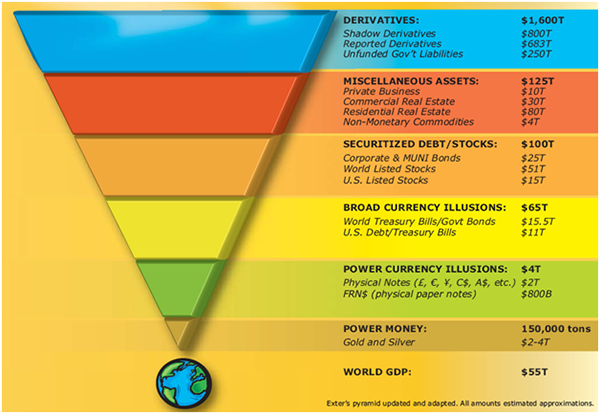
A "weak" interpretation of the pyramid says lower forms of money can be created ex nihilo, like cryptocurrency. There are higher and lower forms of money, but they aren't linked and its not necessarily clear which money in higher or lower based on its form alone. Example, fiat currency. Look at the list of existential hyperinflations and there is a recurring theme: the country or government issuing the fiat is facing or faced an existential threat such as war, foreign occupation after a war, lost a war, engaged in civil war and so on. Or the government engages in mass destruction and expropriation of wealth, such as communist governments (Venezuela the most recent example) or for other reasons (Zimbabwe's genocidal war on white farmers). Other fiat is more secure because the government still exists. All the currencies are fiat, but they have wildly different valuations. Some fiat may be superior to other assets. Would you prefer to hold a gold certificate from the Zimbabwe government or a Canadian government bond?
When Greece faced its sovereign debt crisis about a decade ago, the long-term government bonds didn't drop nearly as much as short-term bonds. It was believed Greece could not pay back its creditors today, but nobody thought Greece wouldn't exist in 10 or 20 years. Extreme hyperinflation is existential: the existence of the fiat issuing entity is called into down. Extreme hyperinflation is the nation-state version of the Bear Stearns and Lehman bankruptcies.
Now consider the stock market. What is the value of a company? In the marketplace, it is the last transaction multiplied across all the shares. What is that valuation though? It is a shared delusion once it exits from a cheap fundamental valuation. At some low price, someone could buy the whole company, finance the debt with cash flow and never have to re-IPO the company. Beyond a certain price, the valuation becomes ephemeral. It is based on the current risk appetite. Did Netflix and Facebook lose billions upon billions of dollars this year? No. The shared delusion that is their valuation collapsed towards fundamental value.
Bonds have a clear valuation because there is a known cash flow. However, the rate of interest and the value of capital itself can exist outside of this calculation. If suddenly people fear lending or refuse to lend at current rates of interest, all existing bonds are devalued. Holding a bond until maturity may produce no paper loss, but inflation could destroy the value of the money by the time it is return.
Which brings me to money heaven. Consider this example. Someone owns Netflix at $300 per share. They've owned it for a long-time and their risk tolerance is declining. Bonds are falling in price and a 5-percent yield on mortgage bonds looks good. They sell their Netflix and buy a mortgage bond. Money flows out of stocks and into bonds.
A quick look at the chart tells us both stocks and bonds are falling in 2022. Paper wealth can escape from stocks into bonds at the same time both keep falling in price. Only when the market rate of interest balances all the factors of inflation, risk appetite and so on, will bond prices stabilize.
Where is Czechoslovakia? Where is Yugoslavia? They still exist as a concept, but not one with any currency (pun intended).
But according to Albert Edwards, who refuses to let this story drop, not only is this divergence about to get much worse, but it will lead to catastrophic market consequences. It's also "the biggest story no-one is talking about."He fleshes out what I was talking about in the prior post:In a note published late last week under the same title (and available to all professional subscribers), Edwards turns his attention to the yen and yuan, and writes that "surely all of us working in finance realize by now that something is likely to snap in the financial system and probably quite soon."
Why? Because according to the SocGen strategist, "the rapidity of current market moves and the polarisation of the now extreme Fed (hawkish) and BoJ (dovish) policies almost guarantees that outcome.... Maybe the outcome wouldn’t be so ugly if central bankers had not spent recent decades ramping up asset prices to today’s grotesque levels through their monetary incontinence. But they did."
Of course, in the end one of the two central banks will capitulate first, and that will most likely be the BOJ as it has far less firepower - both monetary and verbal - than the Fed. One can watch this in real time as US Treasury yields soar higher, while the 10y JGB yield keeps knocking at that 0.25% YCC door "and the louder it knocks, the more rapidly the yen plunges." Indeed, as we forecast a month ago, at some point, either the yen will snap, or the BOJ's defense of the upper YCC barrier will fail (or both).I like his title, "The Biggest Story No-One Is Talking About." I've been talking about the yen for many months. It's a topic I've gone over many times because the fundamental case has been there for more than a decade and the chart was screaming trouble. Yet, very few people notice. The Sounding Line picked up Ready for the Yen Shock? Albert Edwards and others have been warning clients I'm sure. There is Santiago Capital on Twitter, he's active and a good resource for similar ideas.What happens then? Well, according to Edwards, the crashing yen has been propping up US Treasuries, as yen carry traders flee local assets and find (relatively) safety in US paper. This means that any direct intervention to prop up the yen by the BOJ will lead to another snap higher in US yields as the Japanese carry trade buyer drops out of the picture.
But the move higher in US yields would be child's play compared to the total collapse that would follow in Japan as the entire MMT paradigm is exposed for one epic fraud. To wit, when answering the question what happens to JGB yields when the BOJ pulls an RBA and no longer defends the 0.25% barrier, Edwards writes that while "the BoJ will persist in maintaining the 0.25% cap and all that implies" once "it abandons this ceiling or resets it higher" look no further than Australia for what happens next, which he shows shows below.
The conclusion: "When Australia ended YCC yields snapped higher – much higher!" A similar interest rate move in Japan, still the world's second largest economy, and one can kiss all remaining central bank credibility goodbye forever... and with it, also say goodbye to the fiat regime, which perhaps may just be the endgame here.
As for where the yen goes. A reversal keeps with history. Markets down, yen up. Important for trading, but nothing to worry about if you know the standard playbook of the past 14 years.
If the yen keeps falling...the chart below I first posted in early April is humorous because most charts don't resolve this way, especially currency charts. But calling it the Godzilla pattern is accurate because the damage to Japanese assets would resemble that of a Godzilla attack.

Similarly, it was nine years ago that I posted: Chinese Yuan Could Devalue 50% Or More. I recently posted USDCNY 10 and If Yen Doesn't Reverse, But Gains on Yuan looking at the implications of continued yen weakness and what looks like a major reversal in USDCNY.
And also Another Deflationary, DXY 160 Moment Begins. It's my long-standing theory that the endgame goes from periphery to core, with USD either blowing up simultaneously with all fiat or soaring as the system collapses with a series of fiat dominoes tumbling. There are two main scenarios One where JPY and EUR bear the load with USD in a China-led emerging market crisis and the ultimate endgame where even the euro and yen collapse.
In conclusion, I think about the long-term future when it comes to macro and I've added charting skills for myself for when those theories pan out or not. The most profitable moments are when theory and charts line up. Bear markets and major macro moves come about once a decade, with minor moves every few years such as as oil tumbling twice in the past decade. If this is the big one though, follow on events will pale by comparison. For bears and volatility junkies, this will be the peak of their trading life if they trade it well. Trading the move down and catching the bottom will produce a lifetime of profits, probably more than several lifetimes.
The stats out of Japan put a giant exclamation point on the price illusion caused by inflation. Exports rose 15 percent, imports 30 percent. Back out price effect and exports fell 2 percent, imports unchanged from a year ago. They're paying 30 percent more for the same volume of imports...now the tumbling yen makes perfect sense, right?
It's worse, so much worse on Japan's import side. Total imports were up more than 30% (THIRTY!) yy in March. By value.
— Jeffrey P. Snider (@JeffSnider_AIP) April 21, 2022
Actual quantity imported was 0.0% yy. Zero.
The Japanese paid almost a third more than last year to get the same mostly raw materials. That's going to be bad. pic.twitter.com/6v6XmYSp0S
Meanwhile, Russia is pressing ahead with plans to insist on a switch EU payment for its gas to RUB by Thursday. It has underlined it won’t export it for free, while the EU says it won’t pay in RUB. That is as binary a trade as you can get, and the potential outcomes should be obvious. The FX market seems to think so anyway, with EUR/RUB strengthening from 165 at its low to 105 at time of writing. But are we really going to see Russia “win” like that given the huge geopolitical and geoeconomic implications?Westerners upset with Western central banks and Western governments created a false image of Russia, but especially China, as a heroic opponent. If you limit your expectations then yes, to some extent Russia and China are opponents of the globalists. They could slow or hobble the Baizuo by causing them unrecoverable political losses.The much-vaunted Russia-India RUB-INR trade flaunted as the previous catalyst for “the end of the dollar!” is, according to the Indian press, looking far more mundane. The Business Standard reports India and Russia may keep RUB out of the proposed INR-RUB trade, given its high post-sanctions volatility: payments for the rising level of commodity trade that is indeed happening are likely to be settled in INR *pegged to the dollar*, and deposited in an Indian bank account. Under the proposed trade mechanism, when India imports goods from Russia, INR equivalent to the dollar value will be deposited in an Indian bank account. When India exports goods to Russia, Indian exporters can be paid from the same account in INR. You know who used a similar arrangement to work around sanctions? Nazi Germany. I’m sorry, I mean “Nasty Germany”.
The key points are that:
1. commodities will continue to be PRICED in DOLLARS, as we saw with the purported Saudi CNY oil sale;
2. Russia, for now, is still accumulating new USD and EUR reserves via its energy trade surpluses; and
3. nobody wants to touch RUB. Not even India, an emerging ‘neutral’ heavyweight in what article after article now say is a bifurcating world economy.
...If countries want to hold fewer USD reserves because of geopolitics and economies halting exports of the vital commodities USD are supposed to allow others to freely purchase, then that is not negative for the US dollar. Quite the opposite! It is negative for global trade. That may be in USD, and so there is less physical demand for them, but Eurodollar debts still have to be paid back, with rising interest, IN DOLLARS - and when there are less USD reserves, and flows, to do so with. That backdrop is arguably positive for the US dollar for now – unless, and I repeat, you are trading an avalanche of Eurodollar defaults.
Where we are seeing global FX reserve diversification, it is 75% driven by shifts into the likes of Canadian, Aussie, or Singapore dollars for example, all of which are still under the emerging Western/Anglosphere geopolitical umbrella. (Canada finally just opted for the F-35 as its fighter jet of choice, underlining that fact.) Such a development opens up some opportunities: Australia might be able to shift to invoicing more regional trade in AUD in ASEAN over time, for example.
However, we are not yet seeing the much-touted global switch to holding reserves in “commodity-backed” currencies of the future like CNY or RUB. That will require a game-changing economic policy shift or geopolitical event first. The first is seen as theoretically possible if politically unlikely, and the latter as perhaps strategically inevitable, but not necessarily to the dollar’s detriment: being nasty again, one could have made the same trade in the 1930s – and see how that worked out.
Yet there is no positive agenda that follows. There is no desire of the part of China or Russia to free Western peoples' from their own destruction at the hands of the Baizuo. They want to ensure that destruction remains in the West and isn't spread to Russia and China. They seek quarantive, not conquest. They could care less if the dollar collapses or not, as long as their economies are damaged by Western monetary policy. All the better if the dollar survives and the Baizuo can remain in power, selling off their nation and destroying it from within.
China is winning right now. Plenty of nations have become too aggressive too early, and maybe China will follow that path. If they stay on course and avoid war though, the Baizuo will complete the destruction of America as a global power by the 2030s.
In conclusion, nothing is going to change until change is forced via total economic collapse or total war. And what will follow? If I was the CCP, I'd think the U.S. has a pretty good setup! How about we keep the global financial system, but restart it with the yuan at the center? China takes "the exorbidant privelege" for itself? If China emerges victorious from a WWIII, I'd wager the new system would be far close to that than something desired by powerless Westerners hoping the near tyrant loses to the far tyrant.
The story is the same with free trade policy extended beyond national borders.
Epoch Times: The Impossibility of Autarchy
Some believe that if our nation produced everything we needed, we would all be better off because we wouldn’t depend on others. The idea comes from a deep lack of understanding of economics. There’s no such thing as autarchy. There’s no such thing as covering all the needs of a population based on the limit of a politically defined border. It makes no sense.Pure autarchy is idiotic and a strawman. Some fools out there are no doubt calling for pure autarchy, but most people are talking about maximizing domestic capital and labor. And even then, the majority of those people recognize economic efficiency. What most libertarians do not recognize is borders at all or any sense of collective action. They don't want to be part of a nation and therefore only see coercion when it comes to shared prosperity.
The other fallacy about autarchy that anyone can understand is that limiting the economy to the confinement of a random area of land is a poor way to develop, grow, and prosper. It’s almost laughable to read from politicians in the eurozone about how they want to achieve full independence and limit imports while at the same time they brag about the bloc’s enormous trade surplus. It’s funny to see how the most autarchic politicians want to increase exports at the same time. Close our borders to evil foreign commerce that destroys our factories! Let’s build more manufacturing capacity so that we can export to them!The latter part is correct, many politicians are morons. Yet the first sentence is also absurd. One should not focus on improving one's own land, to grow and prosper? This only makes sense if one sees land and people as interchangeable widgets. I do not believe this author is a globalist, but you can see the camel's nose in the tent. The extermination of nations and culture flow from this economic assumption, that a nation should not seek to maximize its domestic fortunes first.
How can autarchy and protectionism be sold to citizens? By selling the false idea of a zero-sum game in the economy. If someone is selling oil to us, they win, and we lose. If someone is selling solar panels to us, they win, and we lose. We would win if we sold everything to ourselves. Really? The math doesn’t work like that. Politicians that sell a zero-sum game in the economy know it’s false, but they also know that protectionism and autarchic aspirations give power to them and make citizens more dependent on political power.It's a much simpler question. Do you want 10 million angry unemployed people for neighbors, and 20 to 30 million underemployed, underpaid workers angered by the crappy jobs and declining standard of living for neighbors so that you can save 10 percent on a solar panel? Or so you can make $10 billion shipping their jobs off to China? The reason why China is wealthy today is not because they embraced free markets. Their economy is struggling because it didn't. They let markets in to some degree, but a major factor was short-sighted Western countries sold their middle class to China. The Chinese, and all of East Asia for that matter, recognize that wages are a function of capital and labor. Increase capital investment and wages will follow. In the financialized West, maximizing returns on capital is the main goal, labor be damned.
As for politics, the thorn in the side of all economic policy is corruption. There will be corruption in whatever policy is chosen. Minimizing that corruption should be a goal no matter the overall system, but the choice of system is itself corrupted. Anti-labor, short-sided, high time-preference individuals want to maximize their take now, long-term be damned. The current economic system that eschews a focus on long-term national prosperity is instead hijacked by short-term parasites who take control over businesses from long-term thinkers who, rationally, will not put their company into risk of bankruptcy by taking on massive amounts of debt. Businesses that are well-managed are "cheapened" by an economic system that favors economic parasitism. That rewards atomized individualistic behavior taken at the expense of neighbors.
I will note here that most libertarians will point out the monetary system as a great villain in this story, and I agree. It still doesn't change my argument on this topic, moreover I see a move on trade as being more politically palatable then abolition of the Federal Reserve. Put another way, if I was dictator, I might move trade down the list of economic reforms, something to be tackled after first seeing how regulatory and tax cuts affect the economy. Perhaps trade will fall off the list. In the current context of U.S. politics though, trade looks like one of the few areas that could muster bipartisan support...
It may be true that some nations have taken advantage of an open economic system in order to sell more while making it more difficult for others, but the solution isn’t protectionism but more open trade. If a nation decides to harm itself by being protectionist, we’re reaping the benefits, not them, because we benefit from trade growth and prosperity while they end in stagnation.Please explain this to the once prosperous rural and suburban areas of the USA that now resemble Ukrainian cities being shelled by Russian forces. Who exactly is prospering? The trick here is a general gain is substituted for a specific loss, which is a favorite trick of the free traders. GDP is up 0.01 percent thanks to this trade deal, but sorry we totally destroyed Youngstown, OH in the process. Learn to code and here's some food stamps and fentanyl.
The world’s supply problems can’t be solved by adding massive overcapacity in every country. That leads to a collapse in productivity and, much worse, real wages. There are plenty of great nations that can cooperate with us to deliver prosperity to everyone. Trade is the blood of the economy. Autarchy only leads to zombification and, ultimately, decay.The nations that are free will prosper. The nations that are not free, who implement socialist and anti-market systems, will fall behind. It is time the United States and other free nations focused on making their own people prosperous first, which yes includes some free trade. There are a whole range of policies between immiserating open borders and immiserating autarchy. For example, the United States could implement a 25-percent general tariff on all imports. Would this eliminate trade? Hardly. It would shift some production from offshore to onshore. The tariff could be used dollar-for-dollar to eliminate taxes on productive use of labor and capital.
Political extremism is on the rise. Thoroughly debunked economic theories such as socialist planning are already making policy (the Green New Deal and associated environmental policies are pure central planning) because the right and neoliberals embraced a libertarian, international-capital (corporatist, not capitalist) view of economics. They abandoned their people. If you want to live in a country that embraces capital uber-alles, the best spots are undemocratic countries such as Singapore or Arab Gulf States. These polities can run roughshod over political opposition. Or embrace the Baizuo's tyrannical takeover in the West, and along with it their economic central planning. Or instead reject both and focus on improving the lives of the average citizen.
There is no political utopian position. Man is fallen. Man is corrupt. What works in a theoretical utopia of perfectly rational individual actors is blown to smithereens when there are subversive groups who gang up and exploit those individuals. And when those individuals complain, they are told to suck it up, that's the market. Don't be surprised when those people turn to whatever policy response is offered up. When the alternative is death by dehydration, any consumable liquid will be accepted a thirsty man.
DC is a grift all the way down. All the progressive groups from BLM to the environmental groups are bought and paid for by the American oligarchs.
On February 28, NBC News ran a piece captioned “Undocumented day laborers face harsh work prospects due to immigration spike”. As hard as it is to believe, neither the headline nor the video itself is satire.Increase supply and prices go down. This is basic economics. There is only one type of immigrant who immediately improves the economy: the super producer. The entrepreneur, the inventor, the business founder. Not someone who runs a convenience store or a restaurant, but a business that creates substantial new wealth. Productive people don't subtract from the economy and their children may become more productive, but they aren't making the average person better off unless there's a labor shortage, in which case adding labor can have an immediate positive impact. Less productive migrants are net negatives. They produce more GDP because they purchase basic necessities, but that money flows to corporations and the wealthy. They consume more welfare than they pay in taxes, sometimes substantially more. It adds more debt (inflation) into the economy and makes the average citizen worse off, the average worker far worse off because their effect on labor prices pulls everyone's wages down. Moreover, we can't ignore the raw numbers of immigrants. There aren't enough productive immigrants to cause problems such as overcrowding in schools. Low/no skill mass migration is the main driver of negative outcomes for ordinary Americans.The primary focus is on workers at the corner of Division and Marcy Avenues in the Williamsburg section of Brooklyn, known as La Parada, or “the stop”. The voiceover explains, “This is a place where immigrant women find a job for the day, primarily doing domestic work. Every day, up to 150 women wait here, bargaining for hourly pay that is often below minimum wage”.
Why, exactly, would workers bargain for pay that falls below the state and/or federal minimum? The video continues: “Often, these day laborers are undocumented”.
Here’s the problem, according to NBC News: “With more women looking for work, there is more competition. Desperate to find a job and with little to no English, many new arrivals don’t negotiate their rate.”
A high minimum wage is a terrible idea because many of these migrants can't produce enough economic output at a $15 minimum wage. What will happen is mass unemployment that drives up welfare costs, coupled with a large black market for sub-$15 an hour labor. The low living standards of American "minimum wage" workers was caused by three factors: feminism, mass immigration and offshoring. The first and third of those are over. Female labor force participation peaked already. Offshoring peaked. A growing desire for onshoring will reverse that trend soon enough, if wars and soaring transportation costs don't do it first. The last factor is more extreme than ever: open borders.
If you are not familiar with New York City or Williamsburg in particular, the neighborhood is rated as number one among “The 10 Most Hipster Neighborhoods on Earth” on Thrillist.According to that outlet: “If hipsters have a mecca, it's most certainly Williamsburg. A world of bow ties, trilby hats, and suede chukka boots, where everyone's an amateur photographer with an unnecessarily expensive DSLR camera.”
Williamsburg is also extremely “progressive”, a blue enclave in a sea of blue in an area polling outfit FiveThirtyEight refers to as “The Elite Circles” (along with lower Manhattan), “the most progressive slice of the city”.
I trust that commuters are not traveling into La Parada from the more conservative environs (like Staten and Long Islands) looking for domestic help, so most of the would-be employers there are likely Williamsburg locals. It appears, then, that hipster would-be socialists are busy dickering for the cheapest, below-minimum wage workers whom they may or may not end up paying — a fact that speaks volumes.
Baizuo love to scream about $15 minimum wage, but I'm willing to bet the minimum wage in New York City could approach $20 an hour without mass immigration. Close the border and deport the illegal aliens, and watch wages soar. Imagine a person violently and gleefully stabbing a knife into the back of the American worker over and over while alternatively screaming "racist" at the worker and "Fight for $15" and you understand the mind of the modern Baizuo.


There's a link to an Australian economist explaining how this all works at the link. Worth clicking through if you're interested.
The 3-D’s suggest inflation will give way to deflation, economic strength will weaken, and over-zealous investors will once again get left holding the bag.The inflation-deflation debate can be boiled down to one chart, whichever way you like it: the ratio of copper and gold. The gold/copper ratio crossed 365 in September 2011 and hasn't looked back. That was also right around the time gold was setting a new all-time high that wouldn't be broken for nearly a decade.Be careful chasing the wrong asset class.
If we are correct, bonds will likely be the best performing asset class in 2022.

Here is the ratio alongside ARKK. The correlation increases as the ratio moves into and out of inflection points.

The other asset to watch is bonds. If that topping pattern completes, everything changes. A continuation of the past requires a failed H&S pattern giving way to a major bullish breakout that would probably take the 10-year yield to zero percent. I am focused on the short side in equities because I expect they fare poorly no matter how the gold-copper ratio resolves in the near-term.

From the vantage point of policymakers in the Federal Reserve, the 1973-74 oil crisis served to further complicate the macroeconomic environment, particularly in regard to inflation. Fed Chairman Burns argued in 1979 that the inflation appeared to be the result of a plethora of forces: “the loose financing of the war in Vietnam. . .the devaluations of the dollar in 1971 and 1973, the worldwide economic boom of 1972-73, the crop failures and resulting surge in world food prices in 1974-75, and the extraordinary increases in oil prices and the sharp deceleration of productivity” (Burns 1979). The intellectual consensus among policymakers at the time was that cost-push inflation (the type of inflation arising from an increase in the prices of inputs to the economy, i.e., worker wages) was outside the influence of monetary policy (Romer and Romer 2012). In the words of an economist who presented to the Federal Open Market Committee in May of 1971, “the question is whether monetary policy could or should do anything to combat a persisting residual rate of inflation ... The answer, I think, is negative. ... It seems to me that we should regard continuing cost increases as a structural problem not amenable to macro-economic measures” (Romer and Romer 2012).Since we know the history, we know that printing money to try to offset recession is impossible. It creates higher inflation that results in a larger recession down the road. The DJIA fell 46 percent from its all-time high in January 1793 to its November 1974 low with only brief rallies, the longest being a 3-month, 17-percent rebound in 1973.Economists have since come to understand that a central bank can influence the extent to which supply shocks affect inflation, but they face a trade-off. Higher oil prices, because of the widespread effect they have on commodities throughout the economy, will tend to generate both inflationary pressures and slower growth. In the short run, these forces tend to have an inverse relationship, meaning when one rises, the other falls and vice versa. Ben Bernanke for example, discussed this in 2004: “How then should monetary policy react? Unfortunately, monetary policy cannot offset the recessionary and inflationary effects of increased oil prices at the same time. If the central bank lowers interest rates in an effort to stimulate growth, it risks adding to inflationary pressure; but if it raises enough to choke off the inflationary effect…it may exacerbate the slowdown in economic growth.” He goes on to explain that the decision to tighten or ease monetary policy ultimately depends on how policymakers balance the risks inherent in pursuing employment and price stability objectives (Bernanke 2004).
Ultimately, the oil crisis of 1973 and the accompanying inflation was a result of many factors culminating in a perfect economic storm. The oil embargo of 1973 was just one of many complicating factors that led U.S. policymakers to overestimate our national potential and to underestimate their own role in the broad inflation that occurred throughout the 1970s.


