Showing posts with label EWI. Show all posts

2022-07-20

What a Draghi! Nationalists and Populists Sink Italian Government

ZH: Italy Government On Verge Of Collapse After Coalition Members Abandon Draghi; Euro Tumbles
Forza Azzuri! I bought some August calls on iShares MSCI Italy (EWI). Still looking for a bounce. Early elections by September could follow if Draghi's government falls. As has been the case before, if the 5-Star can find agreement with the right-wing parties, they have enough votes between them (based on current polling) to form a government. However, Salvini scored an own goal when he tried rehabilitating his pro-Russia position by supporting bad policies such as the EU sanctions. Throw a potential Russian peace offer into the mix and who knows how things will play out over the next eight weeks if an election is coming...

2022-06-12

Chart for the Decade: Greece vs Germany

As I first pointed out in April, the Greece ETF has been basing versus the German ETF.

Greece doesn't look as strong versus the Eurozone ETF, but EZU includes countries such as Italy that also look like Greece:
Note that these ETFs include fluctuation in the euro, but the relative charts cancel that out. 

Investors in European debtor states have not made any money for 20 years. The chart of the Greece ETF alone looks like a gold mining stock, some "expensive oil" services companies such as offshore drillers, but hasn't broken out yet. Italy doesn't look as good here, but it is also tracing out a large basing pattern. In short, outperformance is happening on the downside for now.
Here is the Germany ETF. A possible low could be in the $20 area. Below the green support line and the blue horizontal, there is nothing but air to the downside.
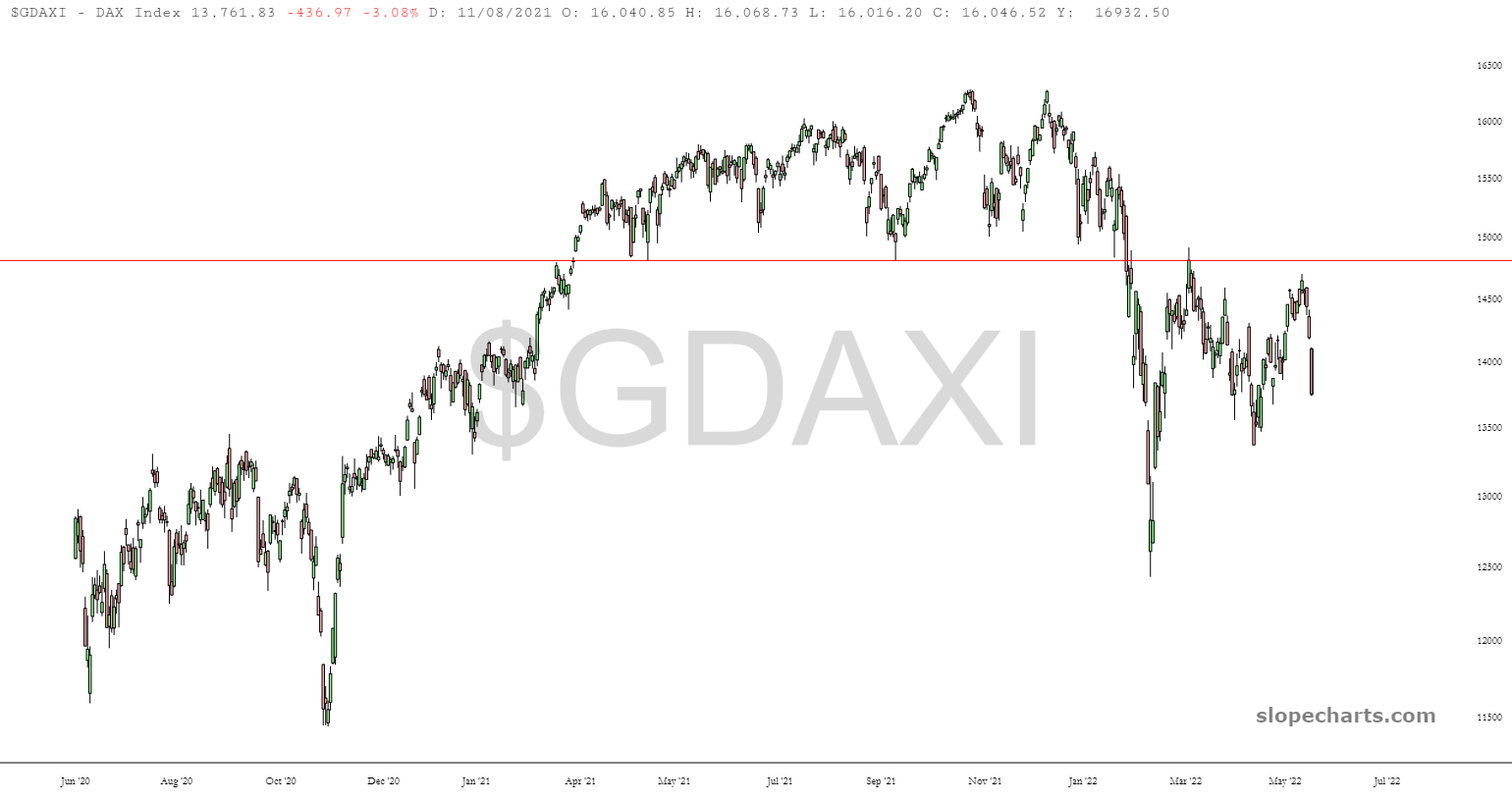
The DAX Index has a clean top and two failed reversal attempts. Major support lines are about 23 percent lower and 50 percent lower from Friday's close.

Going all the way back to the post-2008 fallout era, when Greek sovereign debt emerged almost immediately and first rattled markets in the spring of 2010, critics of the euro and European Union have explained how Greece was being harmed by the euro and austerity programs being forced on the nation without any fiscal transfers:

Greece made a big mistake taking on too much debt in the 2000s at artificially low interest rates afforded by a credit bubble and its use of the euro. Any sovereign state in a similar situation post-bubble would intentionally devalue its currency or see the market would depreciate it for them, outside of an incredible reform movement.

Would it be impossible for the Greek stock market to rally in a bear market? No. There is one outlier scenario where that happens: Greece does something extreme such as exiting the euro and redenominating its sovereign debt in drachmas. More so than most nations, Greece would benefit from currency devaluation because it's economy and assets are already devalued. 

Currency devaluation is an escape valve for incompetent sovereigns. Serial devaluation shows a nation doesn't make hard choices and opts for the easy way out, impoverishing its own people and foreign investors over time. All nations will eventually devalue their currencies though, if reforms were not undertaken and credit not controlled. The mistake was blowing the bubble in the first place, not the currency devaluation that balances assets to liabilities.

Trade Implications

If Greece assets could rally on a euro exit, then Greece should outperform amid high inflation and euro weakness. The macro forces that crushed Greece in the prior decade are now turning in Greece's favor and against Germany. If trends continue for years, it might be Germany that wants out soon.

The cleanest trade here is short Germany, in local currency or in dollars via an ETF such as EWG. (Not necessarily a trade to put on Monday, but one that could have been put on in January and still held today.) Greece is not a clean buy because it will probably fall in a global bear market, but if that basing pattern turns into a breakout at any point, then I would recommend accumulating Greek assets along with Italian and other debtor countries, depressed sectors and so on during the dip because they should outperform in the next bull market. If you find a depressed asset that is harmed by a strong euro and deflation/disinflation, and it still has good underlying fundamentals, it sounds like a potentially good buy on the surface.

A breakout in the "Greece vs Germany" chart would signal a significant turn in macroeconomic forces. Conversely, if the chart were to fail (a "bear market" rally that delays the eventual breakout is not a fail) and sink again, it would tell me the post-2008 central bank trap is alive and well with potentially more QE and even more negative interest rates on the way.

2021-02-26

Just When You Thought Selling Was Done...

Yields have pulled back on Friday, easing selling pressure in the stock market, but the U.S. dollar index is rallying back above its 50-day moving average. iShares Mexico (EWW) is below long-term resistance and has a small topping pattern.
FXI is also battling at support/resistance.
Italy right where it has failed every time since 2008. Haven't been watching this one, but if something is differernt this time, Italy should break through. Otherwise...
Steel ETF
The regional bank ETF hit a resistance line yesterday morning that is from the 2008 top and was hit in June 2018.
GDX perfectly hit my suppot line dawn from teh 2016 high. A strong dollar should weaken it, but I like the risk/reward here because it's right at support.

2018-02-21

Italy About to Turn Nationalist at Intermediate Peak in Social Mood

If you think the euro and European Union are out of the woods, that the populist wave has ebbed, think again. We are still part way through a decades long process. European nations are drifting in a nationalist direct despite social mood (measured by the market indexes) hitting new highs or at least multi-year highs. The elites of Europe (and most of the West) dug themselves so deep in the hole by pushing peak social mood policies well after social mood had peaked. They are still pushing in the wrong direction today, 18 years after the peak and 10 years after they should have woken up. I don't think the French Revolution is a good model for what is about to happen, but King Louis XVI actually tried reforming at first.


Update: other European debtor nations have similar charts.