Showing posts with label Greece. Show all posts

2022-06-12

Chart for the Decade: Greece vs Germany

As I first pointed out in April, the Greece ETF has been basing versus the German ETF.

Greece doesn't look as strong versus the Eurozone ETF, but EZU includes countries such as Italy that also look like Greece:
Note that these ETFs include fluctuation in the euro, but the relative charts cancel that out. 

Investors in European debtor states have not made any money for 20 years. The chart of the Greece ETF alone looks like a gold mining stock, some "expensive oil" services companies such as offshore drillers, but hasn't broken out yet. Italy doesn't look as good here, but it is also tracing out a large basing pattern. In short, outperformance is happening on the downside for now.
Here is the Germany ETF. A possible low could be in the $20 area. Below the green support line and the blue horizontal, there is nothing but air to the downside.
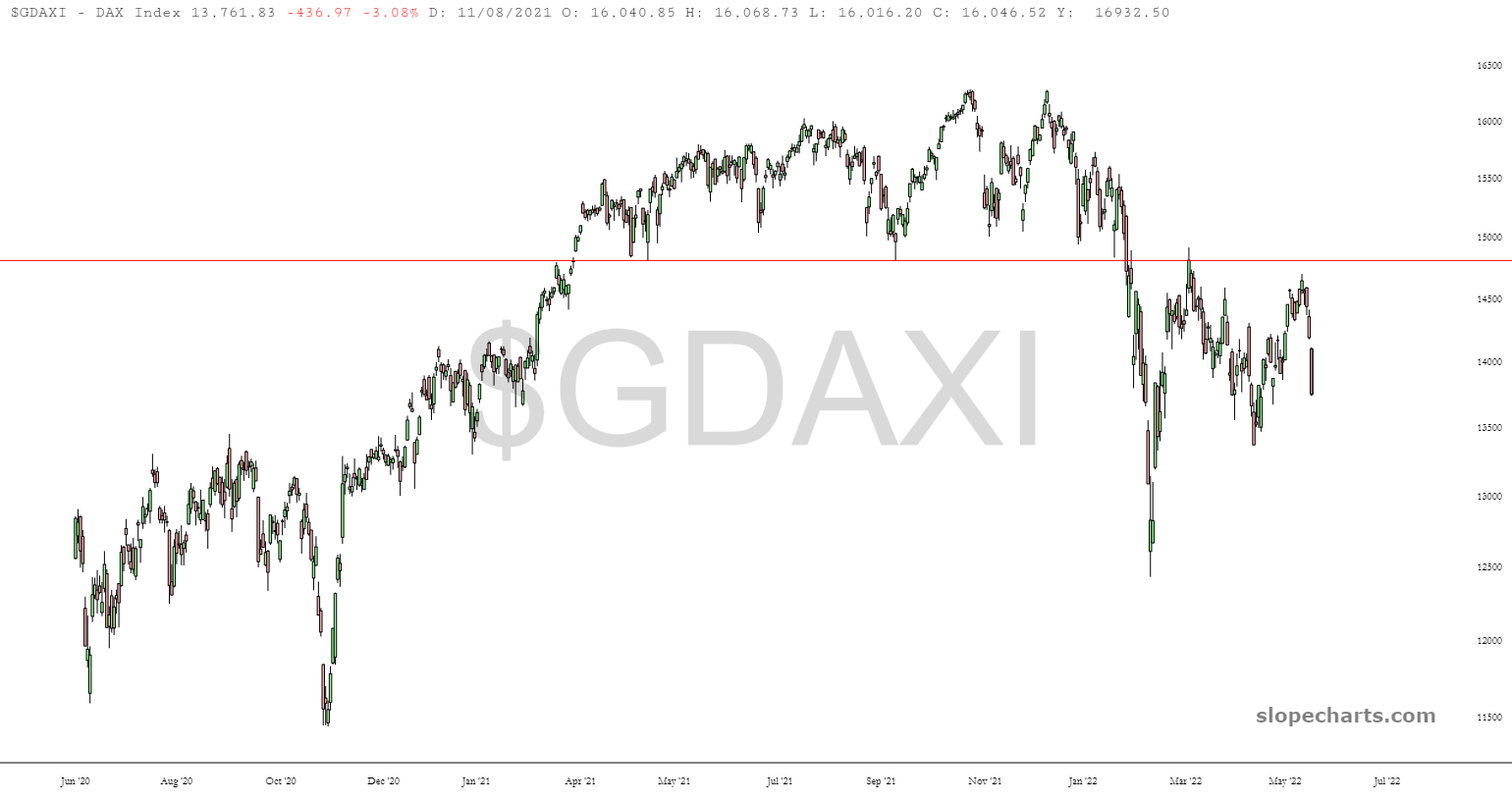
The DAX Index has a clean top and two failed reversal attempts. Major support lines are about 23 percent lower and 50 percent lower from Friday's close.

Going all the way back to the post-2008 fallout era, when Greek sovereign debt emerged almost immediately and first rattled markets in the spring of 2010, critics of the euro and European Union have explained how Greece was being harmed by the euro and austerity programs being forced on the nation without any fiscal transfers:

Greece made a big mistake taking on too much debt in the 2000s at artificially low interest rates afforded by a credit bubble and its use of the euro. Any sovereign state in a similar situation post-bubble would intentionally devalue its currency or see the market would depreciate it for them, outside of an incredible reform movement.

Would it be impossible for the Greek stock market to rally in a bear market? No. There is one outlier scenario where that happens: Greece does something extreme such as exiting the euro and redenominating its sovereign debt in drachmas. More so than most nations, Greece would benefit from currency devaluation because it's economy and assets are already devalued. 

Currency devaluation is an escape valve for incompetent sovereigns. Serial devaluation shows a nation doesn't make hard choices and opts for the easy way out, impoverishing its own people and foreign investors over time. All nations will eventually devalue their currencies though, if reforms were not undertaken and credit not controlled. The mistake was blowing the bubble in the first place, not the currency devaluation that balances assets to liabilities.

Trade Implications

If Greece assets could rally on a euro exit, then Greece should outperform amid high inflation and euro weakness. The macro forces that crushed Greece in the prior decade are now turning in Greece's favor and against Germany. If trends continue for years, it might be Germany that wants out soon.

The cleanest trade here is short Germany, in local currency or in dollars via an ETF such as EWG. (Not necessarily a trade to put on Monday, but one that could have been put on in January and still held today.) Greece is not a clean buy because it will probably fall in a global bear market, but if that basing pattern turns into a breakout at any point, then I would recommend accumulating Greek assets along with Italian and other debtor countries, depressed sectors and so on during the dip because they should outperform in the next bull market. If you find a depressed asset that is harmed by a strong euro and deflation/disinflation, and it still has good underlying fundamentals, it sounds like a potentially good buy on the surface.

A breakout in the "Greece vs Germany" chart would signal a significant turn in macroeconomic forces. Conversely, if the chart were to fail (a "bear market" rally that delays the eventual breakout is not a fail) and sink again, it would tell me the post-2008 central bank trap is alive and well with potentially more QE and even more negative interest rates on the way.

2022-04-24

Greece Beats Germany

Fresh off the heels of posting Tomorrow's News Today, I give you the Greece ETF divided by the Eurozone ETF and the Greece ETF divided by the Germany ETF. Not complete...but basing. Now work backwards: in what scenario will the pattern complete and break out?

2018-05-24

Turkey Violates Greek Airspace 56 Times

Who says you can't go back to Constantinople?

ZH: Turkish Fighter Jets Violate Greek Airspace 56 Times In A Single Day

This is played down as a squabble between NATO allies, but Turkey and the EU are moving in opposite directions politically. Turkey is shifting in a more Islamic direction and Europe in a more nationalist direction. Europe's establishment has seeded Europe with jihadist, Europe's establishment is slowly being replaced.

This is the most dangerous flash point in Europe. And since Turkey is toast, lashing out with a military strike and appeal to wider Islam makes sense.

2017-12-27

Turkey Tensions Rising Again

ZH: Turkey's Main Opposition Party Threatens To "Come And Take Back 18 Islands Owned By Greece"
No worries. The leader of Kemalist CHP will not come in the next days, weeks or months. He will come in 2019, after his party will win the general elections of Turkey scheduled to take place in the same year.

As KeepTalkingGreece.com reports, lashing out at the Greek defense minister’s remarks on the Aegean islands who a few days ago told Turkey "Molon Labe " - meaning “come and take [them]” is a classical expression of defiance. According to Plutarch, Xerxes I, king of the Achaemenid Empire, demanded that the Spartans surrender their weapons and King Leonidas I responded with this phrase. It is an exemplary use of a laconic phrase - Kilicdaroglu said speaking at a party event in the northwestern province of Kocaeli...

“The Greek Defense minister says ‘Come and get it.’ I will come and take all of those islands back.
Turkey is going Islamic or Nationalist. In either case, they will run into an increasingly unfriendly Greece.

2017-10-01

Greece Debt Sale Signaled Market Top Again

In May I wrote:
The last time Greec issued bonds into the private debt markets (2014) it marked a peak for the Greek stock market, and would soon be followed by a political battle over austerity.

2017-07-20

Turkey Still Stirring Up Trouble

ZH: Germany Warns Its Citizens: They Risk Arrest If Traveling To Turkey
Foreign Minister Sigmar Gabriel said Germany had revised its travel advice in the wake of the recent arrests of several human rights activists, including German national Peter Steudtner.

Steudtner “was no Turkey expert – he never wrote about Turkey, he had no contacts in the political establishment … and never appeared as a critic,” Gabriel told reporters.

He added that this meant that any German national travelling to Turkey could suffer the same fate.
ZH: Greek President Blasts Erdogan After Turkish Harassment: "Provocations Are Sign Of Weakness, Come & Get It!"
While Pavlopoulos’ helicopter was heading to islet Panagia, pilots received warning calls and threats from the Turkish armed forces. The Turks claimed the Greeks that they were flying in Turkish Flight Information Region. The Greek delegation ignored the Turkish warnings and the President landed safe in Panagia.

A day earlier, the Turkish armed forces called the Greek helicopters nearing the island of Rhodes to leave the area as “they were flying in a demilitarized zone” where such flights are forbidden. The Greek pilots did not respond to the callings from the Turkish side.

A little later, the Turkish side called on the pilots of Shinook to leave the area as they were flying inside “the Turkish FIR.” On board were President Pavlopoulos, Defense Minister Panos Kammenos as well as the military leadership of the country.

In one incident, the military helicopters transporting Pavlopoulos suffered radio interference from Turkey.

Wednesday morning, a pair of Turkish F4 fighter jets entered the Athens Flight Information Region at 10 a.m. between Lesvos and Lemnos and flew over the Fournoi islets at 8,900 feet.

2017-05-17

Brewing Battle Over Greek Debt Relief

FT: Is Greece just about to default?
Further, to Tsipras’ (and others’) surprise, Greece now runs a big primary surplus — over 3 percent of GDP in 2016, up from balance in 2015, and still running strong into 2017, even if some of it reflects temporary factors. Sure enough, that scorching fiscal withdrawal is accompanied by output declines, yet again. But in that context, Tsipras doesn’t need new finance for the budget as is if deposit flight is contained or if ELA is uncapped. Only if deposits flee and ELA is capped will Greece spiral. But thereby the Euro pandora’s box of ECB legitimacy will bust wide open. If Tsipras is ever going to stand and fight on debt reduction — i.e., default — now is the time.

Merkel, likewise, faced with this prospect, also has good reason to pick a fight on Greek debt reduction now.

Glad as she may be that Mme Le Pen has been dispatched, at least for now, Merkel’s immediate task, faced with “Saint Emmanuel”, is to reassure her voters that she’s not going to go soft, not for him, nor the Brits, nor the Italians, and so certainly not for Tsipras. Given the resurgent SPD since Schultz, her key concern ahead of Fall elections is risk of loss of votes to her right. So a flat-out fight with the IMF and Tsipras over debt reduction, with an insistence on the German version of ECB “orthodoxy” on ELA, all under the rubric of “European rules”, has big political attractions.
Even the most pro-EU members have domestic political concerns that cause them to behave in their national interest. Overall social mood is negative in Greece, tensions are rising in Europe.

The last time Greec issued bonds into the private debt markets (2014) it marked a peak for the Greek stock market, and would soon be followed by a political battle over austerity.

Turkey Stirs Trouble With Greece and EU

ZH: EU Warns Turkey After 141 Greek Airspace Violations In Single Day
Turkish aircraft and helicopters illegally entered Greece’s airspace 141 times on May 15, the Hellenic National Defence General Staff reported.

...Will now Turkey stop Greece’s airspace violations? On the contrary. Greeks expect ‘intensive activity’ due to the Turkish naval exercise Seawolf.

On May 16, a pair of Turkish F-16 and of F-4E as well as one CN-235 violated the Greek airspace three times.

Back in August 2015 I wrote Geopolitical Forecasting Through Technical Analysis: Is Turkey About to Destabilize the Middle East?

Social mood in Greece is high now and the country is about to sell bonds into the private market. Social mood was also high in April 2014, the first time it sold private bonds since the debt crisis started in 2010. Look at what happened next. The current offering is a contrarian indicator.

More broadly, Greek social mood is very negative. Nationalist sentiment is suppressed for now, but it could erupt at any moment. Military tensions with Turkey could be a spark. It would also give pretext to any nationalist governments in Europe who want to push Turkey out of Europe.

2015-09-21

Golden Dawn in Catbird Seat

BBC: Greece election: Alexis Tsipras hails 'victory of the people'
Syriza won just over 35%, slightly down on its previous result and still short of an overall majority.

But it will renew its coalition with the nationalist Independent Greeks. Opposition New Democracy gained 28%.

Far-right Golden Dawn came in third with 7%, slightly up on January's poll.
Golden Dawn is the only party that hasn't stabbed Greek voters in the back yet. Golden Dawn is also in a stronger position than the Nazis were before their sudden rise to power.
As for those who are historically ignorant enough to point out that Golden Dawn only won 18 seats in the Greek parliament with 7 percent of the vote and therefore will never come to power, I will type very, very slowly and point out that in 1928, five years before they took power, the National Socialist Workers Party won 12 seats in the German parliament with 2.6 percent of the vote.

Two election cycles. And then you will see an absolute sea change in Europe. And if the EU attempts to entirely abandon even the pretense of democracy in defense of the invasion, the change will come even faster. And harder.
Unless you expect the economy will boom, Greece's debt will be forgiven and the migrant crisis will be solved harmoniously, it would be smart to bet on Golden Dawn eventually winning an election.

More from Bloomberg: Greek Election Triumph for Left Masks Gains for the Far Right
The anti-immigration Golden Dawn party surged in the Sept. 20 vote on Greek islands hit by a wave of asylum seekers from the war-torn Middle East. The support for the far-right group, whose insignia resembles a swastika and which is under investigation by prosecutors for links to organized crime, highlights the potential of the migrant crisis to stoke nationalist forces in Europe.

“The eastern Aegean islands have many angry voters who feel the massive refugee inflow is destroying them financially largely because of the impact on tourism,” said George Pagoulatos, professor at the Athens University of Economics and Business. “If the European Union fails to integrate the migrants, that would only raise the popularity and appeal of xenophobic and extreme right-wing parties in Europe.”

2015-07-10

Greece Gets Deal Rejected By Voters

MacroBusiness: Tsipras has just destroyed Greece

A long post listing the details of the deal and concludes with:
This is basically the same proposal as that was just rejected by the Greek people in the referendum. There are some headlines floating around about proposed debt restructuring as well but I can’t find them.

This makes absolutely no sense. The Tsipras Government has just:

renegotiated itself into the same position it was in two months ago;
set massively false expectations with the Greek public;
destroyed the Greek banking system, and
destroyed what was left of Greek political capital in EU.
If this deal gets through the Greek Parliament, and it could given everyone other than the ruling party and Golden Dawn are in favour of austerity, then Greece has just destroyed itself to no purpose.

Markets are drawing comfort from the roll over but how Tsipras can return home without being lynched by a mob is beyond me. And that raises the prospect of any deal being held immediately hostage to violence.
It looks like the parliament will approve the deal based on the number of representatives for each party. I can see the vote going down if the public reacts strongly, but will their desire to stay in the euro outweigh their desire for control over the economy? Assuming it goes through, the deal doesn't appear to solve anything. More debt and more austerity, same as before only more so and Greece can't do austerity like a Northern European country (or Slovakia) because the people won't accept it. Two or three years from now, or sooner, there will be renewed anger and a new election. Only two credible alternatives remain for voters who oppose austerity: the hardline Syriza members and Golden Dawn. Prepare for the new Molotov–Ribbentrop Pact.

2015-06-28

Chinese Headline: Do Greeks Want Money or Face?

iFeng: 希腊谈判破裂实行资本管制 民众纠结:要钱还是面子?

The Return of Sovereignty

The crisis in Greece has always been at heart a political crisis. Greece appears to have finally reached the endgame when it comes to the debt, but the next step is unknown. Will the EU come together and work with Greece post default, or is an even greater political breakup already developing?

BBC: Peston: ECB to turn off emergency Greek help
The European Central Bank's governing council is expected to turn off Emergency Liquidity Assistance (ELA) for Greek banks at its meeting later today, according to well-placed sources.

So unless Greek savers miraculously decide to cease withdrawing cash from their accounts, Greek banks would find themselves in serious straits as soon as Monday - because the banks have become dependent on ELA, approved by the ECB but supplied by the Bank of Greece, to provide the cash to depositors who want their money back.

"We think the Greek government will have no choice but to announce a bank holiday on Monday, pending the introduction of capital controls," said a source.

Greece to shut banks and stock exchange on Monday
Greek banks and the stock exchange will be shut tomorrow after creditors refused to extend the country's bailout and savers queued to withdraw cash, taking Athens' standoff with the European Union and the International Monetary Fund to a dangerous new level.

Not unrelated to the collapse of political consensus is the increasingly nationalist East.

RT: ‘Slovakia to Slovaks’: Thousands join anti-Islamization protest in Bratislava, dozens arrested
At least 140 people have been arrested in Slovakia’s capital, where thousands gathered for an anti-immigration and anti-Islamization rally, according to local media reports. The march turned violent as protesters scuffled with police.

The march was organized by the Alternativna cesta group via Facebook. It was called to protest against Brussels’ proposal to tackle the influx of migrants to the EU by imposing compulsory national quotas that require EU countries to accept a specific number of new migrants, most of whom arrived in Italy or Greece.

Hungary to build fence on Serbian border to shut out illegal immigrants
Hungary will build a temporary fence on the border with Serbia as fast as possible to stop the flow of illegal migrants, the foreign minister said.

Austria, meanwhile, reacted angrily to Hungary's announcement that, for an indefinite period, it would not take back refugees it registered when they entered Hungary but left for other destinations in Europe before their asylum requests were decided.

Foreign Minister Peter Szijjarto said several laws needed to be amended before construction of the fence could begin so he could not say exactly when the work on the "temporary border seal" could start.

"In the future, we will apply temporary border seals on every border section where there is no other effective way to impede illegal immigration," Szijjarto said, adding that the government had set aside 6.5 billion forints (20.9 million euros) for the project.

NeuEurope: A Hungarian, Italian, and Greek crisis is becoming European
On Tuesday, Hungary moved to unilaterally suspended EU asylum rules requiring the country to take back refugees who have transited through the country. There are precedents. The Berlusconi government had a “see no evil, hear no evil” policy during the Libyan crisis in 2011, refusing to enforce the Dublin Regulations requiring asylum seekers to seek refuge in the first country they set foot. Italy in effect allowed for their travel to France. However, this is the, so called, Dublin Regulation, but this is the first time this is happening openly.

Brussels called for clarification. The Hungarian government’s response is that the asylum system in the country is “the most overburdened among EU member states” dealing with 60.000 people the first half of 2015. The Commission spokesman noted that “Dublin rules do not foresee the suspension of transfers by the receiving member states,” but it will be hard to take any action to streamline the Hungarian government. On the one hand, an extreme response would call into question the impartiality of the Commission and make the practical management of the crisis difficult. On the other hand, a number of member states have increasingly anti-immigration rhetoric and Prime Minister Victor Orban is likely to find ample support for his decision.

2015-05-12

Greece Enters the Endgame

Greece tapped its emergency IMF reserves to pay IMF debt
Greece emptied an emergency IMF holding account to repay 750 million euros ($839 million) due to the international lender, a Greek central bank official said, avoiding default but underscoring the dire state of the country's finances.
Greece has to repay that money in one month, so we know two things. Greece is broke, for real, and it is one-month until the end unless there's a deal.

Also this: Russia invites Greece to join BRICS bank. Since Greece is now a developing country, it makes sense...

2015-04-23

Could Greece Default and Stay In The Eurozone?

A few scenarios are examined in: Could Greece default and stay inside the Eurozone?
While default sounds definitive it is rarely so clear cut. Default is often subjective and murky, even more so when it involves different obligations of a sovereign state. Different creditors have different definitions of default, some of which are linked to each other and some of which aren’t. Ultimately, it depends who Greece ‘defaults’ on and whether it eventually makes amends – i.e. is the default temporary or is it a permanent write off. For the purposes of this blog we take ‘default’ at its most basic level – non-payment to creditors.

2015-03-18

Hard Right Turn Leads to Electoral Victory

Israeli Prime Minister Netanyahu ran a hard-right campaign in the latest election and was rewarded with a larger majority in parliament.

Hard-right shift delivers upset election win for Netanyahu
In the final days of campaigning, Netanyahu abandoned a commitment to negotiate a Palestinian state - the basis of more than two decades of Middle East peacemaking - and promised to go on building settlements on occupied land. Such policies defy the core vision of a solution to the Israeli-Palestinian conflict embraced by President Barack Obama and his Republican and Democratic predecessors.

With nearly all votes counted on Wednesday, Netanyahu's Likud had won 30 seats in the 120-member Knesset, comfortably defeating the center-left Zionist Union opposition on 24 seats. A united list of Israeli Arab parties came in third.

The result amounted to a dramatic and unexpected victory for Netanyahu - the last opinion polls published four days before the vote had shown Likud trailing the Zionist Union by four seats.
Electoral results fluctuate based on who is in power and current social mood, but the trend continues to favor traditionally right-wing issues. Parties that push into the "extreme" right (extreme being defined by the left-wing media) will have greater electoral success in the coming years. Losing an election for being too right-wing shouldn't concern because public mood will shift to the right in the intervening years. Parties that push hardest to the right will win larger victories in the future. This does not break down into traditional left and right though. Greece's Syriza, a union of socialist, Maoist and communist parties, is relying heavily on nationalism, which is traditionally right-wing. No matter who wins within the right-left dichotomy within a nation, the winner will likely have shifted to the right, or emphasized it's right-wing aspects, on the path to victory.

2015-02-20

Deal or No Deal in Europe

German leftists lampoon the German pensioner ready to fire thunderbolts at Greece

Meanwhile the center-right says "end the horror"

and discussed The joy of "Grexit"
What Greece and Estonia have in common? They both came in a severe crisis in 2009. And what is the difference between the two? The crisis in Estonia was then much more difficult. And the Estonians are now more confident - at least the financial crisis there applies here already overcome.

German-Led Bloc Willing to Let Greece Leave Euro: Malta
Germany and its allies are ready to let Greece leave the euro unless Prime Minister Alexis Tsipras accepts the conditions required to extend his country’s financial support, according to Malta’s finance minister, Edward Scicluna.

Greece’s creditors are cranking up the pressure on Tsipras as he seeks a deal to prevent his country defaulting on its obligations as early as next month. By bowing to German demands, the premier risks a domestic backlash from voters and party members whom he’s promised an end to austerity.

“Germany, the Netherlands and others will be hard and they will insist that Greece repays back the solidarity shown by the member states by respecting the conditions,” Scicluna said in an interview. “They’ve now reached a point where they will tell Greece ‘if you really want to leave, leave.’”

This is the end game. There are no bluffs left.


Germany you got to let me know
Should I stay or should I go?
If you say the euro's fine
I'll be here 'til the end of time
So you got to let me know
Should I stay or should I go?

It's always loans, loans, loans
You're happy when I'm on my knees
One day it's fine and next it's black
So if you want me to pay you back
Well, come on and let me know
Should I stay or should I go?

Should I stay or should I go now?
If I go, there will be trouble
And if I stay it will be double
So come on and let me know

This indecision's bugging me (esta indecision me molesta)
If you don't want me, set me free (si no me quieres, librame)
Exactly whom I'm supposed to be (digame que tengo ser)
Don't you know which clothes even fit me? (no sabes que ropas me queda)
Come on and let me know (me tienes que decir)
Should I cool it or should I blow? (me debo ir o quedarme)

Split

Should I stay or should I go now? (yo me enfrio o lo soplo)
If I go there will be trouble (si me voy va a haber peligro)
And if I stay it will be double (si me quedo sera el doble)
So ya gotta let me know (me tienes que decir)
Should I cool it or should I blow? (me debo ir o quedarme)

Should I stay or should I go now? (tengo frío por los ojos)
If I go there will be touble (tengo frio por los ojos)
And if I stay it wil be double
Si me quedo sera el doble
So ya gotta let me know me tienes que decir
Should I stay or should I go?

2015-02-13

The Finns Run on Greece

Soini tags Greek bailout for election platform
Finns Party chair Timo Soini said that the election result in Greece shows that the European Union’s aid policy has been flawed.

“The election result is a knockout blow to this flawed aid policy. Mistakes have been made for five years and this is the result,” Soini told Yle’s Aamu-tv breakfast programme Monday.

Soini said that he will use the Greek bailout saga as the main platform theme for Finland’s general election due in April. He added that Greece is now more indebted than it was before the eurozone crisis began.

“When Finland began this kind of aid policy at the hands of the old parties, our share of the burden was zero euros, now it’s seven billion euros,” Soini remarked.
The evolving expectation seems to be the Greeks will be pushed to the wall and then get a deal. It appears there will be domestic political costs for many northern European, pro-euro political parties.