Approval is still pending a vote at an extraordinary general meeting in May.


|


Approval is still pending a vote at an extraordinary general meeting in May.
The CCP can inflict more pain on its citizens than than USG can on its citizens. Of Biden, Xi and Putin, who is most vulnerable?
Worth a re-post because yuan depreciation is on the table again: The Logic of Strategy: Yuan Devaluation and the Road to Trade War. I had the direction right, but the political trade war came before the major depreciation in the yuan thanks to Trump's surprise victory.
Which company would be better off today? The one who went all in on saving money in the short-term to hit their quarterly earnings target, or the one who look ahead a decade and diversified their supply-chain out of China, with a thought towards removing it entirely if necessary and onshoring as well? Companies are constantly dying because short-sighted, high-time preference managers run them. They are sociopaths who maximize the shareholder value for today's shareholders, like a tragedy of the commons if we think of the shareholders of that company owning a common resource. Family-run businesses worry about the grandchildren. Multinationals will sell "the grandchildren" into slavery if it means beating estimates by a penny.
As a bear, these high time preference idiots pay the bills, but I'd rather these people didn't exist, creating disasters for the entire society. The U.S. stock market is propped up by the Chinese supply chain and it is shutting down. The people in this video might as well be contract workers who make Apple phones being locked in. You'd think people would have learned from 2020, but apparently not.
China is engaged in political warfare against the Baizuo regime. The CCP knows it can handle a period of slow growth and they also know the Democrats will be wiped out in November if the U.S. economy sinks into recession alongside a crash in U.S. equity markets. People who say trade wars have no winners don't understand politics or human nature. All warfare is destructive. The purpose of warfare is to inflict more pain on the enemy such that he submits. The two ways to win a war are to inflict far more pain or be capable of withstanding far more pain. Trade war is no different, and economic damage in pursuit of a political goal is far more humane than guns and bombs.
The goal of China's shutdown isn't coronavirus, it is to force its own companies off American customers in case the U.S. escalates sanctions, but I suspect the main target is the Baizuo regime. The mother of all self-inflicted whirlwinds is already hitting the USA with horrendous government policy, the woke mind virus spreading idiotic ideas like ESG in the private sector, and disastrous monetary policy. China doesn't have to do much to push the whole shebang right off the cliff, but it needs a good excuse. It's almost perfection that they are enacting the very policies loved by the Baizuo regime to destroy the Baizuo regime. Enjoy the show.


But according to Albert Edwards, who refuses to let this story drop, not only is this divergence about to get much worse, but it will lead to catastrophic market consequences. It's also "the biggest story no-one is talking about."He fleshes out what I was talking about in the prior post:In a note published late last week under the same title (and available to all professional subscribers), Edwards turns his attention to the yen and yuan, and writes that "surely all of us working in finance realize by now that something is likely to snap in the financial system and probably quite soon."
Why? Because according to the SocGen strategist, "the rapidity of current market moves and the polarisation of the now extreme Fed (hawkish) and BoJ (dovish) policies almost guarantees that outcome.... Maybe the outcome wouldn’t be so ugly if central bankers had not spent recent decades ramping up asset prices to today’s grotesque levels through their monetary incontinence. But they did."
Of course, in the end one of the two central banks will capitulate first, and that will most likely be the BOJ as it has far less firepower - both monetary and verbal - than the Fed. One can watch this in real time as US Treasury yields soar higher, while the 10y JGB yield keeps knocking at that 0.25% YCC door "and the louder it knocks, the more rapidly the yen plunges." Indeed, as we forecast a month ago, at some point, either the yen will snap, or the BOJ's defense of the upper YCC barrier will fail (or both).I like his title, "The Biggest Story No-One Is Talking About." I've been talking about the yen for many months. It's a topic I've gone over many times because the fundamental case has been there for more than a decade and the chart was screaming trouble. Yet, very few people notice. The Sounding Line picked up Ready for the Yen Shock? Albert Edwards and others have been warning clients I'm sure. There is Santiago Capital on Twitter, he's active and a good resource for similar ideas.What happens then? Well, according to Edwards, the crashing yen has been propping up US Treasuries, as yen carry traders flee local assets and find (relatively) safety in US paper. This means that any direct intervention to prop up the yen by the BOJ will lead to another snap higher in US yields as the Japanese carry trade buyer drops out of the picture.
But the move higher in US yields would be child's play compared to the total collapse that would follow in Japan as the entire MMT paradigm is exposed for one epic fraud. To wit, when answering the question what happens to JGB yields when the BOJ pulls an RBA and no longer defends the 0.25% barrier, Edwards writes that while "the BoJ will persist in maintaining the 0.25% cap and all that implies" once "it abandons this ceiling or resets it higher" look no further than Australia for what happens next, which he shows shows below.
The conclusion: "When Australia ended YCC yields snapped higher – much higher!" A similar interest rate move in Japan, still the world's second largest economy, and one can kiss all remaining central bank credibility goodbye forever... and with it, also say goodbye to the fiat regime, which perhaps may just be the endgame here.
As for where the yen goes. A reversal keeps with history. Markets down, yen up. Important for trading, but nothing to worry about if you know the standard playbook of the past 14 years.
If the yen keeps falling...the chart below I first posted in early April is humorous because most charts don't resolve this way, especially currency charts. But calling it the Godzilla pattern is accurate because the damage to Japanese assets would resemble that of a Godzilla attack.

Similarly, it was nine years ago that I posted: Chinese Yuan Could Devalue 50% Or More. I recently posted USDCNY 10 and If Yen Doesn't Reverse, But Gains on Yuan looking at the implications of continued yen weakness and what looks like a major reversal in USDCNY.
And also Another Deflationary, DXY 160 Moment Begins. It's my long-standing theory that the endgame goes from periphery to core, with USD either blowing up simultaneously with all fiat or soaring as the system collapses with a series of fiat dominoes tumbling. There are two main scenarios One where JPY and EUR bear the load with USD in a China-led emerging market crisis and the ultimate endgame where even the euro and yen collapse.
In conclusion, I think about the long-term future when it comes to macro and I've added charting skills for myself for when those theories pan out or not. The most profitable moments are when theory and charts line up. Bear markets and major macro moves come about once a decade, with minor moves every few years such as as oil tumbling twice in the past decade. If this is the big one though, follow on events will pale by comparison. For bears and volatility junkies, this will be the peak of their trading life if they trade it well. Trading the move down and catching the bottom will produce a lifetime of profits, probably more than several lifetimes.
In 2008, Wall Street almost blew up the world because home prices broke from history. Home prices never went down nationally. The quants created the correlation with their financial models though, they made it possible and it happened.
Today, I see similar setups throughout the market. Consider this discussion of yen weakness being a threat.
WSJ: Japanese Yen’s Drop Raises Potential for Broader Market Trouble
But the yen’s rout might cut into Japanese demand for Treasurys. That is because as the yen weakens, Japanese investors with dollar-denominated assets will have to pay more to hedge against the risk of currency fluctuations cutting into their returns.This is the exact opposite of reality, but there are models that assume this is how the market works because it has worked in the past. The model is not prepared for Turkey Day. At higher-order stages of collapse, money flows to higher-order monies, which in this case includes U.S. treasuries and U.S. dollars.
I like to say, somewhat teasingly as I am a fan of Austrian economics, that Austrian economics only works about once a decade. I'm referring here to forecasting for investment purposes, not for guiding a government or society over the long-term. During the boom periods, many economic models work because the system isn't stressed. The same way the CCP or any other central planner can appear genius during a boom. It is only when the system breaks that the model fails. Between the busts, the tail can wag the dog. The tail can wag the dog for so long than "everyone" thinks the tail is the dog, and the dog the tail. Or maybe the dog doesn't exist anymore.
The endgame is when the Japanese investor incinerates the yen by dumping U.S. treasuries, triggering a rise in yields than feeds back into a weaker yen. In the endgame scenario where European, Chinese and American investors join in, global rates rise to the point where the yen has to be defended by rate hikes...that trigger currency collapse. Japan's total debt to GDP exceeds 1000 percent. There's no need to be precise because we're playing global thermonuclear war. What is the increase in nominal GDP if the average yield on Japanese debt is 3 percent? At 1000 percent debt-to-GDP, it's 30 percent. Catastrophic deflation or inflation are the options when a system this stretched reaches the crisis point. The euro and yuan are toast in that scenario too. Then the dollar as the last domino when the system reflates.
I have been ever so slowly increasing the amount of time I spend researching Japanese stocks. Still very little time spent on it, but up from zero in recent years. At some point the Japanese market could warrant substantial attention, and better to pay that attention before everyone else figures it out.
Guyane : Le Pen 60,7 % – Macron 39,3 %H/T: French Colonies Reject MacronGuadeloupe : Le Pen 69,6 % – Macron 30,4 %
Martinique : Le Pen 60,87 % – Macron 39,13%
The data comes from the Twitter feed of Sondaggi BiDiMedia. The official results are supposed to be out at 2PM EST.
Update: Macro wins 58.2 percent to 41.8 percent. Not a surprise, unfortunately. Now we'll see if Macron voters get buyers remorse as quickly as the Biden voters.
Millennials suffered a ‘Vietnam event’ in 2021 and Gen-Xers died in record numbers after the vaccines rolled out.
More than 61,000 Millennials and record numbers of Gen-Xers died in 2021 alone, after the Covid vaccines hailed as miracles were rolled out, leaving an unprecedented wake of mortality in the last quarter of the year.A body count higher than a decade of the Vietnam war and concentrated in only one generational cohort. Swept entirely under the rug because the TV and regime media won't talk about it. I wonder, what is the maximum body count this regime could get away with? If they can kill 61,000 Millennials and not only does no one care, but half the country applauds the great victory, how many could they kill before people start noticing? It's got to be well into six figures. Then extrapolate and you're not really far off from what some of the most murderous regimes of the 20th Century were up to. Don't think they can't get there either. As with communism, deaths from toxic vaccines would be classified has deaths of love. The intentions were good! There is no number of deaths that ever causes the do-gooder to realize they're the monster.The Millennial generation, aged about 25 to 40, experienced a staggering 84% increase in excess mortality in the fall of 2021, former Blackrock portfolio manager Edward Dowd told Breitbart’s Steve Bannon in an episode of his War Room in March. Dowd described it as the “worst-ever excess mortality, I think, in history.”
The stats out of Japan put a giant exclamation point on the price illusion caused by inflation. Exports rose 15 percent, imports 30 percent. Back out price effect and exports fell 2 percent, imports unchanged from a year ago. They're paying 30 percent more for the same volume of imports...now the tumbling yen makes perfect sense, right?
It's worse, so much worse on Japan's import side. Total imports were up more than 30% (THIRTY!) yy in March. By value.
— Jeffrey P. Snider (@JeffSnider_AIP) April 21, 2022
Actual quantity imported was 0.0% yy. Zero.
The Japanese paid almost a third more than last year to get the same mostly raw materials. That's going to be bad. pic.twitter.com/6v6XmYSp0S
One of the commodity bull scenarios, the one I'm think is most probably right now, is the coming pullback in assets is less pronounced in commodities. Crude bottoms around $80 (throwing out a number, not a target), copper $4 and so on, while stocks suffer much larger declines. Avoiding losses in equities is the best move now, buying commodities and the new market leaders (won't be tech/growth broadly speaking) on the dip is the next move.


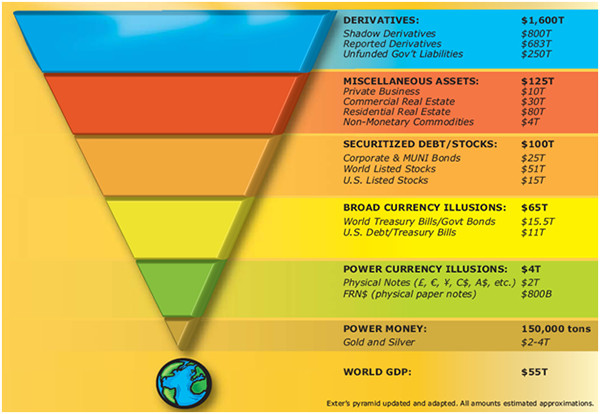
No country wants reserve status and no fiat currency can take the place of the U.S. dollar.
The U.S. dollar supply expands with credit growth, it is the base of inflation.
If the world is rapidly inflating with credit growth, USD should fall. The dollar normally falls during economic booms for this reason. Nearly everyone wants a weaker dollar.
Most countries inflate against USD.
To get an isolated crash in USD where it collapses far more than foreign currencies requires removing the US economy from the world, via civil war or something similarly disastrous like a communist revolution.
In conclusion, falling USD is the system working as intended. A dollar-centric crash is highly unlikely. If the dollar implodes, all fiat implodes with it. The system survives, one could imagine all exchange rates stay constant, but all fiat is now worth far less compared to gold, oil and so on.
To destroy up the system requires breaking it. Extinguishing credit money and making USD fail to function.
Rising USD causes credit defaults and devaluations of foreign currencies. No govt wants this.
Devaluation wipes out foreign debts, cleans the balance sheet of non-USD economies.
If USD is still rising, defaulted countries must issue debt in local currency or some alternative money.
Default in one nation creates contagion that spreads to more nations.
The euro is an artificial currency with no national backing. The yen has inflated credit more than any developed nation on Earth.
China's financial system requires U.S. dollars and it has inflated as much as the US relative to the economy. It has a closed capital account to keep the currency from collapsing.
The path to the dollar losing reserve status flows from a deflationary collapse that wipes out Japan, Europe and China's credit bubbles.
These nations would be "freed" from the dollar at that point if they wish.
The US would become the most indebted nation in the world, with an unsustainably high currency. It could not afford to bailout Japan, China or Europe even if it wanted to.
The US economy would collapse along with the world economy.
At this moment, the U.S. will either let a 1930s-style deflation wipe out the debt, saving the dollar as a currency, or it would actually press CTRL-P. Not swap debt for debt like with QE, and not issue treasuries, but instead the U.S. Treasury would bypass the Fed, directly print fiat dollars into the economy and reflate the system.
The path to a collapsed dollar goes through DXY 140 or maybe 160 or higher. The higher DXY goes, the more likely and more spectacular the ensuing inflation/collapse. DXY 120 would probably constitute a near miss that causes a bigger panic than 2008 and bear market on par with at least the doctom bust of the early 2000s.
Almost everyone in the world is on the wrong side of this trade. They don't believe it can happen or don't expect it will happen, or they are too large. A billionaire cannot preserve their wealth, only their assets. Maybe Bill Gates understands because he's been buying up farmland. Wealth based on numbers will evaporate. Wealth measured in physical capital: farmland, oil wells, factories and so on, they will retain relative value in the transition. Gold and crypto are there for preserving some "number" wealth during the transition. The wealth gap will close because poor people with nothing will still have nothing, but everyone counting wealth in digits, in things like stocks, bonds and so on, will see their wealth converge with zero.
This is an extreme outcome if a series of events keep triggering. A lot of dominos have to fall in the same direction. China housing bubble has to burst for example, something they've avoided several times the past decade. Even if all these dominos start falling, the trend can be aborted at any time by governments doing good things and more likely, doing bad things. Wars could halt the deflation and cause inflation. But this process is getting started again and knowing how these dominos fall will keep investors one step ahead of what will largely be clueless competition. Most investors do not think any of this is possible. They think dollar devaluation is inevitable.
Even if all that happens is another mini-cycle like 2014-2016 and 2018 kicks off, most are wrong footed. Stocks will crumble, bonds rally. Things like gold and crypto fail in lower order versions of these events and then experience explosive rises in extreme, system-breaking scenarios. Crypto is far more vulnerable to losses than gold, a reflection of its speculative rise. If all that happens is a bear market, cryptos and NFTs could lose 90 to 100 percent of their value.
Predicted Trump in 2014: Immigration Issue Set to Explode in America; Prepare for Political Volatility
China trade war in 2014: The Logic of Strategy: Yuan Devaluation and the Road to Trade War
2013: Dollar Rally, Yuan Deval: Chinese Yuan Could Devalue 50% Or More (Yuan deval still not ruled out as of 2021)
Next 10 Years of Political Change in One Chart
Posts on China's avoided bust:
Credit Guarantee Firms Go Down Like Dominoes
Trading
December 2021: The Bear Pill
December 2021: Asset Inflation Is Over, For Now


Jacobin: In Mongolia, Protesters With Empty Stomachs Are Denouncing Empty Promises
What originated as an anti-inflation protest also happened to coincide with the Mongolian Economic Forum, which one protester’s sign referred to as “Mongolia’s Disaster Forum.” Together with the prime minister’s empty promises, the economic forum — which showcased the administration’s “New Recovery Policy” to kickstart the economy, in front of representatives from government, foreign embassies, and the private sector — appeared totally disconnected from people’s ordinary lives. Some protesters even held up signs that read “If only I could live like a Parliament member” and “3 million Mongolians [should] eat together,” while others brought and held up everyday items, such as a half loaf of bread, a small piece of meat, a handful of potatoes, and empty plastic bags. The demonstration became a protest against empty stomachs, empty promises, and an empty government palace. While everyone was voicing different aspirations and discontents, there was also a shared feeling of euphoria and solidarity organized around the imperative: we want to live.Yellow vests in France, truckers in Canada, January 6 and BLM in the USA...it's a global phenomena. What comes next will be something entirely new though. Jacobin are living in the past:...Unlike the empty promises of politicians, the protesters’ slogans had a visceral dimension. There is something haunting about the line “Since I can’t die, I must live” and seeing a teenager holding a poster with the message “I would like to live.” Although the demand “to live” seems like the most basic and self-explanatory of human rights, there is nothing simple about it. It implies the question: to live what kind of life? On one level, the protesters associated this demand with the right to afford the basic necessities of daily life and its reproduction. To be able to afford bread? Of course. But life is about more than biological survival. To be able to live without crushing debt? To be able to trust in the public institutions and infrastructures that organize social life? It is impossible to separate these two. The demand to live, and to live well, is a collective problem experienced as individual privation.
...Mongolians’ anger at the state comes from the overwhelming sense that politicians live in their own bubbles sheltered from the lives of ordinary people. Despite more than three decades of democracy, most Mongolians feel powerless. It was notable that Mongolian youth, who have largely abstained from participating in elections, took to the streets to make their voices heard. A driving factor of the global phenomenon of “democratic disillusionment” is the depoliticization of policy-making, which paradoxically takes place under the mantle of democratic process.
It does not help matters that the ruling Mongolian People’s Party was carved out of the Mongolian People’s Revolutionary Party, which ruled Mongolia during its seventy-year socialist history. Many people see politicians’ corruption, bureaucratic inflexibility, and hollow phraseology as the long tail of Mongolia’s socialist past, rather than as the creatures of electoral competition and market incentives. For most Mongolians, socialism is a failure of the past, which makes the idea that socialism could be something new, democratic, and capacious unavailable to the political imagination. As a result, political discourse is stuck in the dreary cliché of plucky democratic youth versus communist mummies — obscuring the reality that both the ruling party and the opposition are ruthlessly capitalist.Socialism fused the state and the corporation. The failure of anti-market socialism became obvious, thus socialism adopted market forces. Where the left fails is where it looks to the past, towards retreads like Bernie Sanders in the USA.
China and the USA look similar because they took similar paths to the current destination, but went in a different order. China went from full communism to adopting market forces within a socialist system. The U.S. went from full capitalism to adopting socialist controls on society, including corporations. The concentration of power, including economic, results in both countries' ruling classes behaving in similar manners. The only main differences being two. The CCP is sovereign. It is clearly in charge. This give it far greater police power for removing enemies, while the Western ruling class must rely on corporations and cancel culture. The Western ruling class pretends as if there is freedom and that private companies are behaving independently when they destroy any competing companies or individuals with different political views. Similarly to how they are now claiming taking an mRNA shot was optional, despite using all manner of coercive policies via government and corporations to pressure people into taking them.
The other difference is that because it is clearly in power, many CCP policies are aimed at bettering the lives of ordinary Chinese citizens. Whereas in the nominally democratic West, the ruling class pretends it is an aggrieved victim of some nebulous forces such as "system racism" or various "phobias." Its grip on power is also tenuous because the West has an electoral system for peaceful, wholesale revolution. The Western elite are therefore at war with their own citizens, morally justifying their predatory behavior with their victim narratives.
What Follows
There is no escape via "the left" as it has existed because that left got us here. The leftists of the 1960s became the CEOs and politicians of the 1990s and 2000s. They birthed the next generation that is unleashing totalitarian controls today. The left won, and doesn't recognize its vision for society is flawed, impossible because it is doomed by man's nature. If the left wins, things might improve for a generation because of a new class of rulers will be less predatory, but history tells us predators are attracted to power concentration the way a moth is attracted to a flame. A victory by the left will beget a worse situation down the road.
There 's no escape via "the right" either. It is still captured by platitudes about markets and capitalism, failing to recognize that a corporation can be as effective, even more so, at implementing authoritarian policies. Power in all forms including corporate power is an enemy of the people.
There was a major sign of change this week though. Florida has gone to war with one of its largest companies, Disney: Florida lawmakers have stripped Disney of special tax status. If you're not American or not attuned to politics, this might not seem like a big deal, but this event shatters every assumption about politics going back 50+ years. Disney is exactly the type of company that Florida politicians, especially right-wing politicians, would have been guaranteed to defend the past 50 years. Even two years ago, it would be crazy to think of Florida going after Disney. The right is also talking about abolishing the FBI and CIA, among other government agencies. That Florida went after Disney signals these aren't idle wishes of Internet essayists, but something that could become a serious political agenda faster than most realize.
The policies of the past two years revealed that the ruling class hates the people, that politicians hate their voters and corporations hate their customers. The form of revolution will be different everywhere, but as long as inflation is high, the people will be motivated to action against their rulers. From Mongolia to Florida, the revolutions have begun.
This violence and chaos of this era is worse than the 1970s, but perhaps less shocking because the population has been desensitized to how bad things are compared to before. About a third of the population are immigrants or descended from immigrants who never knew that America was once a far better place to live. They have little connection to a past that the ruling class intentionally hid from them. A backlash is already taking shape, we can see the political outlines hinting at massive shifts in voting, but the cultural response that would have led the politics in a prior era is suppressed by censorship.
The ruling class' grip is tighter than at anytime in American history, yet this may prove to be their undoing because when the change comes it will not be gradual. Elites can adapt to slowly changing society, but when it snaps, the ruling class finds itself so far out of touch as to have become the villian of the story. Consider how DAs in California and other states are letting murderers go free. People arrested with AR-15s (supposedly dangerous assault weapons these politicians want banned) and drugs, involved in robberies and murders, are let go without charges by these DAs. Here is only the latest example I've seen, these are a dime a dozen if you go looking through local news: DC police arrest then RELEASE seven men accused of stealing puppy at GUNPOINT, and who are also suspected of taking French bulldog 17 minutes later, despite finding them in gun and drug-filled apartment
In the 1970s, the courts went soft on crime. Sentences were shortened. Clearly guilty criminals let go on newly created technicalities. Yet for the most part, guilty criminals swere arrested, went to trial, and faced sentencing. Now, the government lets them go free. The government, the ruling class, is one the side of the criminals. Who might a 2020s "Dirty Harry" target? The movies that will be made, cannot be made in this environment, but once that movie is made, it will be over for the ruling class. There's censorship and thought control because the ruling class understands how tenuous its grip on power is becoming.
Law & Liberty: Dirty Harry's Justice
Even in our unhappy times, Dirty Harry stands out, because its protagonist is everything our elites hate: A proud white male authority figure who enforces the law without concern for what we would now call the “optics.” This is not a man who hesitates to kill or suffers a bad conscience over doing what is necessary to protect the innocent. The film would be impossible to make today, since it is so blind to the cries of systemic racism and toxic masculinity that so dominate woke criticism.Predictably, art has decayed alongside public debate. Dirty Harry was prescient in warning about a future without freedom. Indeed, our elites gradually narrowed the circle of ideas that can be debated and policies people can vote for. They threw out the notion that the rights of ordinary Americans matter, so that authorities no longer feel duty-bound to protect persons and property from destruction.
Long-term container rates plummet on key US to Far East routes
“This is a very interesting shift,” notes Xeneta CEO Patrik Berglund. “I think it’s fair to say that the comparative weakness of US exports versus US imports from the Far East is taking effect. While imports from the Far East to North America have soared by 31% since the start of the pandemic (Jan/Feb 2019 vs. Jan/Feb 2022) exports have fallen by some 19% for the same period.There's a trade war going on, but USG isn't interested.“In short, there’s been a lot of empty boxes being sent back to the Far East, while demand in the opposite direction is fierce. The rates are starting to reflect that reality.”
In a further sign of weak export fundamentals, US West Coast exports to the Far East are down 2.5% year-on-year for the first two months of 2022, while East Coast exports are down by 19.7%.


